
Movement Pattern
A movement pattern is the basic action an exercise trains.
- Example: pulling, pushing, squatting, lunging, rotating, or bracing
- Check: name the pattern before setting strap length
- Limit: one setup does not fit every pattern
Movement pattern matters in functional suspension training because straps support some actions better than others. Rows, presses, assisted squats, lunges, planks, fallouts, rotations, and mobility drills all use the straps differently.
A good suspension setup starts with the pattern the user needs to train. Pulling, pushing, bracing, rotating, squatting, hinging, and balancing each require different strap length, body angle, stance, and control.
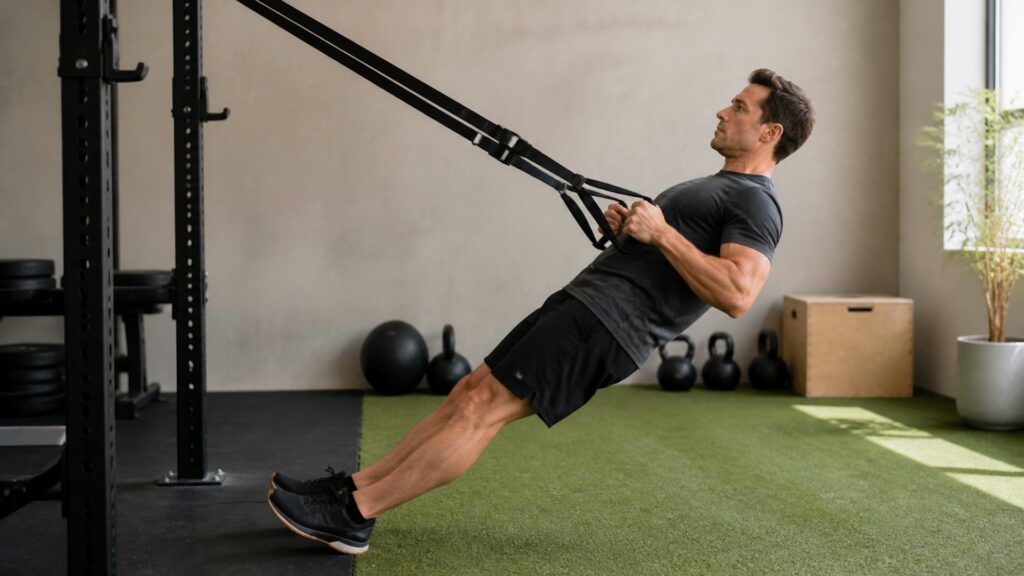
A practical guide to matching suspension exercises to the movement patterns they support.
Tip: Start with the training job, then decide whether straps solve that job better than a fixed tool.
These concepts explain how strap setup, body angle, and movement control shape the training decision.
A movement pattern is the basic action an exercise trains.
A pull pattern draws the body toward the handles.
A push pattern moves the body away from the handles or floor.
An assisted lower-body pattern uses straps for balance or support during leg work.
A brace pattern trains the trunk to resist sagging, extension, or rotation.
Pattern fit is how naturally a strap setup supports the intended movement.
Tip: Suspension training is useful when adjustability and control support the exercise rather than complicating it.
Suspension rows are one of the clearest uses for straps because body angle scales the pull. The user can adjust difficulty without changing equipment.
Pulling patterns often show the value of strap adjustability.
Suspended presses and push-ups can be useful, but the moving handles increase control demand. The user needs enough strength to keep alignment.
Pressing on straps should feel controlled, not chaotic.
Suspension straps can help with balance, depth, and position during lower-body movements. They are assistance tools, not a replacement for all lower-body loading.
Assisted lower-body patterns should build control.
Fallouts, body saws, and anti-rotation drills can become hard quickly. Small range changes can create large increases in challenge.
Core patterns need progression as much as strength patterns.
Suspension training is versatile, but some movements work better with fixed bars, floor tools, bands, weights, or machines.
Pattern fit keeps the workout practical.
Movement pattern review keeps strap exercises tied to real training goals.
It matches strap length, body angle, and stance to the exercise.
It shows when straps are better than fixed tools.
It cannot make an unsafe anchor appropriate.
It cannot make every movement better on straps.
Versatility does not mean every strap exercise is equally useful.
Both use body angle, but pressing often needs more stability control.
Straps can assist position, but they can also reduce loading too much.
Suspended core drills can become intense quickly.
Some patterns fit better with fixed or loaded equipment.
Tip: Judge the setup by the movement it improves, not by how many variations it promises.
Short answers for practical training and buying decisions.
Rows are often the easiest pattern to scale with straps, but presses, squats, lunges, and core drills can also work.
They are better only when the user can control the instability and the goal calls for it.
They can assist squats, lunges, and balance work, but they may not replace loaded lower-body training.
Choose exercises where angle adjustment, assistance, or controlled instability improves the pattern.
Use suspension straps for movement patterns they support clearly, not for every possible variation.
Functional suspension training movement pattern matters because each strap exercise has a different control demand.
Good programming matches strap length, body angle, stance, and instability to the movement being trained.
Use these Review Streets paths to compare related categories and practical next decisions.
Explore strap-based functional training equipment.
Review anchors, body angle, and strap-based resistance.
Browse related fitness training equipment categories.
Choose a retailer
Prices checked regularly. We may earn a commission at no cost to you.