
Functional training
Functional training organizes exercise around movements intended to support a task.
- The task may be sport, work, or daily activity.
- Complexity alone does not make it functional.
- The target should be named.
Functional training matters when exercise is organized around movement patterns and real task demands rather than isolated equipment labels. Squats, hinges, pushes, pulls, carries, rotations, and balance work all ask the body to coordinate force across joints.
The term can become vague, so it needs discipline. A movement is not functional because it looks complex; it is functional when the pattern, load, speed, range, and control match a real training, sport, or daily-use target.
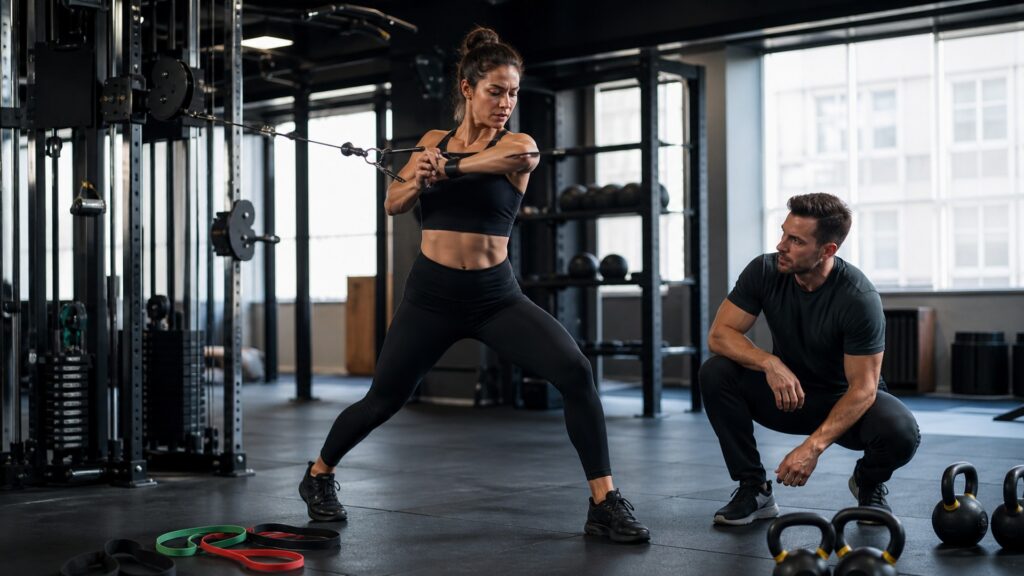
Functional training matters when movement pattern, coordination, load, balance, rotation, and transfer target shape the exercise choice.
Tip: For functional training, decide which variable is actually changing before comparing products.
Functional training organizes exercise around movements intended to support a task. The rest of these concepts explain where functional training changes the swim or training task.
Functional training organizes exercise around movements intended to support a task.
A movement pattern is a coordinated action such as squat, hinge, push, pull, carry, or rotate.
Transfer is the carryover from training to another task.
Core control is trunk positioning under movement or load.
Balance demand is how much stability the exercise requires.
A carry is loaded walking or holding while moving.
Tip: A movement pattern is a coordinated action such as squat, hinge, push, pull, carry, or rotate.
The useful version names the pattern and why it matters.
Functional training is pattern-specific.
Functional exercises often ask several joints to coordinate rather than isolate one muscle.
Coordination is part of the stimulus.
Bands, kettlebells, medicine balls, cables, and suspension trainers can support patterns when chosen carefully.
Equipment should serve the movement.
Functional training becomes vague when it lacks a target.
Transfer requires a named use.
Poorly matched functional drills can be too complex, unstable, or fatiguing.
Functional training matters when it clarifies real movement demands.
Functional Training is useful when its mechanism is matched to a specific swim or training task rather than a generic improvement promise.
It explains what functional training changes during real use.
It gives functional training a practical decision frame based on mechanism, setup, and limits.
Functional Training cannot guarantee performance, safety, recovery, injury prevention, or technique improvement.
Functional Training decisions still need coaching or medical context when pain, symptoms, open-water risk, heavy impact, or individualized programming is involved.
Common shortcuts and misunderstandings can make the topic seem simpler than it is.
Functional Training changes with setting, skill, fatigue, conditions, and the specific drill.
Extra features help only when they solve the actual technique, setup, or movement problem.
Gear and drills can support training, but they cannot promise safety, performance, recovery, or adaptation.
Pressure, speed, resistance, or visibility can feel obvious without proving the training target is correct.
Construction, fit, rebound, buoyancy, drag, and use conditions often matter more than the category name.
Tip: For functional training, treat the tool label as a starting point and inspect the mechanism, setting, and limits.
Concise answers to common questions readers may have after the main explanation.
Start with the exact mechanism functional training changes, then decide whether that mechanism fits the swim, drill, lift, or conditioning task.
No. Functional Training can support better decisions, but outcomes depend on technique, progression, recovery, setting, and individual response.
Compare the fit, construction, movement demand, setup, and evidence limits before comparing functional training by brand language.
Use controlled training sessions to test functional training before relying on it during races, open water, hard throws, or demanding workouts.
Expert help is useful when functional training involves pain, symptoms, open-water safety, complex technique, or individualized programming.
Functional Training matters when it changes a named swim, strength, power, or movement-training task.
The useful decision about functional training follows mechanism, fit, setup, transfer, and evidence boundaries.
Use these related explainers to continue the Review Streets fitness decision path around functional training.
Use it to place this topic inside the broader training-equipment category.
Read it when equipment is being chosen for movement patterns rather than isolated muscles.
Use it when the training decision is tied to athletic output rather than general exercise.
Choose a retailer
Prices checked regularly. We may earn a commission at no cost to you.