
Event Normalization
Translation of different vendor events into a consistent schema while retaining source meaning.
- Mapping: aligns fields
- Context: adds site and device
- Provenance: preserves original record
Integrated security platforms matter because physical-security events rarely belong to one system. A denied credential, forced door, motion alarm, nearby camera, visitor record, intercom call, and operator action may describe one incident, yet separate interfaces force people to locate and align that context manually.
Integration connects source systems through APIs, gateways, shared identity, event normalization, video association, maps, rules, and incident workflows. It can present the right camera when a door alarms, disable credentials after an approved identity change, and preserve a shared incident timeline. The benefit is faster, more consistent assessment—not a universal dashboard. Each source must remain trustworthy, commands need authorization and safeguards, and the platform adds privileges, dependencies, and failure modes that require monitoring and recovery.
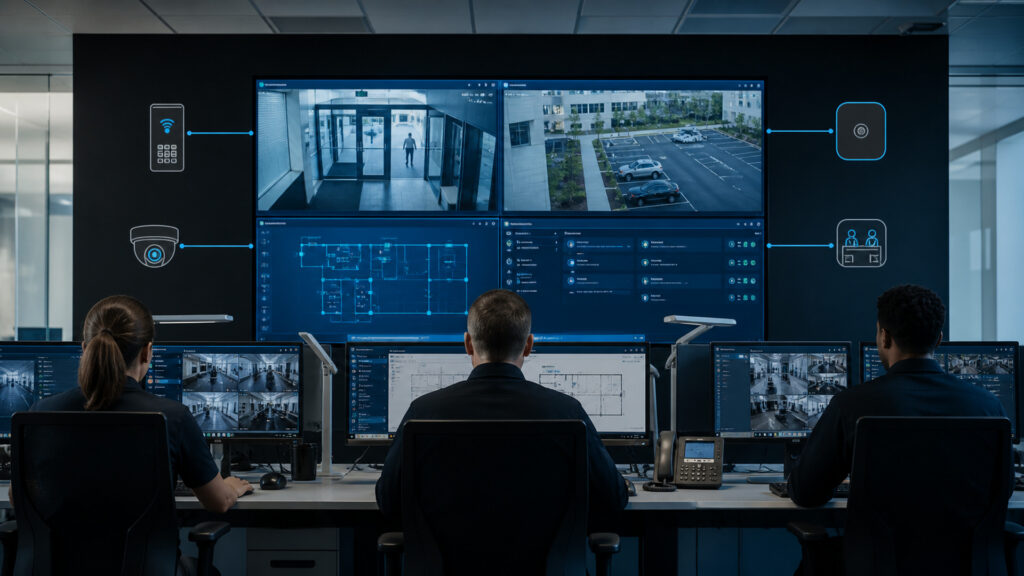
Follow identities, connectors, normalized events, correlation, video context, orchestration, operator decisions, evidence, failure, and lifecycle.
Tip: For one forced-door event, trace the raw source, normalized record, identity context, associated video, operator screen, rule, permitted command, incident record, audit trail, and behavior when each connector fails.
These terms describe the connectors, common models, correlation, and workflow controls used to coordinate security systems.
Translation of different vendor events into a consistent schema while retaining source meaning.
A governed mapping of a person, visitor, contractor, credential, account, and organizational role across systems.
A configured relationship connecting a security event or location with relevant live and recorded camera views.
Authorized rules that sequence notifications, views, tickets, commands, or other actions in response to state.
Software exchanging events, identities, commands, configuration, or health between systems.
The governed case collecting events, evidence, decisions, communications, owners, actions, and closure.
Tip: Preserve the raw source event and identifier beside normalized data. A common label should never erase the vendor-specific state, uncertainty, or error needed for investigation.
Directories and visitor systems map people and roles; connectors translate alarms, grants, denials, faults, video state, and health into common fields for time, site, zone, device, and severity.
Integration matters when operators can compare events without losing what the source actually reported.
Rules associate doors, cameras, sensors, intercoms, maps, occupancy, and recent events by location and time. The operator receives relevant context while retaining the ability to inspect source systems.
Context reduces interface searching but still requires human judgment about what the combined evidence means.
The platform can open incidents, notify roles, display procedures, acknowledge alarms, request dispatch, lock selected doors, revoke credentials, or preserve footage under approved authority.
Orchestration matters when it makes response consistent without allowing one bad event or rule to propagate unsafe action.
Platform outages, expired tokens, schema changes, message queues, clock errors, identity mistakes, or excessive privileges can hide events or disrupt several controls. Source systems should retain safe local operation.
A coordinating platform must fail visibly and avoid turning loss of the interface into loss of every underlying security function.
Versions, certificates, APIs, licenses, owners, data flows, retention, privacy, and support boundaries change independently. Governance assigns authority for mappings, upgrades, incidents, and evidence.
Integration remains valuable only while compatibility, meaning, security, and accountability are actively maintained.
Source systems retain specialized authority and can fail independently.
It aligns identity and time, presents relevant context, guides workflows, links evidence, and reveals cross-system health.
Operators spend less time reconstructing location and state.
Connectors, shared privileges, data replication, rule errors, platform availability, vendor changes, and privacy scope become new risks.
Local safe operation remains necessary.
These assumptions confuse a common interface with common truth, automatic response, and reduced complexity.
Access, intrusion, video, intercom, visitor, identity, and incident systems retain different state, authority, timing, and failure modes. The platform coordinates selected data and commands; it does not erase specialized behavior or ownership.
Irrelevant events, poor mappings, duplicated alarms, stale identity, and noisy analytics can obscure important context. Add an integration only with defined decisions, owners, health monitoring, evidence needs, and measurable operator benefit.
Automation can act quickly but may propagate false events, bad identity, configuration error, or unsafe commands. Consequential actions need guardrails, approval, life-safety review, scope limits, rollback, and complete audit evidence.
Operators may use one interface while administrators still maintain cameras, controllers, panels, connectors, certificates, APIs, licenses, versions, networks, identities, storage, and vendor support. Integration shifts complexity into lifecycle coordination. continuously continuously continuously continuously
Tip: For every integration, document source authority, mapped meaning, latency, health, privilege, permitted commands, failure behavior, manual fallback, evidence provenance, and owner.
These questions explain scope, identity, automation, failure, evidence, and vendor lifecycle.
Access control, intrusion, video, intercom, visitor management, identity directories, incident management, maps, monitoring, analytics, mass notification, and selected building or life-safety systems may exchange carefully bounded events and commands. securely securely securely securely
Use an authoritative lifecycle source, stable identifiers, minimal attributes, role-based mapping, timely revocation, conflict handling, privacy limits, reconciliation, and audit trails. Avoid matching people solely by mutable names or email addresses.
Automate deterministic, reversible, well-tested actions with bounded scope, such as opening an incident or preserving video. Require human authorization for broad lockdowns, emergency decisions, dispatch cancellation, or actions affecting life safety.
Source systems should retain defined local operation, alarms should remain visible through alternate paths, commands should fail safely, connector gaps should alert, operators need fallback procedures, and queued events require reconciliation after restoration.
Retain raw source identifiers, timestamps, original records, transformation mappings, integrity controls, access logs, exports, custody, and version history. The integrated timeline should link to evidence rather than silently replacing authoritative source data.
Integrated security platforms matter because they align identity, time, location, events, video, workflows, commands, and evidence across specialized controls, reducing delay between detection, assessment, and response.
Their value depends on faithful normalization, bounded automation, preserved provenance, least privilege, visible connector health, safe local operation, staged lifecycle change, and explicit ownership across vendors.
These explainers show the underlying controls and the event-integrity practices an integrated platform must preserve.
Understand the specialized controls being coordinated.
See how provenance, time, integrity, and custody support investigation.
Trace triage, verification, escalation, and closure.
Choose a retailer
Prices checked regularly. We may earn a commission at no cost to you.