
Security Zone
A physical area with defined assets, permitted occupants, boundaries, entry rules, sensors, and response expectations.
- Boundary: controls movement
- Risk: justifies protection level
- Policy: defines authorized access
A business security system is a coordinated set of physical barriers, locks, credentials, sensors, cameras, panels, communications, monitoring, response procedures, records, and maintenance controls used to manage defined risks around people, facilities, assets, and operations. No single device performs the whole job.
The system begins with zones and permitted movement. Access control admits authorized identities; intrusion sensors detect selected state changes; video helps assess what occurred; alarm panels and networks send prioritized events to monitors; and responders follow procedures appropriate to the location and threat. Barriers create time for that chain to work. Logs and recordings preserve evidence, while testing exposes dead batteries, blocked views, expired credentials, failed communications, and procedures that would otherwise fail during a real event.
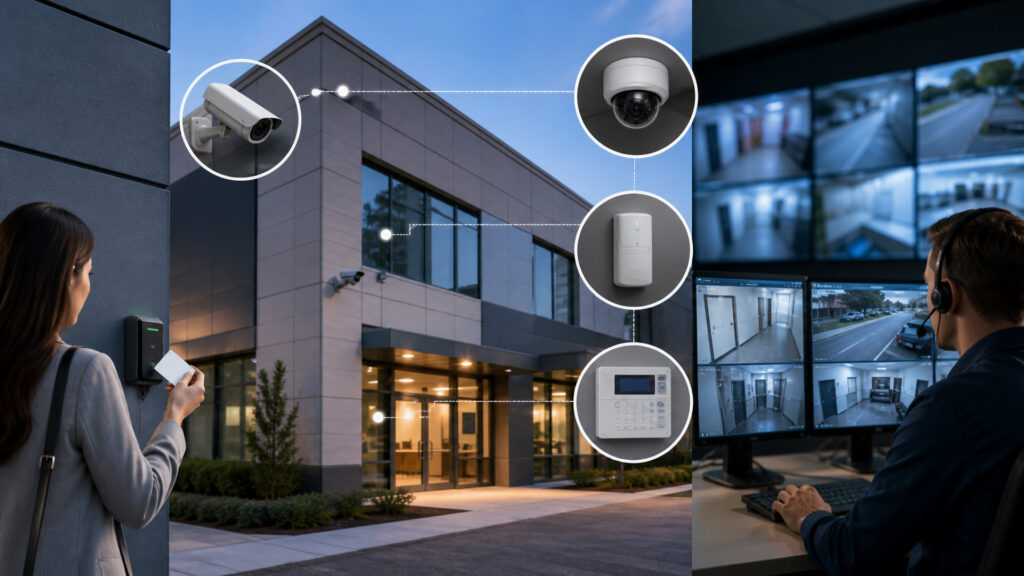
Trace risk, zones, barriers, access, intrusion, video, alarm transmission, monitoring, response, evidence, privacy, maintenance, and recovery.
Tip: Select one credible event and trace prevention, detection, assessment, alarm transmission, decision authority, responder travel, intervention, evidence, business continuity, reset, and corrective action under normal and failed conditions.
These terms describe the zones, devices, signals, decisions, and response states within a layered physical-security architecture.
A physical area with defined assets, permitted occupants, boundaries, entry rules, sensors, and response expectations.
A device that reports selected physical state or change such as opening, motion, breakage, vibration, or environmental condition.
Evidence presented by a person, device, or vehicle to request entry.
A controller that monitors sensor zones, arming state, tamper, power, and alarm communication.
A staffed function receiving, prioritizing, verifying, documenting, and escalating security events.
Documented custody and integrity history for recordings, logs, images, objects, and related records.
Tip: Every detection technology has a field of view, threshold, environment, blind spot, tamper condition, communication path, maintenance need, and response owner; document all seven before relying on it.
Assets, occupants, credible events, operating hours, adjacent spaces, life safety, and business impact define zones. Doors, walls, glazing, fences, lighting, locks, and layout deter or delay movement.
Barriers matter because detection without enough assessment and response time only documents a completed event.
Readers and controllers evaluate credentials, schedules, doors, and anti-passback rules. Contacts, motion, glass, vibration, tamper, and panic sensors detect selected conditions when zones are armed or continuously monitored.
Access control governs expected movement while intrusion detection identifies deviations; combining their context improves assessment.
Cameras capture chosen scenes; analytics can flag motion, crossing, objects, or behavior; the video system associates time and location with access or intrusion events. Operators decide whether evidence supports escalation.
Video reduces ambiguity only when the relevant subject, action, time, and location are visible at usable quality.
Panels use IP, cellular, radio, or other paths to send alarm, trouble, tamper, and supervision states. Monitoring procedures prioritize events, verify where appropriate, and contact onsite, private, or public responders.
A detected event changes outcomes only when communications and procedures place actionable information with a capable responder soon enough.
Access logs, alarms, video, administrator changes, maintenance records, incident reports, and evidence exports require purpose, access, retention, integrity, and deletion. Devices, batteries, certificates, software, storage, and procedures age.
Security performance depends on continuing proof that devices, data, people, and response procedures still operate as designed.
They reduce selected risks but do not create perfect prevention or replace people, procedure, and life-safety design.
It limits ordinary entry, detects deviations, provides assessment context, communicates priority, guides response, preserves evidence, and supports recovery.
Failures become observable through supervision and testing.
Intent, proportional response, legal authority, emergency priorities, and business tradeoffs require trained people and accountable policy.
Unknown paths and human misuse remain possible.
These claims overstate cameras, alarms, credentials, automation, and device quantity.
Visible cameras may deter some behavior and recordings may support assessment or evidence, but cameras do not physically block entry or guarantee monitoring and response. Scene design, detection, communications, staffing, procedures, and intervention determine outcomes.
Additional devices can improve coverage but also create nuisance alarms, blind assumptions, maintenance load, bandwidth, batteries, and ignored alerts. Each sensor needs a defined event, environment, threshold, communication path, response, and test.
A signal reports that configured conditions matched. Faults, users, weather, animals, maintenance, doors, equipment, or deliberate activity can produce events. Assessment combines zone, time, access, video, history, and human verification.
Credentials control compatible portals, but weak doors, glazing, ceilings, tailgating, propping, shared keys, emergency releases, loading areas, and adjacent spaces can bypass readers. The opening and surrounding boundary must provide matching delay.
Tip: Judge the chain, not the gadget: credible event, boundary, detection, assessment, communication, decision, response time, intervention, evidence, restoration, and prevention of recurrence.
These questions explain layers, monitoring, testing, false alarms, records, and integration.
Common layers include locks, barriers, lighting, access control, intrusion alarms, video surveillance, intercoms, visitor management, panic devices, monitoring, communications, incident procedures, records, maintenance, and integrations with life-safety or business systems.
The answer depends on risk, operating hours, staffing, response time, insurance, regulation, site capability, and event type. A monitoring center adds continuous intake and escalation but still needs accurate contacts, instructions, communications, and testing.
Use manufacturer, insurer, code, contract, and risk requirements, plus tests after changes or incidents. Exercise sensors, tamper, power, communications, video, access, emergency release, monitoring, dispatch, records, restoration, and documented corrective actions.
Identify root causes by sensor and environment; correct placement, thresholds, doors, users, animals, weather, maintenance, wiring, power, and procedures. Avoid simply disabling detection without reviewing the risk and adding an appropriate replacement control.
Set periods by purpose, incident needs, legal obligations, privacy, storage risk, and investigative value. Restrict access, protect integrity, log exports, preserve holds, delete predictably, and distinguish routine data from evidence under active custody.
Business security systems work as a chain: risk defines zones; barriers delay; credentials govern expected movement; sensors detect deviations; video supports assessment; communications reach monitors; responders act; and evidence and testing improve the system.
The chain is only as strong as its weakest unobserved dependency. Effective security therefore combines devices with life safety, privacy, trained judgment, current procedures, supervised communications, maintenance, and verified response under realistic failure conditions.
These explainers deepen the identity-and-door mechanism and the imaging, recording, verification, and evidence functions inside the larger security system.
See how identities, credentials, readers, controllers, locks, schedules, logs, and revocation govern entry.
Understand scene design, imaging, recording, search, verification, evidence, privacy, and retention.
Map power, network, facility, platform, supplier, lifecycle, and recovery dependencies.
Choose a retailer
Prices checked regularly. We may earn a commission at no cost to you.