
Why Kettlebells Movement Pattern Matters

Movement pattern matters with kettlebells because the bell's offset load changes how the body creates, redirects, and controls force. A swing, clean, rack squat, press, and carry all use the same tool, but they ask for very different timing and positions.

When the movement pattern fits, kettlebells can train hinge power, grip, trunk control, loaded carries, and compact strength work. When the pattern does not fit, the bell can drift, bang the body, overload the grip, or turn a useful exercise into an awkward one.

By: Review Streets Research Lab
Updated: October 1, 2026
Explainer · 8-12 min read
kettlebells movement pattern explainer hero image for Review Streets
What You'll Learn

How Movement Patterns Shape Kettlebell Training

A practical look at hinge patterns, rack positions, carries, presses, and control with offset loads.

  • Why kettlebell movement patterns depend on timing and path
  • How swings differ from slow strength lifts
  • Where rack position and carries change the training effect
  • Why grip and trunk control matter during offset movement
  • How to choose exercises that fit the user's skill

Tip: A kettlebell pattern should feel controlled and repeatable before it becomes fast or heavy.

Definitions

Key Concepts Behind Kettlebells Movement Pattern Matters

These concepts explain how kettlebells create resistance, skill demands, and practical training tradeoffs.

Offset Load

An offset load places the weight away from the hand, which changes balance and timing.

  • Example: the bell hanging below the handle during a swing
  • Check: notice whether the offset helps the exercise
  • Limit: the offset can make some lifts harder to learn

Ballistic Pattern

A ballistic pattern uses controlled momentum rather than a slow isolated lift.

  • Example: a kettlebell swing or clean
  • Check: learn the hinge and timing before adding speed
  • Limit: poor timing can turn power work into sloppy pulling

Grip Demand

Grip demand is the hand and forearm work needed to control the handle.

  • Example: holding the handle during carries or swings
  • Check: watch whether grip fails before the target work
  • Limit: grip fatigue can end the set early

Hinge Drive

Hinge drive is power created by moving through the hips rather than lifting with the arms.

  • Example: driving a swing from the hips
  • Check: the bell should float from hip power
  • Limit: a weak hinge can stress the back or shoulders

Rack Position

Rack position is the resting position with the bell held near the forearm and torso.

  • Example: holding a kettlebell before a front squat
  • Check: the wrist and forearm should feel controlled
  • Limit: poor rack comfort can limit useful loading

Progression Step

Progression step is the jump between available kettlebell weights.

  • Example: moving from 16 kg to 20 kg
  • Check: increase only when technique stays repeatable
  • Limit: large jumps can change the exercise too much

Tip: Judge kettlebells by the movement they make easier or better, not by the shape alone.

Hinge

Swings Depend On A Strong Hinge Pattern

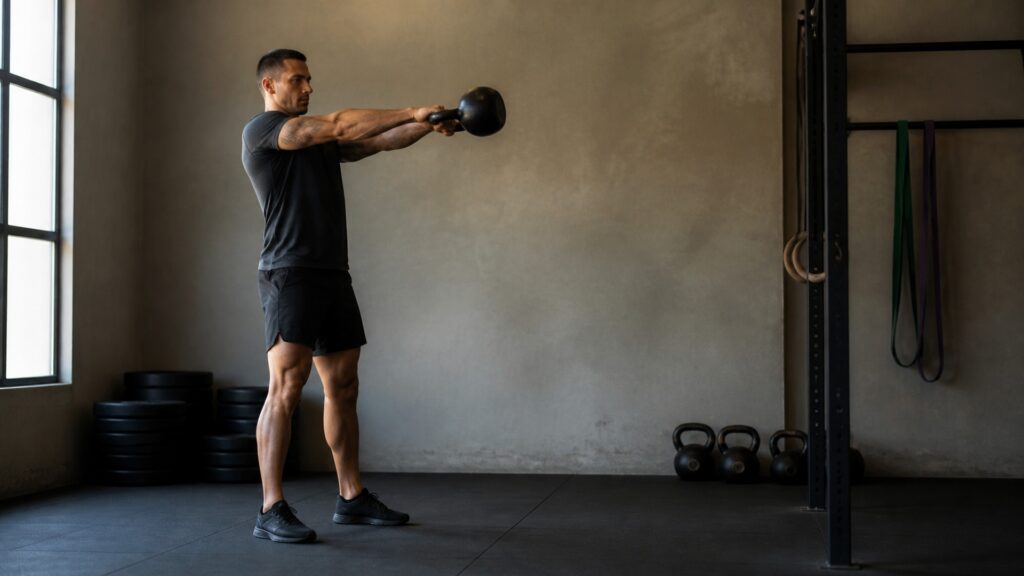
The kettlebell swing is built around hip drive. If the hinge is weak or the user lifts mostly with the arms, the movement loses its purpose.

  • Learn the hinge slowly first.
  • Keep the bell path close and consistent.
  • Use hip drive instead of shoulder lifting.

The hinge is the foundation for many kettlebell power movements.

Path

The Bell Path Has To Stay Controlled

Because the bell moves around the hand, path matters. A clean path keeps the bell close; a poor path can bang the forearm, pull the shoulder, or waste energy.

  • Keep cleans close to the body.
  • Avoid looping the bell far away.
  • Use lighter loads until timing is smooth.

A clean path makes kettlebell movement safer and more useful.

Rack

Rack Position Changes The Exercise

Holding a kettlebell in the rack position changes how squats, lunges, presses, and carries feel. The bell sits near the body while still challenging posture and breathing.

  • Keep wrist and forearm organized.
  • Use rack work only when it feels stable.
  • Choose load that does not collapse posture.

Rack position turns the kettlebell into a compact strength and control tool.

Carries

Loaded Carries Train More Than Grip

Kettlebell carries challenge grip, posture, trunk control, shoulder position, and walking mechanics. Different carry positions create different movement demands.

  • Use suitcase carries for side-to-side control.
  • Use rack carries for posture and breathing.
  • Keep the walking path clear.

Carries show how movement pattern and load position work together.

Skill

Exercise Choice Should Match Current Skill

Some kettlebell movements are simple; others require timing and coaching. A good pattern is one the user can repeat under control before increasing load or speed.

  • Start with goblet squats, deadlifts, and carries when learning.
  • Add swings, cleans, and snatches gradually.
  • Stop when fatigue changes the pattern.

Skill-appropriate movement keeps kettlebell training productive.

Quick Reality Check

Where Movement Pattern Fit Helps And Where It Has Limits

Kettlebells reward good pattern selection and punish careless exercise choice.

Where It Helps

It matches hinge, carry, rack, press, and squat patterns to the user's goal.

It keeps offset loading from becoming uncontrolled movement.

Where It Falls Short

It cannot replace coaching for technical lifts.

Some goals still fit dumbbells, barbells, cables, or machines better.

Common Myths

Misconceptions About Kettlebell Movement Patterns

The tool's shape does not make every movement automatically useful.

Every kettlebell exercise should be fast

Many kettlebell exercises are slow, controlled strength or carry patterns.

Swings are just squats with a bell

Swings are hinge-driven and should not turn into squat-lift hybrids.

A heavier bell fixes the pattern

Heavier loads usually expose pattern problems rather than solving them.

Complex movements are always better

Simple, repeatable patterns often provide more value than rushed complexity.

Tip: Choose the clean pattern before chasing more speed, complexity, or load.

FAQ

Frequently Asked Questions About Kettlebell Movement Patterns

Short answers for choosing, using, and comparing kettlebells.

Why do movement patterns matter with kettlebells?

They determine whether the offset load supports the training goal or makes the exercise awkward.

What pattern should beginners learn first?

Many beginners start with deadlifts, goblet squats, carries, and hinge practice before faster swings.

Are swings required for kettlebell training?

No. Swings are common, but kettlebells can also be used for squats, presses, rows, carries, and controlled strength work.

How do I know a pattern is too advanced?

If the bell path, grip, breathing, or posture breaks down, the pattern or load is too advanced for now.

What is the practical takeaway?

Use kettlebell movements that stay controlled, repeatable, and tied to the session's goal.

Bottom Line

Movement pattern matters because kettlebells use offset loading that changes timing, path, grip, and posture.

The best kettlebell exercises match the user's skill and goal before adding speed, complexity, or heavier loads.

Next Steps

Go Deeper or Compare Your Options

Use these Review Streets paths to compare related categories and practical next decisions.