Why Right-Angle Drill Head Design Matters

Right-angle drill head design is often reduced to its 90-degree form factor, yet its geometry represents a deliberate mechanical solution to spatial constraints and torque transfer challenges. The orientation of the gear housing, bearing alignment, and drive mechanism determines how rotational force is redirected while maintaining structural stability. Misunderstanding this design as merely a compact alternative overlooks the engineering considerations that govern load distribution, heat dissipation, and mechanical durability within confined operating environments.

This explainer examines the internal architecture of right-angle drill heads, including gear arrangements, torque pathways, housing construction, and material stresses. By the end, readers will understand how directional force conversion works, how design influences mechanical efficiency, and why structural configuration plays a central role in tool performance.

By: Review Streets Research Lab
Updated: April 19, 2026
Explainer · 8–12 min read
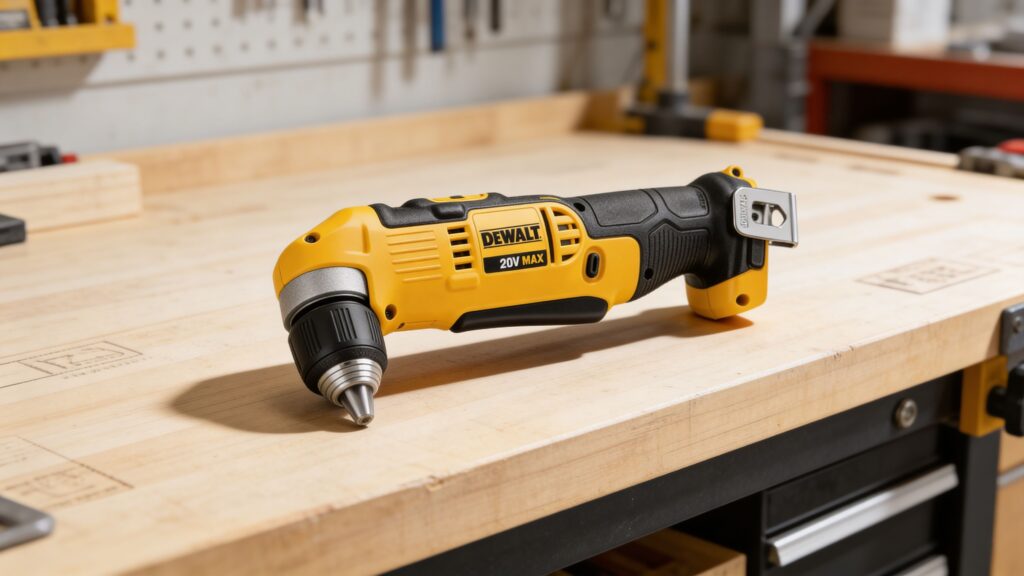
Close-up of a right-angle drill head driving a screw in a tight corner, highlighting compact gear housing and 90-degree head design for confined spaces.
What You’ll Learn

Right-Angle Drill Head Mechanics

A precise overview of how a right-angle head redirects rotation through gears, bearings, and housing geometry, shaping load paths and mechanical behavior.

  • How 90-degree gear trains redirect rotational motion through the head
  • Why bearing placement determines alignment, friction, and radial load handling
  • How housing stiffness controls gear mesh stability under changing torque
  • Where losses occur from contact, lubrication shear, and heat generation
  • How torque transfer creates axial forces that must be structurally supported
  • Why head geometry influences clearance, leverage, and reaction torque pathways
  • How material selection balances wear resistance, toughness, and thermal expansion

Tip: Visualize torque as a path through gears and bearings, then ask where that path bends, spreads, or concentrates stress.

Definitions

Core Components Inside a Right-Angle Drill Head

Understanding how rotational force is redirected requires clarity on the internal parts that guide, support, and contain torque within a compact 90-degree assembly.

Right-Angle Gear Set

The gear set changes the direction of rotation, transferring torque from the input shaft to an output shaft positioned at 90 degrees. Its geometry governs load distribution and mechanical efficiency.

  • Bevel Interface: Angled teeth redirect rotational force across intersecting shafts
  • Tooth Contact: Surface engagement determines friction, noise, and wear patterns
  • Load Sharing: Proper alignment spreads torque across multiple teeth

Input and Output Shafts

These shafts carry rotational energy into and out of the head assembly. Their alignment and support determine how smoothly torque transitions through the angle change.

  • Concentricity: Centered rotation minimizes vibration and uneven loading
  • Axial Support: Shafts resist thrust forces created by angled gears
  • Coupling: Interfaces transfer motion without excessive backlash

Bearings

Bearings stabilize rotating components while reducing friction between moving surfaces. In a right-angle head, they absorb both radial and axial forces generated during torque redirection.

  • Radial Loads: Side forces from gear contact are continuously supported
  • Thrust Loads: Axial forces from angled teeth are controlled
  • Lubrication: Film layers limit heat and surface degradation

Gear Housing

The outer casing holds gears and bearings in fixed alignment. Structural rigidity within the housing preserves gear mesh accuracy under changing torque conditions.

  • Stiffness: Prevents deflection that disrupts tooth engagement
  • Heat Path: Conducts thermal energy away from contact surfaces
  • Sealing: Retains lubrication and limits contaminant entry

Lubrication System

Lubricants create a protective film between gear teeth and bearing surfaces. This film moderates friction, reduces wear, and stabilizes operating temperatures within the compact head.

  • Viscosity: Controls film thickness under varying speeds and loads
  • Shear Stability: Maintains protective properties during sustained rotation
  • Distribution: Ensures contact zones receive consistent coverage

Torque Path

The torque path describes how rotational force moves through gears, shafts, and supports. Its continuity determines how efficiently energy is transmitted around the 90-degree bend.

  • Force Redirection: Converts linear rotation into angled output motion
  • Stress Concentration: Highlights areas of peak mechanical demand
  • Energy Loss: Reveals where friction and deformation reduce efficiency

Tip: View the head as a contained torque pathway where gears bend force and the housing preserves alignment under load.

Power Path

How Torque Routes Through a Right-Angle Head

A right-angle head does not create torque; it redirects it through a compact train of gears and supports, where alignment and stiffness determine how force travels.

  • Input rotation enters the head through a short shaft aligned to the tool axis
  • Angled gear teeth transfer motion across intersecting axes at 90 degrees
  • Bearings carry radial and thrust loads generated by gear contact forces
  • The housing constrains deflection so gear mesh stays consistent under torque
  • Lubrication reduces sliding losses as contact surfaces shear under load

When any link in this pathway flexes, misaligns, or overheats, transmitted rotation becomes less mechanically coherent.

Motors

How Gear Geometry Converts Rotation Across a 90-Degree Turn

Directional conversion depends on the geometry of intersecting gears, where tooth shape and contact position set the balance between smooth transfer and localized stress.

  • Bevel gearing uses angled tooth profiles to carry torque between crossing shafts
  • Contact pattern shifts under load, changing where forces concentrate on the teeth
  • Backlash and mesh stiffness determine how much free play appears during reversals
  • Tooth sliding creates frictional heating that accumulates in compact head volumes

The result is a mechanical bend in the drivetrain whose behavior is defined by tooth engagement, not motor output.

Gearing

Why Bearing Layout Determines Stability Under Load

Bearings do more than reduce friction; they set the positional accuracy of shafts so the gears stay in mesh while managing combined radial and axial loading.

  • Radial loads push shafts sideways as teeth transmit force across the gear faces
  • Axial thrust develops from angled teeth and must be reacted through bearing seats
  • Bearing spacing creates a lever arm that resists tilting and preserves alignment
  • Clearance and preload affect heat, noise, and how consistently the head runs

Stable bearing support is what keeps gear contact predictable when torque rises and direction changes.

Heat Management

How Friction and Lubrication Shape Mechanical Losses

Right-angle heads concentrate multiple sliding interfaces into a small enclosure, where lubrication quality and film integrity govern friction, wear, and thermal buildup.

  • Gear tooth sliding shears lubricant films, turning mechanical work into heat
  • Boundary lubrication periods increase metal-to-metal contact during high load events
  • Grease distribution changes over time, altering which surfaces receive protection
  • Housing material and mass influence how quickly heat is conducted and stored

Thermal behavior emerges from the balance between contact friction and the head’s ability to move heat away.

User Control

How Head Housing Structure Controls Alignment and Backlash

The housing acts as the reference frame for the entire assembly, so its rigidity, tolerances, and interfaces determine whether gears remain positioned as loads vary.

  • Stiff housings resist deflection that would shift shafts and distort gear contact
  • Machined bearing seats maintain concentricity so rotation stays centered and stable
  • Interface tolerances control backlash growth by limiting small positional changes
  • Seals and fasteners preserve internal geometry while keeping lubrication contained

Mechanical “feel” at the output is the visible consequence of how well the housing maintains internal geometry.

Quick Reality Check

Where Right-Angle Heads Help — and Where Constraints Appear

A quick balance check: how right-angle head mechanics change force routing, and where geometry, heat, and load limits become visible.

What Right-Angle Heads Enable

A right-angle head reroutes rotation through intersecting gears, allowing the output axis to fit where straight-line drivetrains cannot maintain alignment.

In constrained layouts, the housing preserves gear mesh while bearings absorb thrust and radial loads, keeping the torque path coherent as resistance rises.

Where Right-Angle Heads Lose Margin

Directional conversion adds sliding contact and additional supports, increasing frictional losses and heat generation compared with a direct drive path.

Under sustained load, lubrication shear and housing temperature can shift clearances, subtly changing backlash and contact patterns as the system reacts to thermal expansion.

Common Myths

Misconceptions About Right-Angle Drill Head Design

Right-angle heads are often reduced to shape alone, but their behavior is defined by gears, bearings, lubrication, and structural alignment.

A right-angle head is only a space saver

Clearance is part of the story, but the head also changes how torque travels through intersecting shafts and gear teeth. That redirection introduces additional forces and alignment demands that shape friction, heat generation, and contact stability.

Torque stays the same through the bend

The output torque is constrained by gear mesh efficiency, bearing losses, and housing stiffness, not just the input torque. Sliding contact on angled teeth and lubricant shear convert some mechanical work into heat within the head.

Gears are the only moving parts that matter

Gears transfer motion, but bearings set shaft position and determine whether the gears meet correctly under load. If bearing seats, spacing, or clearances allow shifting, the contact pattern changes and loads concentrate on smaller areas.

Backlash is always just sloppy manufacturing

Some clearance is intentionally designed to accommodate lubrication films, thermal expansion, and assembly tolerance stack-up. Excess backlash can reflect wear or misalignment, but a zero-clearance mesh is not a stable operating condition in practice.

Heat comes mainly from the motor, not the head

A right-angle head generates its own heat through tooth sliding, bearing friction, and lubricant shear in a compact enclosure. As temperature rises, viscosity and clearances shift, which can alter contact behavior and increase losses even at steady load.

Tip: Think of a right-angle head as a constrained torque pathway where geometry redirects force and the structure must preserve alignment as loads and temperatures change.

FAQ

Frequently Asked Questions About Right-Angle Drill Head Behavior

Concise explanations addressing common points of confusion after learning how torque redirection, gear contact, and structural alignment interact inside angled drive heads.

Why does a right-angle head generate more heat?

Angled gear teeth slide across each other while transmitting force, which creates friction beyond simple rolling contact. That sliding action, combined with bearing load and lubricant shear in a compact enclosure, converts some mechanical energy into heat.

Does the 90-degree turn reduce available torque?

The bend itself does not remove torque, but losses occur at each contact interface. Gear mesh efficiency, bearing resistance, and housing deflection determine how much input rotation reaches the output shaft as usable force.

Why does backlash increase as the head warms?

Thermal expansion changes clearances between gears, shafts, and bearings. As materials expand and lubricant viscosity drops, contact patterns shift slightly, making small positional movement more noticeable at the output.

What causes vibration during load changes?

When torque reverses or fluctuates, gear teeth move between contact zones within their designed clearance. If alignment or stiffness varies under load, that transition produces oscillations felt as vibration.

Why are bearings critical in angled heads?

Intersecting gears create both sideways and axial forces that must be supported simultaneously. Bearings keep shafts positioned so teeth meet correctly, preventing localized loading and unstable rotation.

How does lubrication affect long-term performance stability?

Lubricants form a film separating metal surfaces while carrying heat away from contact zones. As the film thins or redistributes, friction and wear patterns change, altering how smoothly torque passes through the assembly.

Why does the housing material matter mechanically?

The housing maintains the spatial relationship between shafts and bearings. Materials with different stiffness and thermal expansion rates influence alignment stability as load and temperature vary.

What makes some heads feel smoother than others?

Smoothness depends on consistent gear engagement and stable shaft support. Precise geometry, controlled clearances, and steady lubrication keep the torque path continuous instead of fluctuating.

Tip: When behavior changes, trace whether heat, alignment, or lubrication altered how the torque path stays centered through the head.

Bottom Line

Right-angle heads redirect torque through geometry, support, and heat control. Gear contact, bearing stability, housing stiffness, and lubrication collectively determine how efficiently rotational force survives the 90-degree transition under load.

With this system view, changes in smoothness, temperature, or backlash become understandable consequences of alignment, friction, and structural response rather than isolated mechanical quirks.

Next Steps

Explore Further or Apply the Framework

With the internal mechanics clarified, these sections expand into structured overviews, side-by-side evaluations, and deeper guidance for interpreting design differences.

Right-Angle Drill Roundups

An organized overview of notable right-angle drill designs, highlighting key mechanical layouts and structural features across different use contexts.

Right-Angle Drill Comparisons

Focused evaluations that contrast torque routing, housing geometry, and thermal behavior to clarify how design choices shape real-world operation.

Right-Angle Drill Buying Guides

Structured guidance explaining which mechanical specifications influence durability, alignment stability, and sustained load behavior in angled drive systems.

Quick Summary

Why Right-Angle Drill Head Design Matters

  • Right-angle heads redirect torque through intersecting gear geometry
  • Gear tooth contact patterns control friction, heat, and efficiency
  • Bearings manage radial and axial loads from angled gearing
  • Housing stiffness preserves alignment under changing mechanical stress
  • Lubrication quality influences wear, backlash, and thermal stability