
Runout Space
Runout space is the distance needed to slow down safely after a sprint or drill.
- Example: extra space after timing gates
- Check: measure beyond the finish point
- Limit: short runout can make fast drills unsafe
Safety factors matter in speed training equipment because athletes are often moving fast, resisting load, reacting to cues, or decelerating near markers. A small setup problem can become a bigger issue when speed, fatigue, surface, or spacing changes.
Good safety checks do not remove the challenge from speed training. They make sure the drill has enough room, appropriate resistance, visible markers, reliable timing setup, and recovery that keeps movement quality from falling apart.
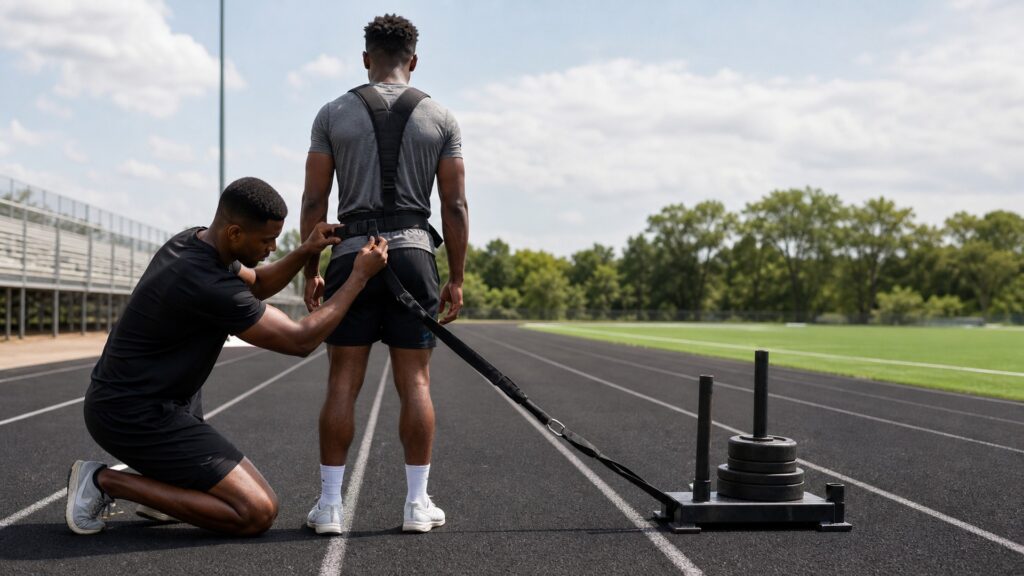
A practical look at surfaces, spacing, resistance, visibility, deceleration, and fatigue in speed equipment.
Tip: Fast drills need safe space, surface, and stopping control before they need more intensity.
These concepts clarify the practical signals readers should check before choosing equipment or planning workouts.
Runout space is the distance needed to slow down safely after a sprint or drill.
Surface traction is how reliably the athlete's feet grip the ground.
Resistance safety is whether sleds, bands, parachutes, or harnesses load the athlete predictably.
Marker visibility is how clearly the athlete can see cones, gates, lines, or cues while moving fast.
Deceleration control is the ability to slow or stop without losing posture or balance.
Fatigue risk is the safety and technique decline that appears after repeated fast efforts.
Tip: The best equipment choice is the one that matches the training job, available space, and user's current ability.
Speed drills need space before, during, and after the measured effort. Athletes need room to accelerate, cross the finish, and slow down safely without running into walls, equipment, or other people.
The drill is not safe until the stop is safe.
Track, turf, grass, pavement, and gym flooring all change grip and impact. Wet grass, dusty floors, and uneven surfaces can make even simple speed drills risky.
Surface quality is part of the equipment setup.
Sleds, bands, parachutes, and harnesses can pull the athlete off line if they are overloaded, poorly attached, or used in cramped spaces.
Resistance should challenge the sprint without surprising the athlete.
Cones, wickets, gates, and timing equipment need to be visible and stable. They should guide the drill without sitting where the athlete is likely to step, trip, or collide.
A clean lane makes fast movement easier to control.
Speed work asks for high output. As fatigue builds, reaction, foot placement, posture, and stopping control can all decline. That is a training-quality issue and a safety issue.
Safe speed training protects quality as much as effort.
Safety checks make speed equipment more predictable, but they do not make every setup appropriate.
They reveal issues with runout, surface, markers, resistance, and fatigue before problems happen.
They help athletes repeat fast efforts with cleaner control.
They cannot fix unsuitable space, poor footwear, or drills beyond the athlete's ability.
They do not replace coaching for high-speed mechanics.
Speed drills need more setup care than slow drills.
Even short sprints need room to slow down safely.
Bands, sleds, and parachutes still need secure attachment and predictable pull.
Poorly placed markers can catch feet or distract athletes at speed.
Fatigue can also affect braking, reaction, and body control.
Tip: Treat strong claims as reasons to inspect the workout fit more closely.
Short answers for practical training and buying decisions.
Check runout space, surface traction, lane clearance, resistance attachments, marker placement, and fatigue.
They can be when loads are appropriate, attachments are secure, and the athlete can keep mechanics clean.
Enough for the start, sprint distance, and controlled slowdown beyond the finish.
Stop when times drop sharply, mechanics deteriorate, or the athlete cannot slow down cleanly.
Safety factors matter because speed equipment is used at high output where small setup errors can matter quickly.
Safety factors matter because speed training equipment is used during fast movement, resisted efforts, and rapid deceleration.
The best setup gives athletes enough space, traction, visibility, resistance control, and recovery to move fast safely.
Use these Review Streets paths to compare related categories and practical next decisions.
Review the main tools and how they shape speed drills.
See how movement patterns affect safe setup.
Compare practical speed tools before buying.
Choose a retailer
Prices checked regularly. We may earn a commission at no cost to you.