
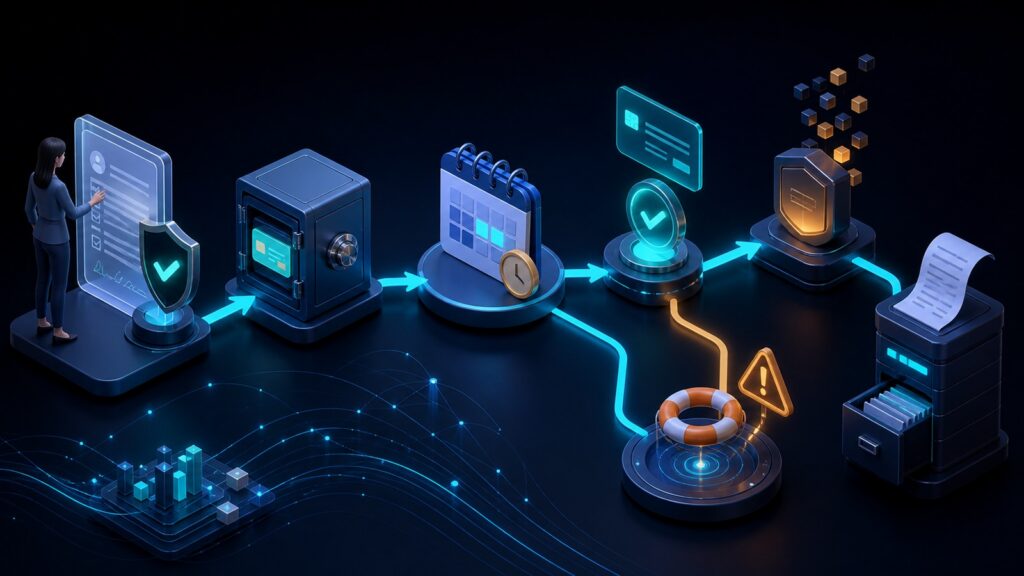
Why Subscription Payment Gateways Data Flow Matters

Subscription payment data must connect a bill, one or more collection attempts, and the result applied to the customer's account. Those records often live in different systems. If the connection breaks, a customer can pay successfully yet remain marked overdue, or a repeated message can apply the same payment twice.

Reliable data flow preserves the relationships between records and gives delayed or failed updates a way to recover. It is not enough for a message to arrive: the receiving system must apply the right result to the right renewal, once, and retain evidence of what it did.

By: Review Streets Research Lab
Updated: September 25, 2026
Explainer · 8-12 min read
Editorial business scene illustrating subscription payment gateways data flow
What You'll Learn

Keep Every Renewal Connected From Bill to Bank

Understand the identifiers, notifications, and checks that stop a successful payment from becoming an unresolved account problem.

  • Link the customer, subscription, invoice, and payment attempt
  • Separate repeated notifications from new transactions
  • Handle delayed events without replacing newer information
  • Protect sensitive payment data during integration
  • Find missing updates before customers or finance discover them

Tip: Pick one renewal and check whether you can trace it without relying only on the customer's email address, date, or amount.

Definitions

The Data Connections Behind a Renewal

Each identifier and confirmation should have a specific purpose.

Record Identifier

A record identifier is a stable value used to locate a specific object in a system.

  • Example: An invoice ID distinguishes this month's renewal from last month's bill for the same amount.
  • Check: Keep each system's identifier and the mapping between them.
  • Limit: An email address or payment amount may not uniquely identify a record.

Payment Attempt History

Payment attempt history records the collection attempts associated with an obligation.

  • Example: A declined attempt and a later success both point to the same renewal invoice.
  • Check: Retain the relationship rather than overwriting all earlier attempts.
  • Limit: Several attempts do not necessarily represent several amounts owed.

Webhook Event

A webhook event is a notification sent to another system when something happens at a provider.

  • Example: A payment-success notification reaches the subscription application.
  • Check: Verify the sender using the provider's supported mechanism.
  • Limit: Delivery may be delayed, repeated, or out of order.

Deduplication

Deduplication prevents a repeated input from creating the same business effect again.

  • Example: A redelivered payment event does not add a second credit to the customer's balance.
  • Check: Track the relevant event and business record identifiers.
  • Limit: Different event types can still describe related parts of one payment.

Processing Acknowledgment

A processing acknowledgment indicates that a receiving system has accepted or handled an update under a defined contract.

  • Example: An integration records whether an accounting import was actually applied.
  • Check: Distinguish receipt of a message from completion of the business update.
  • Limit: An HTTP success response alone may only mean that work was queued.

Reconciliation Check

A reconciliation check compares independently obtained records to find missing or inconsistent updates.

  • Example: A report identifies successful payments that have no matching accounting entry.
  • Check: Review differences and assign them for resolution.
  • Limit: A check must cover the relevant time period and transaction states to be useful.

Tip: Keep sensitive payment details out of ordinary logs. References are useful for tracing without copying complete payment credentials.

Identity

Give Each Renewal a Stable Reference

A customer can have multiple subscriptions, several invoices, and more than one attempt against an invoice. Matching solely by email or amount can attach a result to the wrong bill. Preserve the provider's customer and transaction identifiers alongside the business's own invoice and subscription references.

  • Record the relationship before or as collection is initiated.
  • Keep the original obligation linked to later attempts.
  • Avoid reusing one identifier for unrelated business actions.

For example, two monthly subscriptions at the same price still need separate references if their payments are to be applied correctly.

Instructions

Keep Retries Connected to the Original Operation

When a connection times out, the request may already have reached the payment provider. Check the current status before starting another operation. Use the provider's supported idempotency rules when retrying the same request, and retain the business reference so that an operator can determine what the attempt was meant to collect.

  • Store the request's result or unresolved status.
  • Distinguish retrying a request from initiating a new permitted attempt.
  • Do not assume that a missing response means no charge occurred.

The aim is to recover from uncertainty without turning a network interruption into a second collection.

Events

Expect Delays and Repeated Notifications

An event receiver should not depend on messages arriving once in a perfect sequence. Verify the notification, preserve it durably where appropriate, and prevent duplicate business effects. When an older event conflicts with newer information, use the provider's documented state handling or retrieve the current record rather than blindly replacing the latest status.

  • Check event authenticity before changing customer records.
  • Track processed events and affected business objects.
  • Make a recovery path for events that could not be applied.

A delayed failure notification should not lock out a subscriber whose later payment has already succeeded.

Downstream Updates

Check What the Receiving System Actually Did

A payment event might update billing successfully while its accounting import fails because a customer mapping is missing. That is an integration exception, not evidence that the payment failed. Keep those statuses separate and give staff a way to repair the rejected update without collecting money again.

  • Record acceptance and application of important updates.
  • Keep failed imports in a reviewable queue.
  • Reapply the missing update without duplicating successful steps.

If finance fixes the customer mapping, the system should complete the accounting handoff rather than ask the subscriber for another payment.

Financial Trail

Follow Adjustments Through to the Payout

A later refund, dispute, or fee can affect the money that reaches the bank. Preserve those relationships instead of reducing all activity to the most recent payment status. Compare the provider's transaction and payout detail with the receiving records to identify updates that were lost or applied incorrectly.

  • Link refunds to their original payments.
  • Keep payout references and their supporting detail.
  • Investigate unmatched records with a named owner.

Reliable data flow makes it possible to explain both the customer's balance and the merchant's deposit from connected evidence.

Quick Reality Check

When a Customer Pays but Still Looks Overdue

Separate the collection result from the systems that have not yet applied it.

What to Investigate

Find the successful provider payment and its invoice reference, then check the billing and accounting updates.

Look for a missing mapping, rejected import, delayed event, or an update applied to the wrong renewal.

What to Repair

Correct and replay the failed update through a process that avoids duplicate effects.

Confirm the customer balance and access afterward instead of submitting another payment request.

Common Myths

Misconceptions About Subscription Data Flow

A connected system can still have incomplete or inconsistent records.

Every notification represents a new payment

The same event can be delivered again, and several related events may describe one payment. Identify the business effect before applying it.

A delivered message proves accounting is complete

The receiver may have queued work or rejected a later step. Track the actual application of the financial update.

Matching by amount is enough

Different renewals can share the same amount. Stable references are needed to distinguish them reliably.

Tip: Test missing and repeated updates, not just a successful end-to-end renewal.

FAQ

Questions About Subscription Payment Integrations

Practical checks for connected billing, payment, and accounting systems.

Which references should we retain?

Keep the customer, subscription, billing obligation, payment attempt, refund, and payout references relevant to the process, along with mappings between systems.

Should every webhook update access immediately?

Only events that satisfy the business's defined access rules should do so. Validate the event and the relevant current state first.

What should be monitored?

Monitor failed deliveries, rejected updates, old unresolved items, and differences between provider records and downstream records.

How can we test resilience?

Test delayed and repeated messages, a missing customer mapping, a timeout with an uncertain result, and a later refund. Verify that recovery does not duplicate collection or accounting.

Bottom Line

Good subscription payment data flow connects each obligation to its attempts, results, adjustments, and financial records.

Use stable references, verified events, duplicate-safe processing, and reconciliation so that a delayed message does not become a customer or accounting error.

Next Steps

Go Deeper or Compare Your Options

Use these Review Streets paths to compare related categories and practical next decisions.

Choose Where Enterprise Renewals Are Collected

Use a subscription payment gateway for recurring collection when the enterprise accounting setup cannot meet a specific payment requirement through its existing modules or integrations.

Quick Summary

Trace Every Renewal

  • Keep stable links between records.
  • Repeated messages must not repeat business effects.
  • A failed import is not a failed payment.
  • Reconciliation catches missing handoffs.