
Reach Zone
The space a belted occupant can access without excessive leaning or loss of driving posture.
- Safe reach differs while moving
- Seat position changes the boundary
- Airbag space must remain clear
Vehicle organization matters because finding or catching an item while moving steals vision, a hand, or attention from driving. A stable storage plan puts driving tasks within a safe pre-trip workflow, keeps emergency equipment reachable when the cabin is damaged or dark, and prevents routine objects from rolling into pedals, aisles, or passenger space.
Organization is not the same as adding pockets everywhere. Containers, shelves, nets, and dividers must remain attached under braking, keep heavy objects low, respect cargo and seating limits, preserve airbags and exits, and tolerate cabin heat. The useful system assigns each item a location, restraint level, access priority, inventory interval, and removal rule.
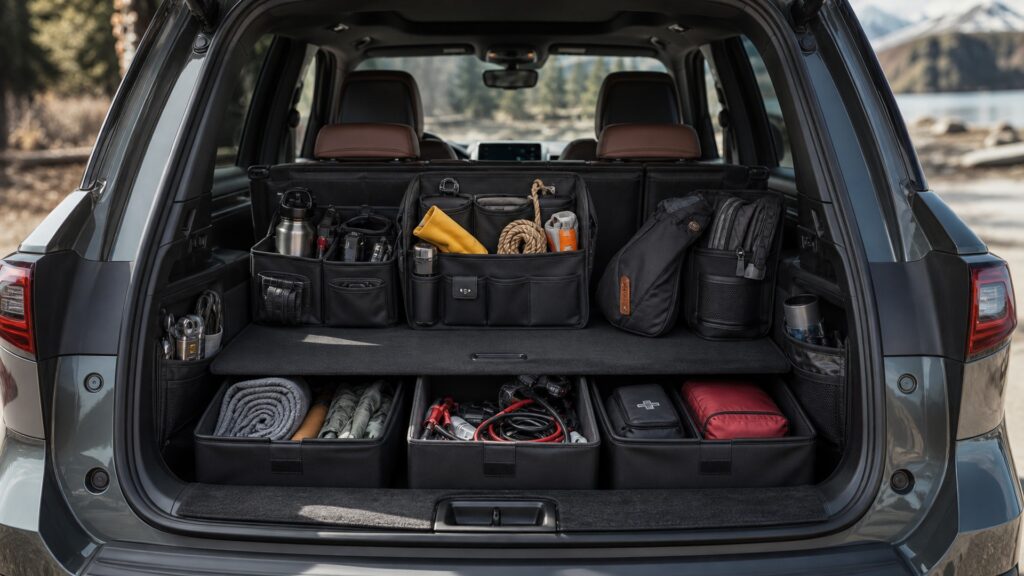
A sound system follows an item from selection and placement through normal access, hard braking, collision loading, emergency retrieval, replenishment, and removal.
Tip: Perform every search, refill, and device adjustment while parked; if an item is routinely needed during motion, redesign the workflow rather than moving the container closer to the driver.
These terms turn tidiness into an operational and crash-safety system.
The space a belted occupant can access without excessive leaning or loss of driving posture.
A non-driving task that takes one or both hands away from vehicle control.
A connection or enclosure intended to limit load movement during acceleration or impact.
The route force follows from stored object through container, strap, anchor, and vehicle structure.
The ability to retrieve safety equipment under plausible darkness, damage, smoke, stress, or blocked doors.
A scheduled check that removes expired, damaged, seasonal, duplicated, or no-longer-needed contents.
Tip: A container is not restraint unless its attachment and closure can manage the loaded mass in the directions created by braking and impact.
Daily parking credentials, charging cards, sunglasses, and cables need known locations but not necessarily moving access. Emergency tools need secure yet reachable positions. Rare cargo belongs farther from occupants, while anything that can wait should be handled before departure or after stopping.
The safest location often reduces the urge to reach rather than shortening the reach itself.
Small compartments stop ordinary rolling and noise, yet severe braking creates forces far above casual handling. Lids, straps, nets, drawers, and anchors must carry the loaded mass without releasing it into occupants or control areas.
Organization controls routine motion; crashworthy restraint requires a deliberate load path beyond the organizer shell.
Consistent placement reduces memory and visual search, but CDC advises against reaching for objects, opening compartments, or catching falling items while driving. The correct response to a missing object is to stop safely, not search more efficiently.
Organization supports attention by removing in-motion tasks, not by making multitasking more convenient.
Sun-soaked cabins can damage batteries, aerosols, food, medicines, adhesives, and electronics. Containers can block seat travel, vents, airbag deployment, child restraints, spare-tire access, or emergency exits. Moisture can collect beneath closed bins.
An unused cavity is not automatically a safe storage location.
A first-aid kit without usable contents and a flashlight with dead batteries create false confidence. Labels, quantity limits, check dates, seasonal changes, and return-to-location habits keep the inventory smaller and more dependable.
Organization delivers value when the expected item is present, functional, and accessible—not merely when the container looks orderly.
Organization can protect attention and access while only real restraint controls heavier cargo under severe deceleration.
Known locations reduce pre-trip friction, support emergency readiness, and keep loose objects away from pedals, doors, passengers, and controls.
Mass-aware storage and routine inventory checks reduce clutter, expired supplies, unnecessary weight, and the temptation to search while driving.
Pockets and dividers do not prove crash restraint, and easy reach does not make a manual task safe while the vehicle is moving.
Cabin heat, moisture, airbags, child restraints, seat movement, visibility, weight limits, and emergency exit paths can disqualify an otherwise convenient location.
These myths confuse neat appearance, convenience, and crashworthy storage.
A zipper, elastic edge, or light plastic lid may control everyday movement without carrying collision loads. Mass, closure strength, attachment, anchor structure, direction, and containment determine whether objects remain secured.
Frequent use should trigger pre-trip setup or a parked workflow, not routine reaching. CDC identifies reaching for objects and opening compartments as distractions that remove hands or attention from driving.
A trunk separates cargo from occupants, but loads can still damage the vehicle, shift handling, penetrate seatbacks, or escape through an open hatch. Respect capacity, distribute weight, and use suitable anchors and barriers.
Additional pockets can hide expired supplies, encourage unnecessary inventory, consume passenger space, and create weakly retained loads. A smaller labeled system with removal rules is often faster to inspect and easier to trust.
Tip: Judge the complete loaded system and the behavior it encourages, especially under sudden braking and emergency access.
These answers address emergency kits, loose water bottles, trunk loads, temperature-sensitive items, and how often the system needs review.
Choose a secure location reachable after a plausible crash or roadside stop without becoming a projectile. Occupants should know it, and critical items may need separation if the trunk or one door becomes inaccessible.
Yes. Any loose object can migrate through the driver footwell during turns or braking. Use a retained holder that fits the container, and stop safely rather than attempting to recover a dropped item.
Keep it low, forward where vehicle guidance permits, balanced across the vehicle, and attached securely to suitable structural points. Do not exceed payload, axle, seatback, roof, hitch, or organizer ratings.
Follow labels for medicines, aerosols, batteries, pressurized containers, food, adhesives, electronics, and other temperature-sensitive products. Cabin conditions can exceed ambient temperature and degrade performance or create leakage and fire risk.
Check after each major trip or use, at seasonal changes, before emergencies or long travel, and on a regular calendar. Remove trash, duplicates, expired supplies, damaged straps, dead batteries, and unexplained items.
Vehicle organization matters because deliberate placement removes search and retrieval from driving, preserves emergency access, and limits how ordinary objects move through the cabin.
Build around parked workflows, mass-aware restraint, low storage, clear safety zones, temperature limits, a concise inventory, and scheduled removal—not around maximum pocket count.
These explainers show how organizers interact with restraint zones, usable reach, visibility, and the accessory system around them.
Review the cabin rules for retention, airbags, pedals, visibility, power, materials, and crash projectiles.
See how reach, posture, support, and control access change when storage or organizers occupy driver space.
Decide when a removable organizer is sufficient and when a vehicle-level cargo or electrical upgrade is justified.
Choose a retailer
Prices checked regularly. We may earn a commission at no cost to you.