
Airbag Deployment Zone
The volume through which an airbag door, cushion, or tether must open and inflate.
- Zones can include seats and pillars
- Accessories can become projectiles
- Vehicle guidance defines exclusions
Car interior accessories work by adding a secondary surface, holder, organizer, power source, or contact point to a cabin designed around occupants, controls, restraints, sensors, and crash loads. A mat captures debris, a cover receives wear, a mount positions a device, and an organizer restrains objects—but each changes geometry or material interaction.
The correct question is therefore not whether an accessory fits inside the car. It is whether it stays where intended, preserves pedal travel and sight lines, avoids airbag and belt paths, respects seat sensors and child restraints, tolerates heat, and can be cleaned without damaging original surfaces. Vehicle instructions override generic fit claims wherever safety systems are involved.
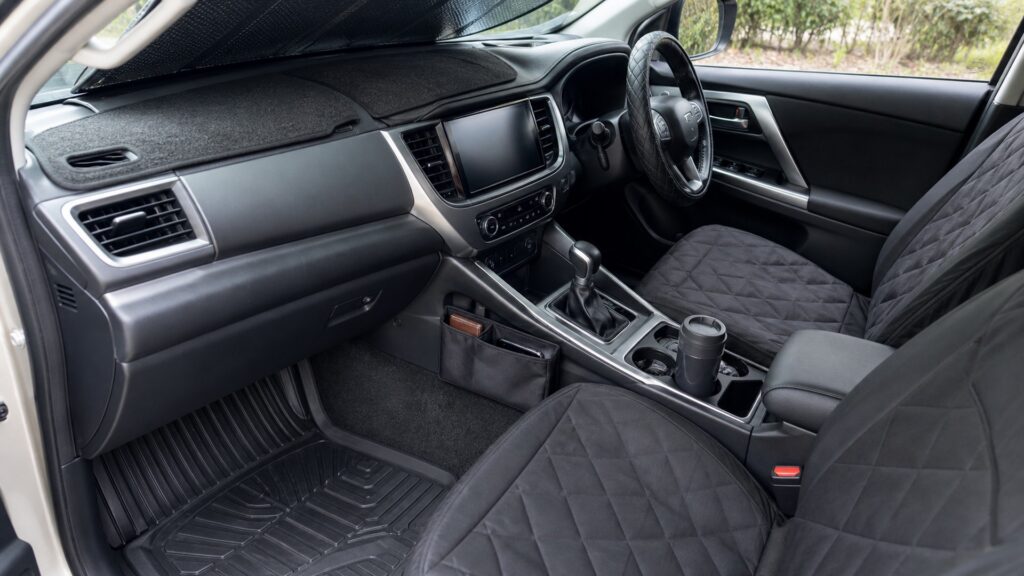
A responsible installation maps attachment, movement, load, heat, cleaning chemistry, and crash behavior before convenience is evaluated.
Tip: Photograph the cabin before installation and identify every moving control, restraint anchor, airbag label, sensor-sensitive seat, vent, and service access point the accessory could cover.
These terms identify the cabin systems an accessory can influence even when the product is not electronically connected.
The volume through which an airbag door, cushion, or tether must open and inflate.
A sensing system used to inform passenger-airbag operation based on seat conditions.
The unobstructed space needed for accelerator, brake, and clutch movement and return.
A designed anchor, strap, clip, or fastener that resists accessory movement.
The electrical current and heat demand added by a powered device or group of devices.
An unsecured object that continues moving relative to the cabin during sudden deceleration or impact.
Tip: Test the accessory with the seat, steering column, pedals, vents, belts, doors, and consoles through their full intended range before driving.
Protection products intercept wear and contamination; organizers define storage; supports change posture; mounts relocate screens; powered accessories draw energy. The selected product should solve one observed problem without creating a second problem at an adjacent interface.
An accessory succeeds at the boundary between its intended function and the original cabin, not on a product page.
Acceleration, braking, vibration, temperature cycling, seat adjustment, and repeated loading can shift an accessory that looked secure while parked. Retainers must resist the relevant direction, and soft products must not curl into controls or walking paths.
Fit is a dynamic property verified after use, not a one-time visual impression.
Seat-mounted side airbags need a designed release path, occupant-classification systems can respond to added layers, and belts need accessible buckles and free webbing. NHTSA advises against degrading these systems and directs users to vehicle-specific guidance.
A stitched airbag label on an accessory is not independent proof of compatibility with a specific seat.
Cabin heat softens plastics, weakens adhesives, accelerates battery aging, and increases volatile emissions. Powered hubs concentrate current at connectors. Cleaners that are safe on one polymer, coating, leather-like finish, or screen can haze or embrittle another.
Interior convenience must survive the vehicle's temperature and material environment without creating heat or surface damage.
A phone, bottle, tool, pet barrier, or organizer load continues moving until restrained. Attachments, pockets, and latches should retain expected contents, while accessories must not obstruct handles, doors, windows, or emergency egress.
The useful storage system is the one that contains its load when the cabin experiences more than gentle cruising.
Accessories can protect and organize the cabin only while preserving the geometry and behavior of original controls and restraints.
Well-fitted mats, covers, organizers, supports, mounts, and power accessories can reduce wear and make recurring tasks easier.
Reversible, retained products can adapt the cabin to passengers or cargo without permanent changes when their interfaces are verified.
No convenience benefit justifies obstructing pedals, sight lines, airbags, belts, occupant sensors, child-restraint anchors, vents, or emergency exits.
Universal fit language cannot establish vehicle-specific crash compatibility, electrical capacity, material safety, or secure retention under real driving loads.
These myths treat the cabin as empty furniture rather than an engineered occupant-protection system.
Dimensions do not reveal airbag deployment, occupant sensing, pedal travel, belt access, thermal behavior, electrical loading, or crash retention. Compatibility requires checking the exact vehicle, seating position, product instructions, and installed function.
Fabric, foam, and rubber can still block airbags, alter seat-sensor loading, interfere with pedals, conceal belt anchors, retain heat, burn, release contents, or become entangled. Softness does not remove geometry or material consequences.
The outlet, fuse, wiring, plug contacts, adapter, and each load have ratings. Total current, startup surges, loose connections, cable routing, and whether the outlet remains energized while parked all affect safety and battery drain.
Open pockets may prevent ordinary rolling yet release heavy or rigid objects during severe braking or a crash. Restraint strength, closure, mounting direction, load placement, and attachment structure determine whether contents remain contained.
Tip: Evaluate what the accessory contacts, what can move, and what must still operate during a crash or emergency.
These answers cover seat covers, floor mats, phone mounts, power accessories, and how to evaluate an unfamiliar product.
No. Seat-mounted airbags and occupant sensors vary, and NHTSA warns that improper covers can interfere. Follow the vehicle manual and use a product specifically documented for the exact seat and configuration.
No. Stacking can defeat retainers, raise the surface toward the pedals, and allow movement. Use one compatible driver's mat, attach every designed retention point, and verify full pedal movement and return.
Choose a location permitted by current law that preserves the driver's direct view, airbag zones, controls, vents, and secure device retention. Set the route before moving and minimize visual and manual interaction.
Only if the vehicle and device instructions permit it and measured standby draw is acceptable. Some outlets remain energized, and adapters, cameras, coolers, or trackers can deplete the 12-volt battery during storage.
Define its purpose, inspect materials and instructions, verify exact fit, map safety-system interfaces, test movement and electrical load, assess cleaning and heat, then recheck attachment carefully after repeated real use.
Car interior accessories work by adding controlled protection, storage, support, display, or power functions to an already engineered occupant space.
The installation is successful only when it remains retained, material-compatible, electrically appropriate, and clear of pedals, visibility, restraints, airbags, sensors, vents, and emergency movement.
The floor and seat explainers apply the same fit, retention, material, sensor, and cleaning principles to the two most commonly covered surfaces.
Learn how liners and mats contain contamination while preserving retention and pedal clearance.
Examine wear barriers, spill handling, seat airbags, occupant sensing, heaters, and child-restraint interfaces.
Trace the power, wiring, network, display, and installation limits behind powered cabin accessories.
Choose a retailer
Prices checked regularly. We may earn a commission at no cost to you.