
Application Catalog
A fitment record mapping a part to vehicle attributes.
- Year and model are insufficient sometimes
- Engine, build date, and options matter
- VIN can resolve configuration
An automotive replacement part works only when it restores the function that diagnosis identified. The chain begins with the exact vehicle configuration and failure mode, then moves through current part numbers, specifications, source quality, installation requirements, calibration, and a repeatable post-repair test.
Skipping one handoff can make a plausible part fail in practice. A connector may fit while its signal range is wrong; an updated part may require companion hardware; a correctly installed sensor may still need aiming or relearning. Replacement is therefore a controlled restoration process, not simply removing one object and bolting in another.
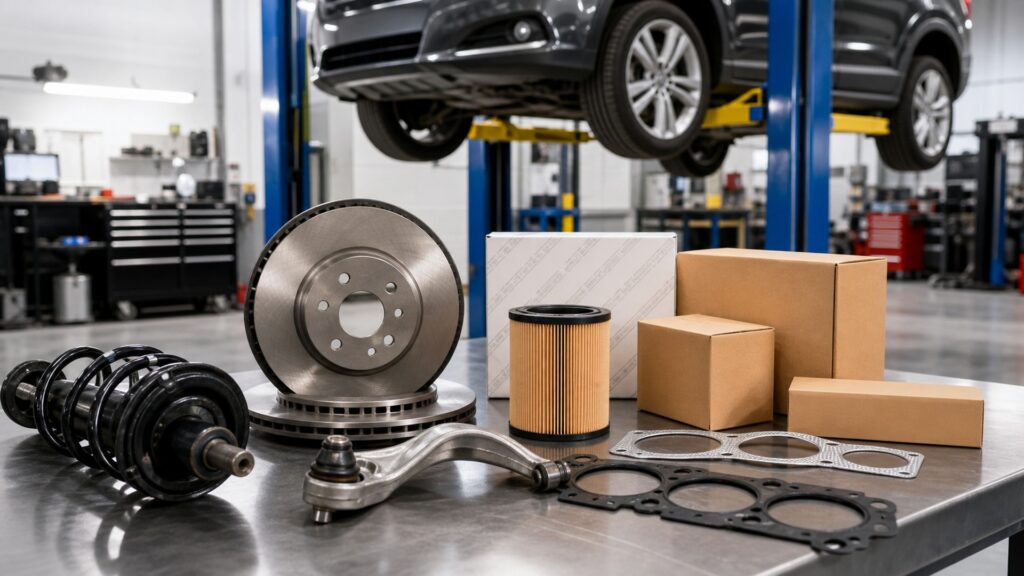
Follow vehicle identification, specification matching, sourcing, installation, calibration, and proof that the failed function returned.
Tip: Write down the failed function before shopping; a catalog match cannot rescue a diagnosis aimed at the wrong cause.
These terms distinguish vehicle application, source category, part-number history, and the setup required after installation.
A fitment record mapping a part to vehicle attributes.
A part supplied within the vehicle maker's service channel.
A non-vehicle-maker replacement offered for an application.
A used core restored through disassembly, replacement, machining, and testing.
A newer part number replacing an earlier service number.
Software setup, relearn, coding, or adjustment required after installation.
Tip: Fitment has layers: attachment, dimensions, ratings, connectors, software, and the procedure must all agree.
The process begins by diagnosing the failed function and identifying the exact vehicle configuration before choosing a part.
A correct part cannot fix an incorrect diagnosis.
Dimensions, connectors, materials, ratings, software, and supersession notes determine whether a candidate performs the required function.
Physical attachment alone does not establish compatibility.
Each source can solve the same function with different documentation, process control, availability, warranty, and price.
Source category is not a universal quality ranking.
Installation transfers the specification into the vehicle; contamination, connector damage, wrong torque, trapped air, or missed coding can create a new failure.
The installed system—not the box label—determines the repair.
After installation, clear evidence is needed that the original fault is gone and adjacent systems operate correctly.
Verification closes the repair loop and catches a wrong diagnosis or installation.
Replacement-part myths confuse physical attachment, source labels, diagnostic codes, and warranty rights with proven restoration.
The process ties a diagnosed failure to the exact vehicle application and current specification.
Calibration and a repeatable test provide evidence that the intended function returned.
Catalog fitment cannot prove that a component addresses the root cause.
Installation or coding errors can defeat a correctly selected part.
Replacement-part myths confuse physical attachment, source labels, diagnostic codes, and warranty rights with proven restoration.
Mounting holes prove only one dimension. Connector keying, sensor range, material, pressure rating, software, build-date changes, and calibration can still make the part incompatible. Vin fitment remains an important vehicle-specific boundary.
FTC guidance says using aftermarket or recycled parts does not by itself end warranty coverage. Damage caused by a defective part or improper installation can affect coverage for that damage.
Service parts can be superseded as designs and supply change. Confirm the current catalog number and notes rather than assuming an old number remains the required choice. That vehicle-specific boundary still matters.
A diagnostic code reports a detected condition, not necessarily the failed part. Wiring, power, ground, leaks, mechanical faults, and software must be tested against service information. Calibration remains an important vehicle-specific boundary.
Tip: Ask what evidence connects this exact part to the diagnosed cause and current vehicle configuration.
These questions resolve VIN fitment, remanufacturing, recalls, calibration, and online catalog claims.
Start with VIN, model year, engine or motor, drivetrain, build date, trim or option codes, and the old part number. The needed fields depend on the application split. That vehicle-specific boundary still matters.
No. A used part is generally resold from another vehicle; a remanufactured part is processed through a defined restoration and test program. Verify what was replaced and tested. That vehicle-specific boundary still matters.
The vehicle may need a known reference, aiming geometry, learned range, or software identity before it can interpret the new signal correctly. Requirements are system- and model-specific. That vehicle-specific boundary still matters.
Check the VIN with NHTSA and contact the manufacturer or authorized repair channel. Safety recall remedies are generally handled through the recall process, not ordinary retail substitution. That vehicle-specific boundary still matters.
Cross-check the supplier catalog, current service part number, VIN or option split, dimensions, connectors, ratings, and installation notes. Treat marketplace labels as leads, not final authority. Calibration remains an important vehicle-specific boundary.
Automotive replacement parts work through a chain of correct diagnosis, exact fitment, defensible sourcing, procedure-controlled installation, required calibration, and proof that the original function returned.
The package label or physical attachment cannot complete that chain; current service information and a condition-specific verification close the repair.
The next explainers show why recovery time matters and which larger vehicle system the replacement must restore.
See how diagnosis, parts access, repair time, and recurrence turn a component failure into a reliability outcome.
Trace the powertrain, chassis, braking, steering, and control functions that a replacement component must restore.
Choose a retailer
Prices checked regularly. We may earn a commission at no cost to you.