How Commercial Electric Vehicles Work

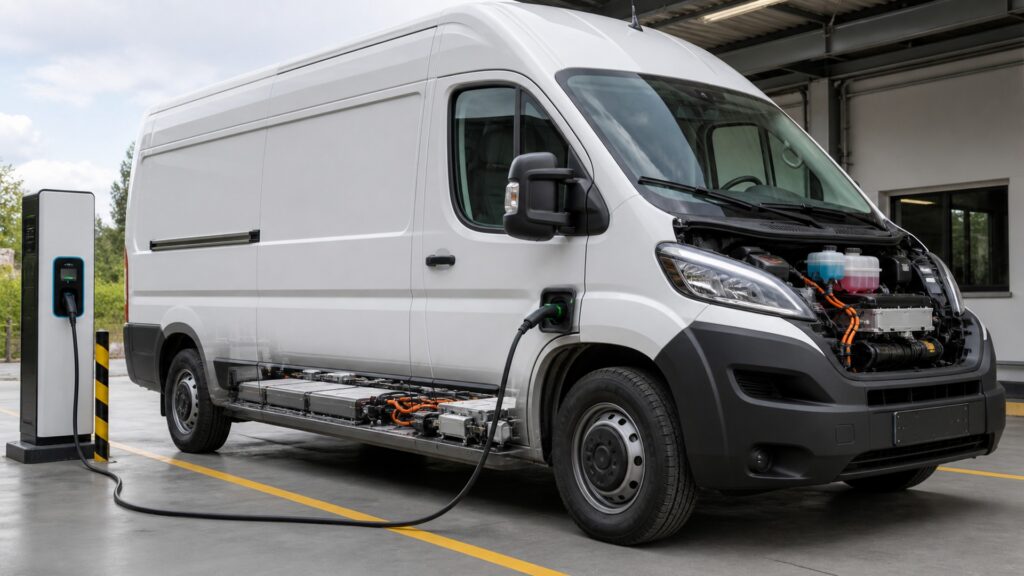
A battery-electric commercial vehicle stores energy in a traction battery, controls its delivery through power electronics, and uses an electric motor to turn the wheels through a driveline. Charging restores battery energy between assignments. During suitable braking conditions, the electric drive can recover some energy that would otherwise be dissipated as heat.

The explanation here concerns battery-electric vehicles. Commercial use can also involve plug-in hybrids or hydrogen fuel-cell vehicles with different energy arrangements. Within battery-electric vans and trucks, the layout and equipment vary, but the useful questions remain the same: where energy is stored, how it reaches the wheels, and what else needs it during work.

By: Review Streets Research Lab
Updated: October 6, 2026
Explainer · 8-12 min read
commercial electric vehicles explainer hero image for Review Streets
What You'll Learn

Follow Energy from the Charge Port to the Wheels

Connect the drive system with charging and working equipment.

  • What the traction battery stores
  • How power electronics control motor output
  • How the driveline turns motor torque into vehicle motion
  • Why braking recovery cannot replace charging
  • How charging, cooling, and auxiliary supplies support the vehicle

Tip: Separate stored energy, measured in kilowatt-hours, from power, measured in kilowatts. They answer different questions about capacity and rate.

Definitions

Six Components in a Battery-Electric Drive System

These components perform different jobs in the energy path.

Traction battery

The traction battery stores electrical energy used by the propulsion system.

  • Example: the energy store supplying the vehicle during a route
  • Check: the vehicle’s usable energy and operating instructions
  • Limit: charge percentage alone is not a universal range figure

Power electronics

Power electronics control and convert electrical power for the drive and other systems.

  • Example: controlled electrical supply to the traction motor
  • Check: the exact vehicle’s architecture
  • Limit: these components are not user-serviceable accessory outlets

Electric traction motor

An electric traction motor converts electrical energy into mechanical rotation for propulsion.

  • Example: motor torque transmitted toward the driven wheels
  • Check: the fitted drive arrangement
  • Limit: motor output does not establish the vehicle’s payload rating

Driveline

The driveline transfers mechanical power from the motor to the driven wheels.

  • Example: gearing and drive components connecting the motor with the wheels
  • Check: the actual vehicle configuration
  • Limit: electric vehicles do not all have identical gearing or axle layouts

Onboard charger

The onboard charger converts incoming AC electricity into DC for battery charging.

  • Example: charging from compatible AC supply equipment
  • Check: the vehicle’s supported charging specifications
  • Limit: DC fast charging follows a different conversion arrangement

DC/DC converter

A DC/DC converter changes DC electricity from one voltage level to another.

  • Example: supplying a lower-voltage vehicle system from the higher-voltage energy system
  • Check: the vehicle’s designed auxiliary supply
  • Limit: the low-voltage system and traction battery have different roles

Tip: The same word battery can refer to different vehicle systems; identify whether the discussion concerns traction or low-voltage support.

Stored energy

The Battery Supplies Energy Under System Control

The traction battery holds the energy needed for the electric drive. Control systems manage how that energy is used and charged within the vehicle’s operating conditions. The driver requests motion through the controls; this is not a simple direct connection between an accelerator and a battery. Available performance and charging behavior depend on the particular vehicle and its current state.

  • Use the vehicle’s charge and warning indications.
  • Distinguish energy capacity from motor power.
  • Follow the specified operating and charging guidance.

The Department of Energy’s component explanation identifies the traction battery and power electronics as separate parts of the energy path.

Reference: DOE battery-electric component explanation.

Wheel motion

The Motor Produces Torque and the Driveline Delivers It

Electrical power reaches the traction motor through the controlled drive system. The motor produces rotation and torque, which the driveline transfers to the driven wheels. Tire contact with the road then provides the force that moves the vehicle. Gearing and axle arrangements depend on the design; an electric badge does not establish one universal layout.

  • Identify the driven-wheel arrangement for the vehicle.
  • Treat motor capability separately from carrying limits.
  • Account for traction and road conditions during driving.

A strong acceleration response does not prove that additional cargo is within the vehicle’s weight or axle ratings.

Slowing down

Some Braking Energy Can Return to the Battery

During suitable deceleration, the electric machine can resist wheel motion and convert some of that motion’s energy back into electrical energy. This recovery reduces the amount lost solely as brake heat. Conventional friction brakes remain necessary, and the vehicle determines how its braking functions cooperate. Drivers need to understand the fitted modes and instructions.

  • Learn the actual vehicle’s braking behavior.
  • Use the brake pedal as required.
  • Do not treat recovered energy as a substitute for a charging plan.

NHTSA explains that electric-drive braking works alongside conventional braking. Recovery is limited; the vehicle cannot replenish all energy used merely by slowing down.

Reference: NHTSA electric-drive and braking explanation.

Replenishment

AC and DC Charging Use Different Conversion Paths

With AC charging, the vehicle’s onboard charger converts the incoming supply to the DC electricity needed by the battery. In DC fast charging, the external equipment performs the AC-to-DC conversion and supplies supported DC charging power to the vehicle. Compatibility and charging controls still matter. Actual power can vary, so a station’s maximum rating is not a guaranteed constant rate into the battery.

  • Check the vehicle and equipment’s supported charging arrangement.
  • Distinguish charger peak power from delivered energy.
  • Use charging information for the exact vehicle.

The eSprinter operator’s manual describes AC and DC charging for that vehicle. DOE charging guidance explains why charging time depends on both vehicle and equipment factors.

Reference: Mercedes-Benz eSprinter operator’s manual, DOE charging equipment guidance.

Supporting work

Cooling and Auxiliary Supplies Keep More Than the Wheels Working

The vehicle also needs to manage component temperatures and supply controls, lights, and other equipment. A DC/DC converter supports the lower-voltage system from the higher-voltage supply in typical battery-electric layouts. Heating, cooling, and supported working equipment may consume energy during a job, including while parked. Their supply arrangement depends on the fitted vehicle and equipment.

  • Include relevant auxiliary demand in the duty assessment.
  • Keep thermal and electrical warnings connected to qualified support.
  • Use only supported equipment interfaces.

A refrigerated delivery vehicle, for example, must support both its road movement and its refrigeration arrangement. A stationary period is not automatically a period of zero energy use.

Reference: DOE fleet EV auxiliary-load guidance.

Quick Reality Check

Stored Energy and Instantaneous Power

These related quantities describe different capabilities.

Energy in kilowatt-hours

An amount stored or used over an interval.

Relevant to the work the vehicle can support between charging opportunities.

Power in kilowatts

A rate of energy transfer or use.

Relevant to drive output, equipment demand, or charging rate at a particular time.

Common Myths

Misconceptions About Commercial Electric Drive

Keep the components and energy flows distinct.

Every electric commercial vehicle has the same driveline

Motor, gearing, and axle layouts depend on the vehicle.

Braking recovery makes external charging unnecessary

It recovers only some energy during suitable deceleration.

The largest motor rating means the largest payload

Carrying limits depend on the complete vehicle and its ratings.

The charger’s maximum power is delivered constantly

Actual charging behavior depends on the vehicle, equipment, and relevant conditions.

Tip: Read each rating for the function it actually measures.

FAQ

Questions About How Commercial EVs Work

Clarify the main mechanisms without confusing vehicle types.

What replaces the combustion engine in a battery-electric vehicle?

An electric motor or motors provide propulsion, powered by a traction battery through the controlled electrical system.

Does an EV still have mechanical drive parts?

Yes. The driveline transfers motor output to the driven wheels through the arrangement used by that vehicle.

Why does the vehicle still need friction brakes?

Energy recovery cannot provide every required braking function or operate identically in every condition.

What is different about AC and DC charging?

AC supply is converted by the onboard charger; supported DC charging receives converted power from external charging equipment.

Do all commercial electric vehicles use only a battery for energy?

No. This explanation covers battery-electric vehicles. Plug-in hybrids and fuel-cell vehicles have additional or different energy systems.

Bottom Line

Battery-electric commercial vehicles connect stored battery energy, controlled motor power, and a mechanical driveline to move the load.

Charging replenishes energy, braking recovers some of it, and auxiliary and thermal systems support the complete working vehicle.

Next Steps

Go Deeper or Compare Your Options

Use these Review Streets paths to compare related categories and practical next decisions.