Why Commercial Electric Vehicles Operating Function Matters

A commercial battery-electric vehicle has to do more than complete one trip. It must carry its intended load, support any onboard equipment, return with a workable energy plan, and be ready for the next assignment. Operating function is the connection between those tasks and the time available to perform them.

This makes the periods between journeys part of the transport system. A van can be mechanically sound and parked in the right place yet unavailable for a demanding route because its charging session never started. Equally, a vehicle does not always need a full battery before every departure; it needs the condition and energy appropriate to the assignment, following its manufacturer’s guidance.

By: Review Streets Research Lab
Updated: October 6, 2026
Explainer · 8-12 min read
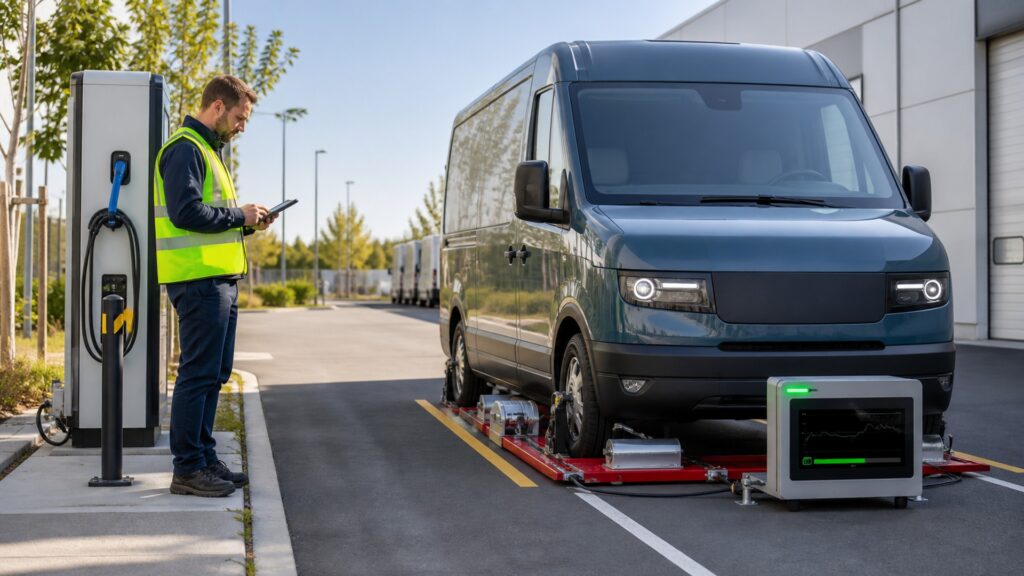
commercial electric vehicles explainer hero image for Review Streets
What You'll Learn

Connect the Working Day to the Next Departure

Follow movement, onboard demand, charging, and handover as one cycle.

  • How the complete duty cycle differs from daily mileage
  • Why charge percentage and route energy are different measures
  • How auxiliary equipment affects the day’s demand
  • Why average charging power matters more than a peak figure
  • How to verify readiness and respond to interrupted charging

Tip: Record actual arrival and departure times alongside charging results. A planned overnight session is useful only if it takes place.

Definitions

Six Terms for a Repeatable Electric Working Day

Keep energy, power, time, and vehicle status distinct.

Duty cycle

A duty cycle is the pattern of driving, stopping, loading, waiting, and other use during the work.

  • Example: a delivery route followed by depot unloading and charging
  • Check: the complete sequence and its conditions
  • Limit: total distance alone does not describe the assignment

State of charge

State of charge is the vehicle’s reported battery charge level, commonly shown as a percentage.

  • Example: a charge display checked before dispatch
  • Check: the exact vehicle and the intended route
  • Limit: equal percentages on different vehicles do not imply equal available energy or range

Energy demand

Energy demand is the amount of energy needed for the relevant work and onboard uses.

  • Example: energy consumed by driving and cabin conditioning
  • Check: the actual route, load, equipment, and conditions
  • Limit: one favorable trip does not establish every day’s demand

Dwell time

Dwell time is the period the vehicle remains at a location between movements.

  • Example: time parked at the depot before the next shift
  • Check: whether charging access exists during that time
  • Limit: unloading or another task may reduce the usable charging window

Charging power

Charging power is the rate at which energy is transferred, expressed in kilowatts.

  • Example: an average battery-energy increase equivalent to 10 kilowatts during a session
  • Check: the delivered rate and the point at which it is measured
  • Limit: a charger’s peak rating does not guarantee a constant battery charging rate

Dispatch readiness

Dispatch readiness means the vehicle’s condition, equipment, driver, and energy suit the next assignment.

  • Example: a prepared van with a verified charge for its booked route
  • Check: the actual departure requirement
  • Limit: being connected to a charger does not prove readiness

Tip: Kilowatt-hours measure energy; kilowatts measure the rate of energy transfer. Keep them separate when checking a schedule.

Work pattern

Map the Whole Cycle Before Judging the Vehicle

Start at vehicle collection and continue through loading, travel, stops, waiting, return, and preparation for the next user. Identify which activities need the vehicle to remain available and where it can actually charge. A short daytime gap may disappear once unloading and repositioning are included. A long overnight stop may be useful only if someone connects the vehicle and confirms the session.

  • Record the working sequence, not only mileage.
  • Identify actual charging locations and access.
  • Include preparation and handover tasks.

The operational question is whether the complete cycle repeats reliably, including a busy day and its following departure.

Energy during work

Account for the Load and Equipment That Travel Together

Assess the candidate vehicle with its required load, route, and relevant conditions. Include auxiliary equipment using the vehicle’s energy supply, such as cabin conditioning or supported working equipment. Waiting can consume time and energy even when the odometer does not move. Use observations from representative service rather than assuming a distance-only estimate captures every demand.

  • Assess the loaded and equipped vehicle.
  • Include relevant stationary equipment use.
  • Review seasonal and route variation.

The Department of Energy’s fleet guidance identifies heating, cooling, terrain, and auxiliary loads as factors in vehicle selection and duty assessment.

Reference: Department of Energy fleet EV duty guidance.

Charging time

Use Delivered Energy to Check the Available Window

Consider a deliberately simplified example: an assignment requires the battery to gain 30 kilowatt-hours before departure. If the average net rate into the battery is 10 kilowatts throughout the session, that gain takes three hours. A one-hour window at that same net rate adds only 10 kilowatt-hours. These invented figures illustrate the arithmetic; they are not specifications or a charging prediction for any vehicle.

  • Use energy needed divided by average net charging power.
  • Distinguish battery-energy gain from electricity drawn at the supply.
  • Allow for the real vehicle and charging arrangement.

Actual power can vary with the vehicle, battery state, equipment, and site limits. Supply losses and onboard uses also mean the charger’s advertised rating is not automatically the net rate entering the battery.

Reference: Department of Energy charging equipment explanation.

Shared resources

Make Charging and Handover Someone’s Responsibility

When several vehicles share infrastructure, a parking plan also becomes an energy plan. Assign access based on departure needs and the supported charging arrangement. Make clear who connects vehicles, confirms sessions, responds to faults, and reports readiness to the next user. Keep charger identity in the record so repeated failures can be linked to the right equipment.

  • Confirm sessions rather than assuming connection is enough.
  • Coordinate vehicles that need the same charging resource.
  • Provide a named contact for interrupted charging.

The Department of Energy’s infrastructure guidance emphasizes defined maintenance responsibility and useful charging records. Those arrangements help prevent a failed session from remaining unnoticed until dispatch.

Reference: Charging infrastructure operation and maintenance.

Changed conditions

Reassess the Next Assignment When the Day Changes

An extra delivery, an extended wait, or an interrupted charging session can change the energy available for later work. Give dispatch a way to compare the revised requirement with the vehicle’s current readiness. The response might involve a supported charging stop, a suitable replacement, or a revised assignment. Do not assume the original plan remains valid merely because the vehicle completed the earlier trip.

  • Report changes early enough for a decision.
  • Check the revised route and timing together.
  • Record the reason for any service interruption.

For example, a van returning late may still finish today’s work while losing part of the charging window needed for tomorrow. Readiness belongs to the next departure as well as the last arrival.

Quick Reality Check

Connected to a Charger Versus Ready to Depart

Verify the result of charging along with the rest of the assignment.

Charging arrangement

A compatible connection, available equipment, and a usable time window.

A session that starts and delivers energy as expected.

Departure readiness

Vehicle condition and equipment appropriate to the next job.

Verified available energy, prepared driver, and workable route plan.

Common Myths

Misconceptions About Commercial EV Operation

A useful plan connects the whole day instead of relying on a single display.

A short route always has a small energy demand

Load, conditions, and auxiliary uses also affect the assignment.

A plugged-in vehicle must be charging

Check the session and the resulting state rather than connection alone.

Peak charger power determines the whole charging time

The actual rate can vary and is limited by the vehicle and charging arrangement.

Completing today’s route proves tomorrow’s readiness

A late return or charging interruption can affect the next departure.

Tip: Use actual service and charging records to refine the plan after deployment.

FAQ

Questions About Commercial EV Operating Function

Answers for scheduling electric work vehicles.

Does every departure require a full battery?

Not necessarily. Follow the manufacturer’s guidance and prepare sufficient energy for the particular assignment and its operating plan.

What is the difference between kilowatts and kilowatt-hours?

Kilowatts measure power, or the rate of energy transfer. Kilowatt-hours measure an amount of energy.

Can advertised charger power be used as a guaranteed average?

No. Actual delivery depends on the vehicle, battery state, equipment, site arrangement, and other relevant conditions.

What should a handover include?

Current condition, relevant reports, charge status, equipment readiness, and any changes affecting the next assignment.

What should happen after a failed overnight charge?

Report it and reassess the departure requirement. Use the approved support and alternative transport arrangements rather than assuming the route remains feasible.

Bottom Line

Commercial EV operating function depends on matching the complete duty cycle with usable energy, charging time, and clear handover responsibility.

Verify readiness for the next assignment and adjust the plan when route conditions or charging results change.

Next Steps

Go Deeper or Compare Your Options

Use these Review Streets paths to compare related categories and practical next decisions.