
Attachment Point
The place where an accessory connects to a bike, body, or bag.
- It determines whether the item can be used securely.
- Mounts vary across bars, frames, saddles, helmets, and pockets.
- Poor fit can make a useful item impractical.
Cycling accessories work by adding support roles around the bicycle and rider. They attach, carry, illuminate, measure, organize, hydrate, or help with roadside repair.
The mechanism is usually simple but specific: a light needs placement and power, a cage needs bosses or straps, a computer needs a mount and sensor data, and a pump or tool needs compatibility with the bike.
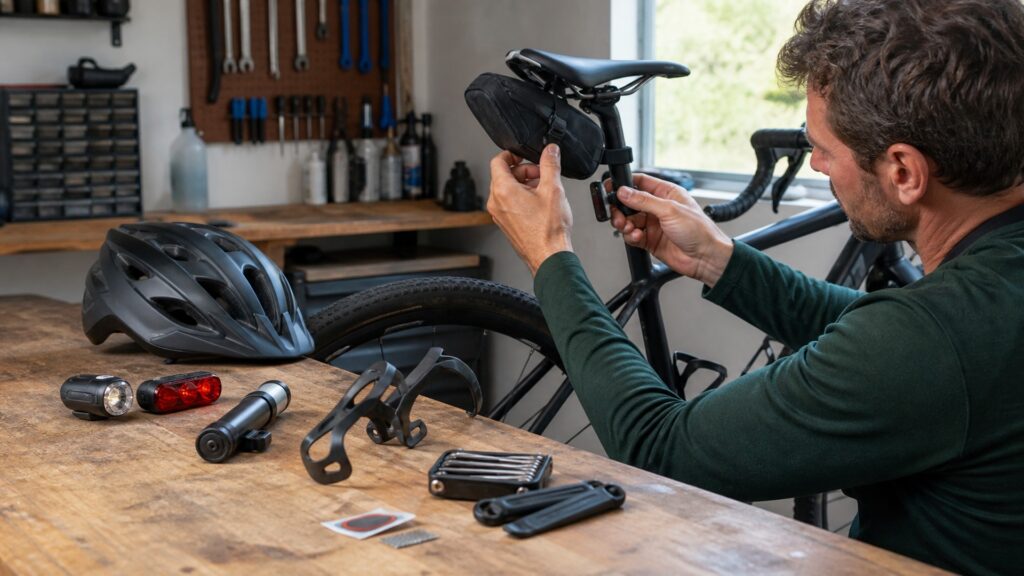
This explains how accessories function without confusing them with the bicycle's core ride systems.
Tip: Classify the accessory by job first: attach, carry, light, measure, hydrate, protect, or repair.
These definitions connect the main idea to the variables, limits, and practical signals readers need to compare options.
The place where an accessory connects to a bike, body, or bag.
A function that helps a ride without creating the bicycle's motion.
A device that records or displays ride data.
A cage, rack, bag, or pocket arrangement for bringing items on a ride.
A light, reflector, or signal-focused item used to make presence easier to notice.
Tools, pumps, tubes, plugs, or inflators used for problems during a ride.
Tip: Use each term to keep accessory jobs from blending together.
A cycling accessory usually supports a ride condition rather than creating the ride itself.
The accessory's job starts outside the bicycle's core motion system.
An accessory can be well designed and still fail the use case if the bike lacks the right mount, space, strap path, or clearance.
Compatibility is part of how the accessory works.
Visibility, carrying, hydration, measurement, and repair are separate accessory jobs with different constraints.
The best explanation keeps accessory roles apart.
Where an accessory sits can affect reach, weight distribution, cable room, steering space, and how easy it is to use while stopped or riding.
Accessory function includes placement, not just ownership.
Accessories can help with a ride, but they cannot guarantee visibility, prevent mechanical problems, coach training, or replace bike maintenance.
Accessory claims should stay modest and observable.
Accessory mechanics explain attachment, placement, support role, compatibility, and practical limits.
It separates lights, bags, computers, cages, and tools by function.
It explains why fit and placement matter.
It does not guarantee safety, training progress, or repair success.
It does not replace bicycle maintenance or local requirements.
Common shortcuts and misunderstandings can make the topic seem simpler than it is.
Mounts, clearances, bar space, and standards vary.
It displays or records data; interpretation is separate.
They help respond to some problems but do not prevent wear or damage.
Lights support visibility while route choices and rules still matter.
Tip: Treat strong claims as starting points for comparison, not final answers.
Concise answers to common questions readers may have after the main explanation.
They attach to the bike, rider, or storage setup to support visibility, carrying, hydration, measurement, repair, or comfort.
The accessory needs a stable place to sit without blocking controls, movement, or clearance.
They support the bicycle and rider, but they usually are not core systems like frame, wheels, drivetrain, or brakes.
Some support visibility or preparedness, but they cannot guarantee safety.
Yes. Computers and sensors often require mounting, pairing, calibration, or battery checks.
Cycling accessories work as support systems: they attach somewhere, perform a defined ride job, and carry compatibility or placement limits.
A useful accessory explanation starts with function and fit, not with a generic claim that more gear is always better.
Use these Review Streets paths to connect the explainer to related categories, comparisons, and next decisions.
Use this to separate the bicycle from add-on support gear.
Read this for accessories used around structured rides.
Browse accessory categories after understanding support roles.
Choose a retailer
Prices checked regularly. We may earn a commission at no cost to you.