
Training Accessory
An add-on used to support a planned or repeatable ride.
- It may measure, carry, hydrate, navigate, or organize.
- It depends on the ride job.
- It is not a training plan by itself.
Cycling accessories training function matters because many rides depend on support outside the bicycle frame: data display, sensor pairing, bottle access, route navigation, storage, and battery management.
Those functions can make a ride easier to structure or repeat, but they do not turn accessories into coaches or prove a fitness outcome.
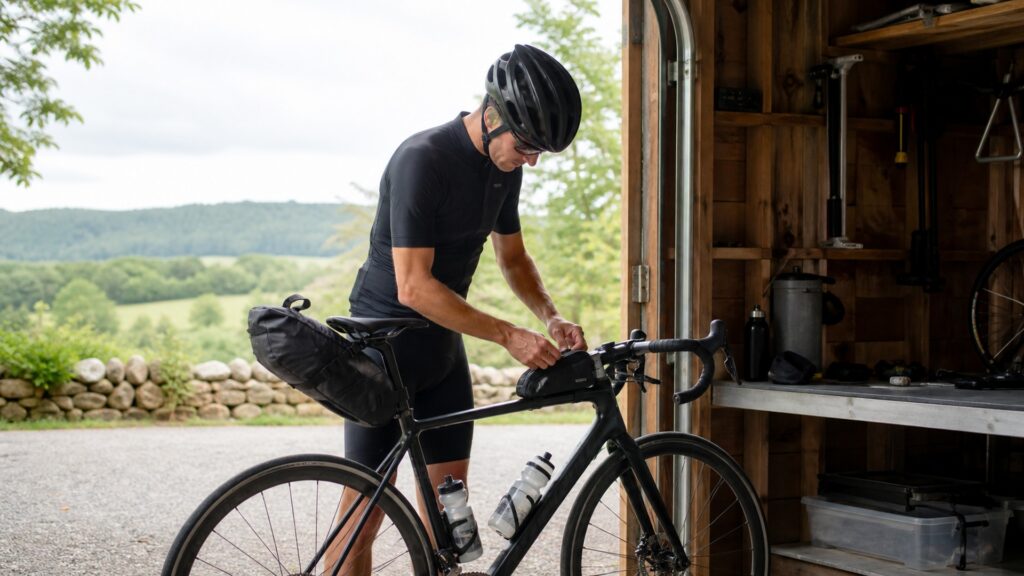
This explains accessory functions that help planned rides while keeping data and outcome claims separate.
Tip: Name the training support job before choosing the accessory: measure, navigate, hydrate, carry, or repeat.
These definitions connect the main idea to the variables, limits, and practical signals readers need to compare options.
An add-on used to support a planned or repeatable ride.
A metric shown on a cycling computer or app.
The connection between a sensor and display device.
The ability to carry and reach bottles or fluids.
A mount or device used to follow a route.
The ability to set up similar rides or compare similar data later.
Tip: Keep data display, storage, hydration, and navigation in different roles.
A cycling accessory has training function when it helps structure, measure, repeat, navigate, hydrate, or carry during a ride.
Training function is support around the ride.
Cadence, speed, heart-rate, and power readings depend on placement, pairing, battery status, calibration needs, and device compatibility.
Data accessories are only as useful as their setup.
Longer or structured rides may need bottles, nutrition storage, tools, layers, or phone access, making cages and bags part of the support system.
Not every training accessory is electronic.
Phone mounts and bike computers can help follow routes, compare similar sessions, and reduce route-finding friction.
Repeatability can be a practical accessory function.
A display can show numbers and a bottle cage can support access, but neither guarantees adaptation, weight change, recovery, or safety.
Training function should stay separate from promised outcomes.
Training-function analysis explains how accessories support planned and repeatable rides.
It separates measurement, hydration, carrying, and navigation roles.
It shows why setup and compatibility matter.
It does not coach the rider.
It does not guarantee fitness, calorie, recovery, or health outcomes.
Common shortcuts and misunderstandings can make the topic seem simpler than it is.
Bottle cages, bags, mounts, and repair kits can support structured rides too.
More metrics can add noise if the ride purpose is unclear.
Pairing only connects devices; setup and device quality still matter.
Calorie estimates depend on assumptions and should be treated cautiously.
Tip: Treat strong claims as starting points for comparison, not final answers.
Concise answers to common questions readers may have after the main explanation.
It is the way an accessory supports a planned ride through data, navigation, hydration, carrying, or repeatability.
No. It displays or records information; planning and interpretation are separate.
Yes, when they support longer or more structured rides.
Electronic accessories lose their function when the battery cannot last through the ride.
No. Data can support comparison, but progress depends on broader context.
Cycling accessory training function matters when support gear helps measure, navigate, hydrate, carry, or repeat a ride.
The value comes from matching the accessory to the ride job, not from treating every metric as a training answer.
Use these Review Streets paths to connect the explainer to related categories, comparisons, and next decisions.
Use this for the attachment and support mechanics behind accessories.
Read this to compare accessory support with bicycle-side training function.
Browse accessories after identifying the needed training support role.
Choose a retailer
Prices checked regularly. We may earn a commission at no cost to you.