
Bottom Bracket
The axle area where the crank rotates through the frame.
- It is the center of the pedal circle.
- A rough or loose bearing changes ride feel.
- It links rider force to the drive system.
An exercise bike works by turning a fixed pedal circle into controlled load. The rider pushes the pedals, crank arms rotate around the bottom bracket, a belt or chain moves the flywheel, and a brake system resists that motion.
The operating model is mechanical before it is digital. Screens, classes, distance estimates, and workout programs sit on top of the drive train, so the clearest explanation starts inside the frame and then moves outward to controls and feedback.
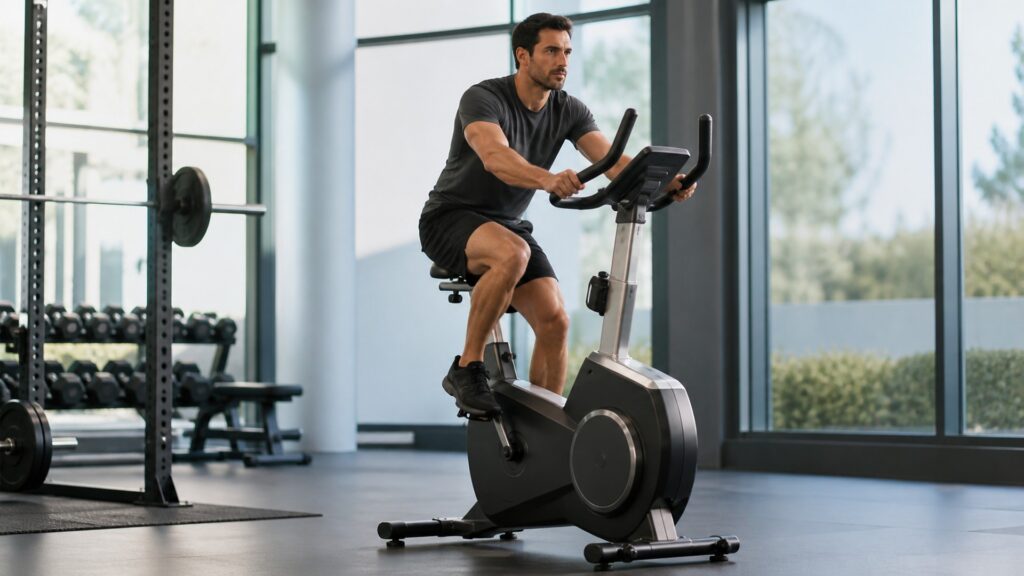
Follow the bike as a machine: force enters at the pedals, moves through the drive train, meets a brake, and appears back to the rider as controlled effort.
Tip: When a product description jumps straight to apps or classes, look back to the crank, flywheel, and brake; those parts explain the bike's basic behavior.
These definitions connect the main idea to the variables, limits, and practical signals readers need to compare options.
The axle area where the crank rotates through the frame.
A belt transfers crank rotation toward the flywheel on many home bikes.
The spinning mass carries motion between pedal pushes.
A non-contact brake that changes load near the flywheel.
A contact surface pressed against the flywheel.
A sensor or calculation that counts pedal revolutions.
Tip: Use the definitions as a mechanical chain: axle, drive, flywheel, brake, contact position, then feedback.
The machine begins at the rider's feet. Each push turns the crank arms around the bottom bracket, and that rotation is transferred toward a flywheel through a belt, chain, or direct-drive arrangement.
This explains the bike's first job: converting leg force into rotation without forward travel.
The workload comes from a brake acting against the flywheel or fan, not from changing the shape of the pedal path. Magnetic, friction, and air systems produce that load in different ways.
The brake method is the main reason two stationary bikes can feel unlike each other at similar effort labels.
Saddle setback, seat height, handlebar reach, and pedal style change the rider's geometry. In a mechanics article, fit matters because it changes how the body meets the crank.
Fit is not a separate comfort chapter; it is part of how the machine receives force.
The console reports time and cadence fairly directly, while distance, calories, resistance level, and watts may rely on model-specific calculations.
A display is most useful when it helps repeat a session on the same bike.
A stationary bike narrows cycling to pedaling against controlled load. That simplicity is useful indoors, but it removes steering, braking skill, road texture, wind, slope changes, and traffic awareness.
The machine works by isolating pedaling; readers should understand both the benefit and the missing pieces.
The drive-train view is strong for understanding feel, controls, and display limits, but it should not be stretched into training promises.
It clarifies why brake type, flywheel behavior, drive tension, and rider geometry shape the feel of an indoor bike.
It helps readers treat console data as machine feedback rather than as universal fitness measurement.
The mechanism does not prove calorie burn, cardiovascular progress, rehabilitation value, or outdoor cycling skill.
Individual fit problems and clinical questions need context beyond a product mechanism explanation.
Common shortcuts and misunderstandings can make the topic seem simpler than it is.
Apps can guide sessions, but the physical ride still comes from crank rotation, drive transfer, flywheel behavior, and braking load.
Magnetic systems avoid pad contact, but calibration, step size, and software control still determine how precise a setting feels.
Flywheel mass can help, yet bearing quality, drive tension, brake tuning, and frame rigidity also shape smoothness.
Stationary-bike distance is simulated from machine assumptions. It can support consistency, but it does not recreate road grade, wind, or handling.
Tip: Treat strong claims as starting points for comparison, not final answers.
Concise answers to common questions readers may have after the main explanation.
The rider turns the crank, and a brake or fan resists the flywheel's motion. That resistance is what makes pedaling feel harder.
Smoothness usually comes from the interaction of flywheel inertia, drive alignment, bearing quality, brake behavior, and consistent rider position.
It is different rather than automatically better. Magnetic systems avoid contact wear, while friction systems can be simple and direct but may need pad care.
Some bikes estimate watts from resistance and cadence. Others use more direct measurement. The method matters before comparing numbers.
Saddle position changes how the rider reaches the crank, so it affects force transfer and stroke feel, not just comfort.
An exercise bike is a compact drive train: rider force turns a crank, the drive spins a flywheel, and a brake controls the load.
Once that sequence is clear, features such as screens, classes, and metric dashboards can be judged without mistaking them for the machine's core mechanism.
Use these Review Streets paths to connect the explainer to related categories, comparisons, and next decisions.
Use this next to focus specifically on the fixed pedal circle and body-position consequences.
Read this to see how the machine's controls organize different kinds of sessions.
Browse bike types after the operating model is clear.
Choose a retailer
Prices checked regularly. We may earn a commission at no cost to you.