
Circular Crank Path
The fixed route the pedal follows around the crank axle.
- It defines the bike's movement shape.
- The foot repeats this route every revolution.
- Resistance does not turn it into a stride.
The movement pattern matters because an exercise bike gives the feet a route before the rider chooses effort. That route is a circular crank path with top and bottom dead-center positions, repeated from a seated setup.
Resistance, apps, and displays can distract from that basic fact. Saddle height, saddle fore-aft, hip angle, knee extension, ankle tracking, and pedal retention all change how the body meets the same circle.
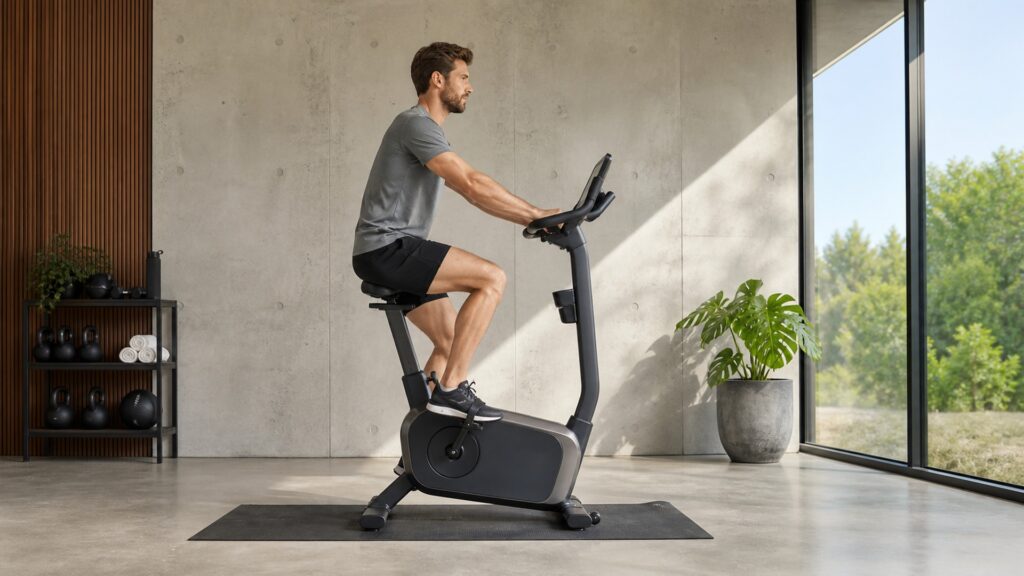
The movement pattern is the fixed geometry that explains fit, feel, comparison, and repetition.
Tip: Before judging intensity, check the shape being repeated: the pedal circle is the movement the rider must live with throughout the session.
These definitions connect the main idea to the variables, limits, and practical signals readers need to compare options.
The fixed route the pedal follows around the crank axle.
The upper point of the pedal circle.
The lowest point of the pedal circle.
The forward-back position of the seat relative to the crank.
A cage, strap, clip, or platform that controls foot placement.
A pedal-forward bike position with back support.
Tip: Separate the pedal circle from resistance; one defines where the foot goes, the other changes how hard it is to keep moving.
The bike's movement pattern is not a loose idea of cardio. It is the path created by crank arms rotating around an axle while the rider remains supported by the frame.
That fixed shape is why movement pattern deserves its own explanation.
The path belongs to the machine, but the body meets it differently depending on saddle height and fore-aft position.
Movement pattern matters because setup changes the body's relationship to a path it cannot freely choose.
Top dead center and bottom dead center help explain why pedaling can feel smooth on one bike and awkward on another. The rider applies force more effectively through some parts of the circle than others.
The circle is simple, but force around the circle is not perfectly uniform.
A bike should not be compared to an elliptical, rower, stair machine, or treadmill only by effort labels. Each machine organizes the body differently.
Movement pattern is the cleanest way to explain why these categories feel different.
The same repeated path helps pacing, but it also repeats any mismatch in reach, saddle position, or foot placement many times.
The bike's repeatability is valuable only when the movement path is workable for the rider.
The pedal-circle model is strong for fit and category comparison, but it is not a medical conclusion.
It shows why small position changes can alter the feel of the same bike.
It clarifies why bikes differ from striding, stepping, rowing, and treadmill movement even when all are used for cardio.
It cannot determine whether a rider should use a bike for pain, rehabilitation, or clinical goals.
It also cannot predict comfort from geometry alone because duration, adjustment range, and individual context matter.
Common shortcuts and misunderstandings can make the topic seem simpler than it is.
Familiar movement can still be mechanically specific. The crank path, seat position, and repeated joint angles shape the entire ride.
Resistance changes force. The feet still follow the crank circle unless the rider changes posture on a bike designed for that use.
They usually keep a circular pedal path, but the body is reclined and the pedals are placed forward, changing support and reach.
The rider matters, but flywheel behavior, drive quality, pedal retention, and fit also affect smoothness.
Tip: Treat strong claims as starting points for comparison, not final answers.
Concise answers to common questions readers may have after the main explanation.
It is a repeated circular pedal path around a crank, usually performed from a seated position with the frame supporting balance.
They name the least direct parts of the pedal circle and help explain why flywheel smoothness and fit can change stroke feel.
It changes how the rider's body meets the fixed path. The crank circle stays the same, but hip and knee angles shift.
An elliptical guides the feet through a standing oval stride, often with handle movement. A bike uses crank-driven circular pedaling from a supported position.
No. It is a major comparison factor, but resistance type, adjustment range, space, and intended use still matter.
The movement pattern of an exercise bike is the repeated circular crank path and the body position built around it.
That pattern explains why setup details matter, why bikes differ from other cardio machines, and why repeatable motion can be both useful and limiting.
Use these Review Streets paths to connect the explainer to related categories, comparisons, and next decisions.
Use this to connect the pedal circle to the drive, flywheel, and brake system.
Read this to apply movement-pattern logic to a bike-versus-rower decision.
Use this when repeated motion and contact points raise equipment-level safety questions.
Choose a retailer
Prices checked regularly. We may earn a commission at no cost to you.