How Heavy Duty Pickup Trucks Work

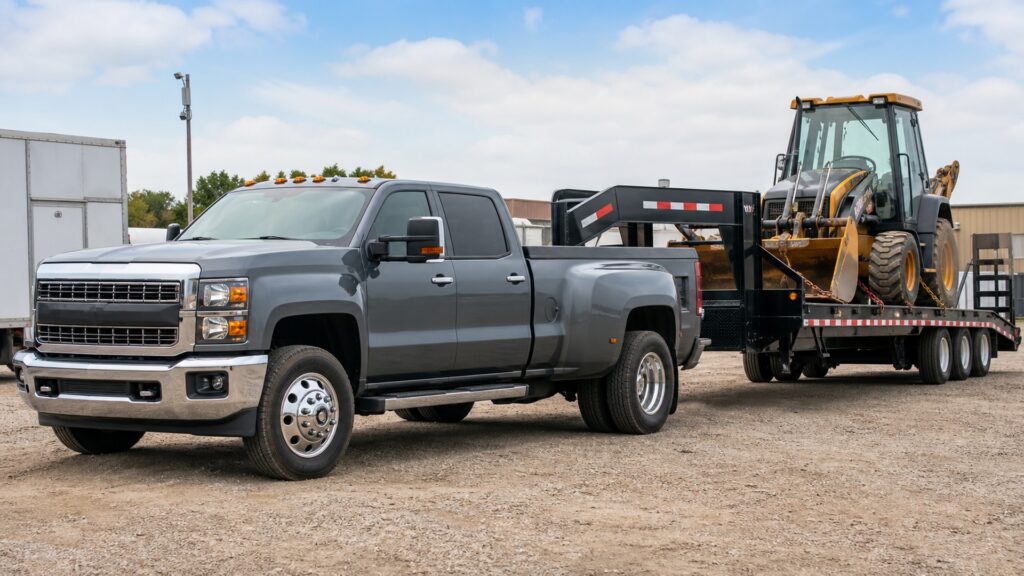
Heavy-duty pickup trucks work by combining a load-bearing chassis with a drivetrain, running gear, cooling system, and towing equipment sized for demanding hauling. The engine and gearing move the vehicle; the frame, suspension, axles, wheels, and tires support it; and the brakes and controls help manage its speed and direction. The useful capability comes from that complete system.

A powerful engine is only one part of the design. Carrying cargo loads the truck itself, while towing also introduces hitch forces and a separate vehicle that must be controlled. Each HD configuration has limits for those tasks, and gasoline or diesel power, cab size, bed length, and other equipment can change the available capability.

By: Review Streets Research Lab
Updated: October 5, 2026
Explainer · 8-12 min read
heavy duty pickup trucks explainer hero image for Review Streets
What You'll Learn

Follow the Load and Power Through an HD Pickup

Understand how the main systems share the work of carrying, pulling, and controlling weight.

  • Trace loads from the bed and hitch to the ground
  • Follow engine power through gearing and axles
  • Understand what cooling contributes during sustained work
  • Separate carrying capacity from towing capability
  • Recognize how braking and trailer controls work together

Tip: Read the ratings for the complete configuration rather than treating engine output as a load limit.

Definitions

Six Systems Behind Heavy-Duty Capability

Each system has a distinct mechanical job and a limit it cannot solve alone.

Load path

A load path is the route through which forces pass from a load into the vehicle and ultimately the ground.

  • Example: bed cargo supported through structure, suspension, axles, wheels, and tires
  • Check: keep the entire support system within its ratings
  • Limit: one stronger component does not establish a higher vehicle rating

Wheel torque

Wheel torque is rotational force delivered at the driven wheels after the drivetrain's gear reductions.

  • Example: a lower gear providing more turning force to start a loaded truck
  • Check: consider transmission and axle gearing alongside engine output
  • Limit: available tire grip and vehicle limits still constrain the task

Axle assembly

An axle assembly supports or locates wheels and, on a driven axle, transmits propulsion forces.

  • Example: a driven rear axle carrying part of the truck and hitch load
  • Check: check actual axle loading against its rating
  • Limit: being under total truck weight does not prove every axle is within its limit

Cooling circuit

A cooling circuit moves heat away from a component and rejects it through appropriate heat exchangers.

  • Example: engine coolant carrying heat to a radiator
  • Check: follow maintenance requirements and watch for abnormal temperatures
  • Limit: cooling equipment does not authorize overload

Hitch load

Hitch load is force the trailer places on the truck through its connection, including downward tongue or pin load.

  • Example: a fifth-wheel trailer adding load in the bed area
  • Check: include downward load in the truck's weight calculation
  • Limit: the full trailer weight is not identical to the load carried at the hitch

Tow/haul mode

Tow/haul mode is a vehicle control setting intended to adapt operation for towing or carrying loads.

  • Example: a transmission holding gears differently under load
  • Check: use the exact vehicle's operating instructions
  • Limit: the setting does not increase rated capacity

Tip: Distinguish the system that makes a task easier from the rating that permits the task.

Supporting Weight

The Load Reaches the Road Through Several Components

In a conventional body-on-frame HD pickup, the frame supports the cab, bed, and major assemblies. Suspension carries the frame above the axles and wheels, while tires transfer forces to the road. Load placement affects how much reaches each axle. Cargo far back or a substantial hitch load can make rear-axle capacity important even before the total vehicle limit is reached.

  • Count occupants and installed equipment as well as cargo.
  • Keep loads secured and appropriately positioned.
  • Check vehicle, axle, and tire limits independently.

The visible bed is only the first part of the support chain.

Moving Weight

The Engine Works Through the Transmission and Axles

The engine produces rotational power, and the transmission selects gear ratios suited to speed and demand. Lower gearing trades rotational speed for greater wheel torque, while the axle gearing provides a further reduction. Driven wheels must still find grip. Four-wheel drive, where fitted, can distribute propulsion to another axle under the conditions the system permits.

  • Compare the engine, transmission, axle ratio, and drive layout together.
  • Follow the manual for four-wheel-drive operating restrictions.
  • Do not equate easy acceleration with a correctly rated load.

Gasoline and diesel engines can both power HD trucks; the suitable choice depends on the particular configuration and work.

Sustained Work

Cooling Lets the Powertrain Keep Doing Its Job

Moving a loaded truck over a long grade produces heat in the engine and other working components. Cooling systems transfer that heat away through coolant, oil, airflow, and the equipment fitted to the vehicle. Their effectiveness depends on condition as well as design. A restricted heat exchanger or unresolved leak can undermine an otherwise suitable truck.

  • Use the specified fluids and maintenance schedule.
  • Investigate abnormal temperature behavior or fluid loss.
  • Follow warning instructions rather than continuing under heavy load.

An HD cooling system supports its intended duty; it does not make temperature warnings optional.

Connecting a Trailer

Towing Adds Load to the Truck and the Combination

A trailer carries much of its weight on its own axles, but it also loads the pickup through the hitch. A conventional receiver and a fifth-wheel or gooseneck connection apply that load through different arrangements. The truck must have a compatible, approved installation and enough remaining carrying capacity for the downward load alongside people and equipment.

  • Use loaded trailer and hitch weights.
  • Check receiver, coupling, vehicle, axle, and combined-weight limits.
  • Confirm the required trailer lighting and brake connections.

A trailer below the advertised towing maximum can still place too much load on the truck.

Controlling Speed

Brakes and Driving Aids Have Different Roles

Service brakes turn motion into heat to slow the vehicle. Compatible trailer brakes help control an equipped trailer, while engine or exhaust braking on suitably equipped trucks can reduce the demand placed on friction brakes during descents. Tow/haul and other controls assist operation within the manufacturer's instructions; they cannot repair worn equipment or compensate for an overloaded combination.

  • Inspect truck and trailer braking systems as required.
  • Allow space for the load, road, weather, and visibility.
  • Use descent and towing aids according to the manual.

Moving a heavy load and bringing it under control are equally necessary parts of the truck's job.

Quick Reality Check

What the HD System Provides

The components work together, but the configuration's limits still define its use.

Where It Helps

Supporting demanding cargo and compatible trailer loads with an appropriately rated chassis and running gear.

Managing sustained work through suitable gearing, cooling, braking, and controls.

What It Does Not Guarantee

Unlimited payload or permission to attach any trailer that physically connects.

Proper condition, correct loading, or suitable operation without inspection and planning.

Common Myths

Misconceptions About How HD Pickups Work

The whole vehicle matters more than a single headline feature.

The engine determines every capacity.

Structure, axles, tires, braking, cooling, equipment, and ratings also matter.

Maximum towing can be added to maximum payload.

Hitch load, people, equipment, and cargo share the truck's limits, and combined-weight limits also apply.

A diesel engine is required for an HD truck.

Gasoline HD configurations also exist. Use the exact truck's ratings and operating needs to compare.

Tow/haul mode raises the vehicle's ratings.

It changes how equipped systems operate, not the permitted load.

Tip: Use the loading label and model-specific towing guide to turn mechanical understanding into a practical check.

FAQ

Questions About HD Pickup Mechanics

Clear answers about supporting, moving, and controlling loads.

What makes the truck heavy-duty?

The complete configuration is engineered and rated for demanding hauling and towing, rather than merely receiving a larger engine.

Why do axle ratings matter separately?

Weight is not always distributed evenly. An axle can reach its limit even when total vehicle weight is acceptable.

Does four-wheel drive increase payload?

Not automatically. It changes the drive arrangement and adds equipment; use the rating for the actual configuration.

Why does towing use carrying capacity?

The trailer applies downward load through the hitch, which the truck must support alongside occupants and cargo.

What is the best first check before loading?

Identify the exact truck's vehicle, axle, tire, hitch, and towing limits, then compare them with the complete loaded setup.

Bottom Line

Heavy-duty pickups work as coordinated systems for supporting, moving, cooling, and controlling substantial loads.

Use the capability of the complete configuration, with every relevant rating and the condition of both truck and trailer accounted for.

Next Steps

Go Deeper or Compare Your Options

Use these Review Streets paths to compare related categories and practical next decisions.

Manufacturer references: Ford Super Duty technical specifications; Ford towing information and model-year guides; Chevrolet towing guides by model. Use the manual and ratings for your own model year and configuration.