
Catch
The compressed start of the rowing stroke.
- The seat is forward.
- The handle is near the flywheel.
- It begins the drive phase.
A rowing machine works by turning a sliding stroke into resistance at a flywheel, water tank, magnetic brake, or hydraulic system. The user begins at the catch, pushes through the drive, finishes with the handle near the body, and returns during recovery.
The machine is a timing system as much as a resistance device. Footplates, seat rail, handle path, chain or strap, damper behavior, stroke rate, and split time all depend on whether the stroke is organized cleanly.
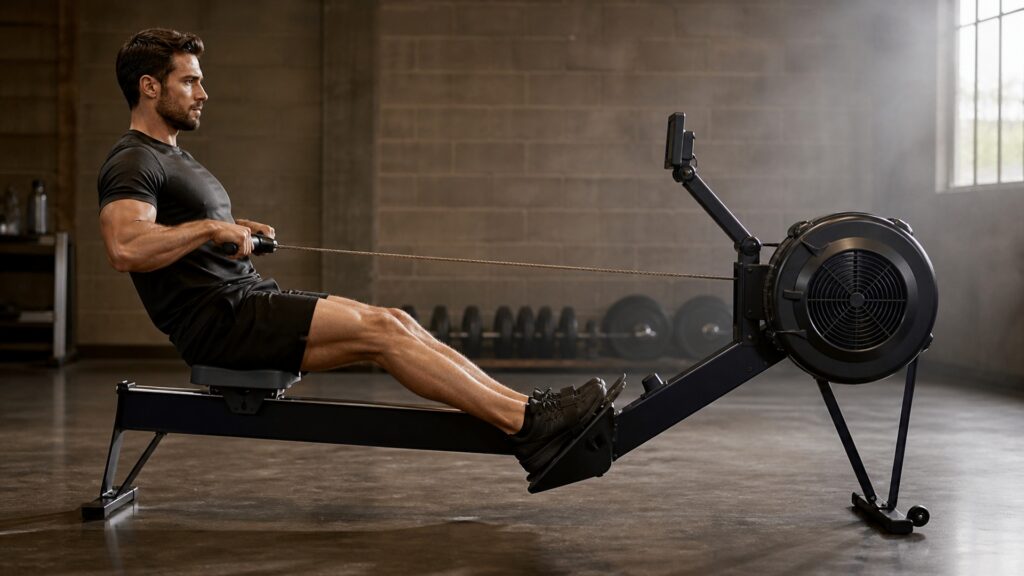
Follow the machine from body sequence to resistance system to monitor output.
Tip: On a rower, the path through time matters: a hard pull with poor sequence is not the same machine input as a controlled stroke.
These definitions connect the main idea to the variables, limits, and practical signals readers need to compare options.
The compressed start of the rowing stroke.
The part of the stroke where the user pushes and pulls.
The return toward the next catch.
The seat that moves along the rail.
The rotating part loaded by air, water, or magnets.
A rowing monitor pace estimate, often shown per 500 meters.
Tip: Read the terms in stroke order: catch, drive, finish, recovery, then monitor feedback.
The rower gives the user a compressed start position, then asks for an ordered drive and a controlled return. The seat, footplates, and handle make the body sequence part of the machine's operation.
The rower's mechanism begins with sequence, not just force.
During the drive, force travels from the feet and seat through the handle to a chain, strap, or cord. That connection spins the flywheel or moves fluid or hydraulic resistance.
The handle is the link between body timing and resistance.
Rowers do not all create load the same way. Air rowers use fan drag, water rowers move paddles through a tank, magnetic rowers use a brake field, and hydraulic rowers use cylinders.
Resistance type changes what the stroke feels like and how settings should be read.
The monitor converts machine behavior into stroke rate, time, distance, watts, calories, or split estimates. Some readings are direct timing; others depend on formulas.
The monitor is useful for repeatability when its assumptions are understood.
Indoor rowing keeps the repeated catch-to-recovery sequence, but it removes boat balance, oar handling, wind, current, and steering.
The machine works by isolating a rowing-like stroke, not by recreating a boat.
The rower mechanism explains feel, timing, resistance behavior, and monitor limits.
It shows why stroke sequence affects output rather than acting as optional technique trivia.
It clarifies why resistance type and monitor formulas change machine feel.
It does not prove calorie burn, injury prevention, rehabilitation value, or water-rowing skill.
Those claims need evidence beyond the mechanical explainer.
Common shortcuts and misunderstandings can make the topic seem simpler than it is.
The pull matters, but the seat, footplates, drive order, and recovery are what make the stroke work.
Damper changes airflow feel on many air rowers; effort still comes from the stroke.
Split is a machine-modeled pace, not actual boat speed on water.
Air, water, magnetic, and hydraulic systems use different mechanisms, so level numbers do not transfer cleanly.
Tip: Treat strong claims as starting points for comparison, not final answers.
Concise answers to common questions readers may have after the main explanation.
The handle system spins or loads a fan, water paddle, magnetically braked wheel, or hydraulic cylinder, depending on the design.
The sliding seat lets the legs change position through the drive and recovery, making body sequence central to the machine.
Stroke rate counts how many complete strokes happen per minute.
It moves paddles through water, but it still does not recreate boat balance, oar handling, current, or steering.
Use caution. Calculations and calibration differ, so numbers are most reliable for comparison on the same machine.
A rowing machine works by coordinating a sliding seat, braced feet, handle pull, resistance system, and monitor model around a repeated stroke sequence.
Understanding that chain makes rowers easier to compare without turning machine data into unsupported outcome claims.
Use these Review Streets paths to connect the explainer to related categories, comparisons, and next decisions.
Use this to go deeper on catch, drive, finish, and recovery.
Read this to connect stroke mechanics with session structure and feedback.
Browse rower types after understanding the mechanism.
Choose a retailer
Prices checked regularly. We may earn a commission at no cost to you.