
Catch Compression
The forward setup position before the drive.
- It prepares the stroke.
- Too much or too little reach changes timing.
- It is not a rest position.
The movement pattern matters because a rowing machine is built around an ordered stroke, not a single continuous push. Catch compression, leg drive, body swing, arm draw, finish position, and controlled recovery determine how the machine receives force.
That sequence makes rowing-machine movement more timing-sensitive than many cardio categories. Seat slide, footplate brace, handle path, stroke rate, and recovery rhythm all shape whether the same resistance system feels smooth or disorganized.
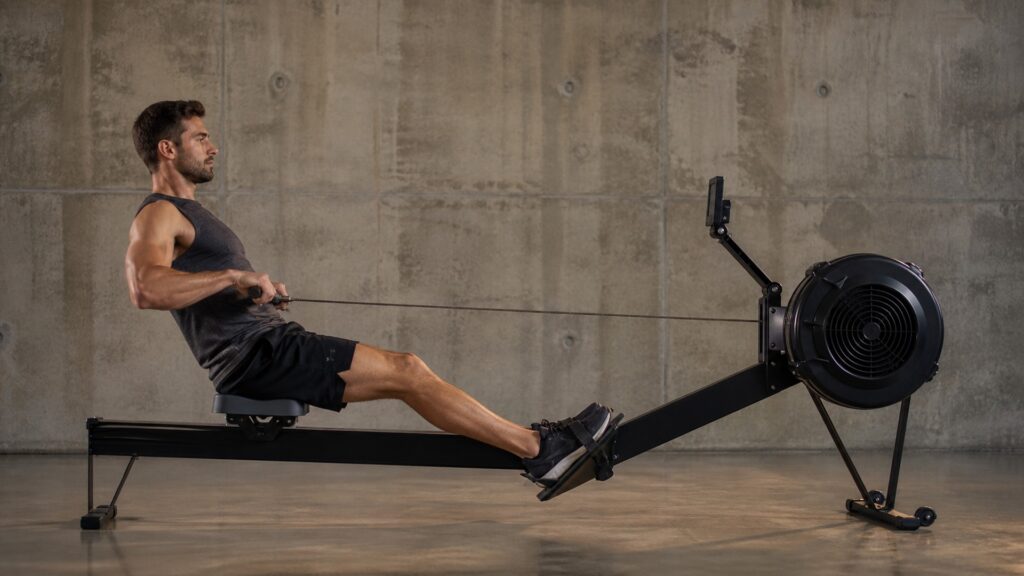
The movement pattern explains rower feel by following the stroke from setup to return.
Tip: On a rower, the return is not empty time; recovery quality decides the next catch.
These definitions connect the main idea to the variables, limits, and practical signals readers need to compare options.
The forward setup position before the drive.
The opening push against the footplates.
The torso movement through the middle of the stroke.
The pull that brings the handle toward the finish.
The return toward the catch.
The route the handle travels through the stroke.
Tip: Use the definitions as a timeline through the stroke rather than a feature list.
Rowing-machine movement is organized as catch, drive, finish, and recovery. Each phase has a job, so skipping the order changes the machine input.
The movement pattern matters because order affects output.
The rower rewards sequence because the legs, torso, and arms contribute at different moments. Treating the stroke as only an arm pull misses the core movement logic.
Distinct body actions make the rower different from simpler repeated motions.
The moving seat and handle path mean body position and timing influence each other. Foot strap position, rail smoothness, and handle height can change how the stroke feels.
Fit is part of movement quality because the body moves through the machine.
Other cardio machines can be useful, but their movement patterns differ. The rower uses a sliding pull sequence rather than seated crank rotation, standing elliptical stride, or repeated stepping.
Movement pattern is the cleanest category boundary.
The rower repeats its stroke many times, so timing habits and setup mismatches can compound. That observation should stay practical, not medical.
Repetition makes the movement pattern consequential without proving health outcomes.
The stroke-sequence model explains timing, feel, category comparison, and common rower misunderstandings.
It shows why rowing is not just pulling against resistance.
It helps readers understand why small timing changes can alter split, smoothness, and perceived control.
It cannot diagnose technique, prescribe training, or evaluate pain.
It also cannot prove one rower is better without model-specific details.
Common shortcuts and misunderstandings can make the topic seem simpler than it is.
The arms finish the drive, but the movement pattern starts with braced feet, seat travel, and leg drive.
Recovery sets position and rhythm for the next catch.
Rate is only frequency. Sequence and force still matter.
Resistance changes load, while the catch-to-recovery sequence defines the pattern.
Tip: Treat strong claims as starting points for comparison, not final answers.
Concise answers to common questions readers may have after the main explanation.
It is a repeated sequence of catch, drive, finish, and recovery using a sliding seat and handle pull.
Changing the order changes how force reaches the machine and how the next stroke is set up.
No. The sliding seat, foot brace, and recovery phase make it a full stroke sequence.
Biking repeats a crank circle; rowing repeats a sliding stroke with phases.
No. It can describe mechanical demands, but pain or injury questions need qualified guidance.
Rowing-machine movement pattern matters because the machine receives force through an ordered stroke rather than a simple repeated push or pull.
Catch, drive, finish, and recovery explain why timing, setup, and comparison with other cardio machines require rower-specific logic.
Use these Review Streets paths to connect the explainer to related categories, comparisons, and next decisions.
Use this to connect the stroke pattern to the resistance system.
Read this to see how stroke pattern affects pacing and drills.
Use this to apply movement-pattern logic to a bike comparison.
Choose a retailer
Prices checked regularly. We may earn a commission at no cost to you.