
Stair Tread
The step surface or moving pedal the user stands on.
- It creates the climbing pattern.
- Travel varies by model.
- It is not a bike pedal.
A stair machine works by giving the user a repeated stepping task in place. Depending on the design, the machine may use rotating stair treads, linked pedals, or compact step platforms to simulate climbing without actual stairs.
The operating logic is upright and mechanical: the feet meet moving steps or pedals, the frame supplies handrail support, controls regulate speed or resistance, and the console translates activity into machine-specific readings.
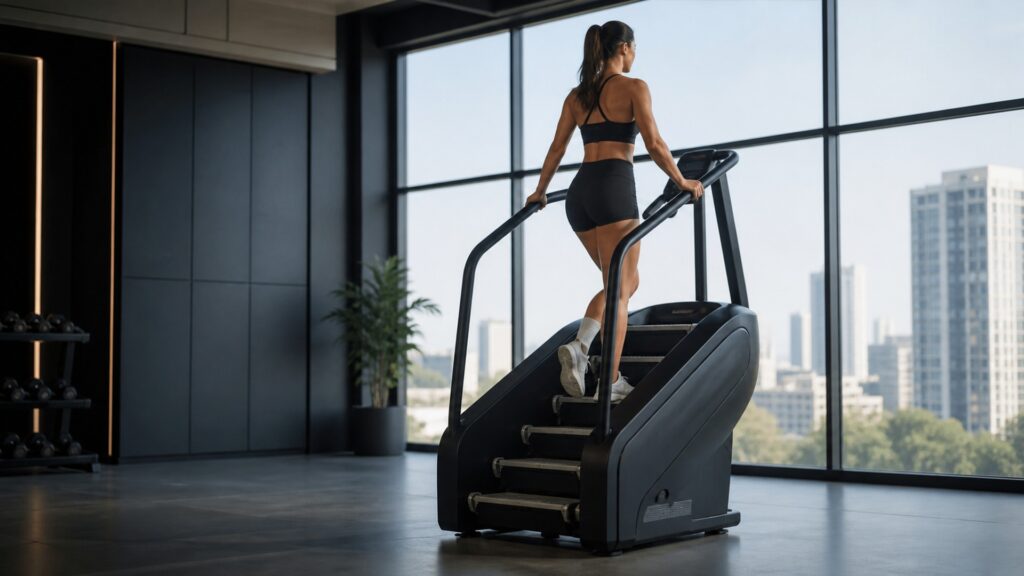
A stair-machine explanation focused on stepping mechanics, support, controls, limits, and practical comparison.
Tip: Keep the explanation tied to the step path and upright support before interpreting intensity labels.
These definitions connect the main idea to the variables, limits, and practical signals readers need to compare options.
The step surface or moving pedal the user stands on.
The vertical travel or perceived lift of each step.
A support point used while stepping.
How quickly steps repeat.
An adjustable foot that helps keep the machine steady.
A machine-specific setting for speed, resistance, or program demand.
Tip: Treat step path, support, and console level as separate ideas.
Stair machines create repeated stepping without requiring the user to travel upward. Rotating stairs, linked pedals, and compact steppers all keep the person in place while the foot path repeats.
The core mechanism is simulated climbing in a fixed location.
The machine controls how quickly or firmly the stepping task repeats. Some designs use powered treads; others use resistance against pedals.
Control method explains why stair machines can feel very different.
Handrails help the user stay positioned while stepping, but they are not equivalent to a rower handle or elliptical arm.
Support is part of the setup, not the machine's main mechanism.
Stair-machine displays may show time, level, step rate, floors, distance, watts, or calories. Some are direct counts; others are estimates.
The display helps repeat sessions on the same machine when its assumptions are understood.
The machine captures repeated stepping, but it removes real stair landings, turns, uneven step dimensions, carrying tasks, and environmental context.
It works by isolating stepping, not by recreating every stair situation.
Stair-machine analysis is strongest when it stays with observable movement, support, controls, and setup.
It explains how repeated stepping differs from other cardio-machine patterns.
It helps readers interpret levels, rails, and footprint without vague effort claims.
It cannot prove calorie burn, medical suitability, or injury prevention.
Those claims need user-specific evidence outside the product explainer.
Common shortcuts and misunderstandings can make the topic seem simpler than it is.
They use repeated steps or pedals, not a moving belt under a walking gait.
Rails are support points; the feet and step mechanism define the category.
Floors are simulated from machine assumptions.
Levels depend on the product's control system.
Tip: Treat strong claims as starting points for comparison, not final answers.
Concise answers to common questions readers may have after the main explanation.
Rotating treads, pedals, or step platforms create a repeated climbing task while the frame stays in place.
No. They simulate repeated stepping but remove landings, turns, varied steps, and environmental conditions.
Level is a product-specific control for speed or resistance, not a universal measurement.
They help with support and access while the feet perform the stepping task.
No. They are estimates and should not be treated as precise personal measurement.
A stair machine works by turning climbing into a repeated indoor step pattern controlled by speed, resistance, support, and display logic.
Understanding those mechanics makes it easier to compare stair machines without relying on generic intensity claims.
Use these Review Streets paths to connect the explainer to related categories, comparisons, and next decisions.
Use this to focus on the repeated stepping pattern itself.
Read this for access, rails, stops, and stability checks.
Browse stair-machine types after the mechanism is clear.
Choose a retailer
Prices checked regularly. We may earn a commission at no cost to you.