
Running Belt
The moving surface under the user's feet.
- It loops around rollers.
- Tension and tracking affect feel.
- It is not road surface.
A treadmill works by moving a belt under the user at a controlled speed. A drive motor turns rollers, the belt loops over a deck, tension and tracking keep the belt aligned, and the console sends speed or incline commands to the machine.
That setup creates indoor walking or running in place, but it is not the same as outdoor terrain. Belt motion, deck cushioning, incline motors, speed sensors, ventilation, and emergency stops explain the treadmill as a machine before any workout claim is made.
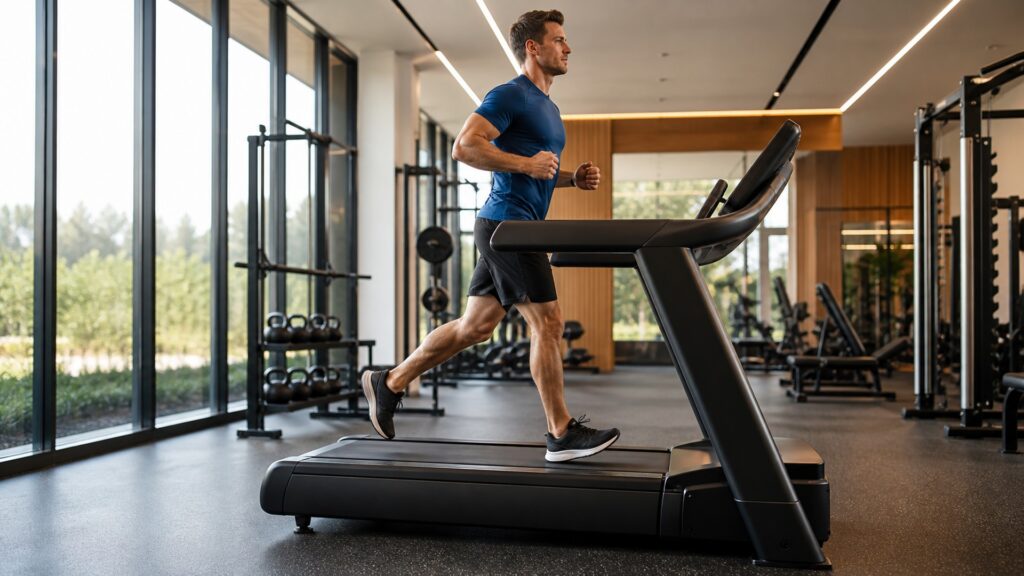
Follow the treadmill from motor command to belt motion, deck support, incline, and feedback.
Tip: Start with the belt path; most treadmill features only make sense after the motor, rollers, and deck are clear.
These definitions connect the main idea to the variables, limits, and practical signals readers need to compare options.
The moving surface under the user's feet.
The motor that turns the belt system on most treadmills.
Cylinders at the front and rear of the belt path.
The platform below the belt.
The mechanism that raises or lowers the deck angle.
A stop control attached to many treadmills.
Tip: Separate belt motion from user gait; the machine controls the surface, not the person's stride.
The treadmill begins with a belt loop moving around front and rear rollers. The drive motor and controller set the belt speed while the deck supports the user's footfalls.
The treadmill's main mechanism is controlled belt motion.
Unlike a manual outdoor surface, the treadmill belt continues according to the machine's speed setting. The user has to match gait to that moving surface.
Speed control is what makes treadmill use mechanically distinct.
Incline changes the deck angle by raising part of the frame. It can simulate slope, but it does not recreate wind, corners, uneven ground, or downhill terrain unless the model supports decline.
Incline is a mechanical deck change with limits.
The deck, belt thickness, roller size, lubrication, and alignment influence noise, feel, and maintenance. These are mechanical factors, not proof of injury prevention.
Contact feel comes from the belt-deck system.
A treadmill can directly control time, speed, and incline, while distance, pace, calories, and workout summaries depend on machine calculations and profile settings.
The console is useful when readers know which numbers are controlled and which are modeled.
The treadmill mechanism explains indoor belt motion, speed control, incline, contact feel, and display limits.
It clarifies why belt tracking, deck support, and motor control affect use.
It helps readers avoid treating console outputs as universal measurements.
It cannot prove injury prevention, calorie burn, running improvement, or medical suitability.
Outdoor running skill and individual gait questions require separate context.
Common shortcuts and misunderstandings can make the topic seem simpler than it is.
It moves a belt over a deck and removes outdoor terrain, turns, wind, and surface variation.
Cushioning changes feel, but injury claims need evidence beyond the deck design.
Incline tilts the deck, but outdoor hills include changing surfaces and environment.
Calories are estimated from formulas and inputs, not directly measured for each person.
Tip: Treat strong claims as starting points for comparison, not final answers.
Concise answers to common questions readers may have after the main explanation.
The belt moves around rollers over a deck, usually driven by a motor.
Tracking keeps the belt centered so it does not rub or drift during use.
Incline raises the deck angle to simulate slope within the machine's limits.
No. It changes surface feel but does not guarantee injury prevention.
It stops or interrupts machine operation when pulled, depending on the model.
A treadmill works by controlling a moving belt over a supported deck while the user matches walking or running gait to that surface.
Motor control, rollers, belt tracking, incline, cushioning, console estimates, and stop features explain the machine without making unsupported health claims.
Use these Review Streets paths to connect the explainer to related categories, comparisons, and next decisions.
Browse treadmill types after understanding the belt, deck, and motor system.
Use this to contrast belt motion with repeated stepping.
Read this to compare treadmill gait with stair-machine stepping.
Choose a retailer
Prices checked regularly. We may earn a commission at no cost to you.