
Arming State
The controller condition in which specified zones, credentials, and timing rules are actively monitored for unauthorized events.
- Entry method can change it
- Doors may need closure
- Indicator feedback confirms transition
A vehicle security system is a state machine built from several protections rather than one alarm. It decides when the vehicle is armed, recognizes authorized credentials, monitors doors or other sensors, evaluates whether a change matches an intrusion condition, and chooses a response. The response may include lights, horn, notifications, logging, or preventing normal powertrain authorization.
Those layers solve different problems. Perimeter switches report openings; interior or tilt sensors observe other changes; an immobilizer checks whether starting is authorized; telematics can send information elsewhere. No single layer makes theft impossible. Dependable security comes from coordinated states, protected credentials, controlled false alarms, honest fault indication, and a documented way for the owner or technician to recover access.
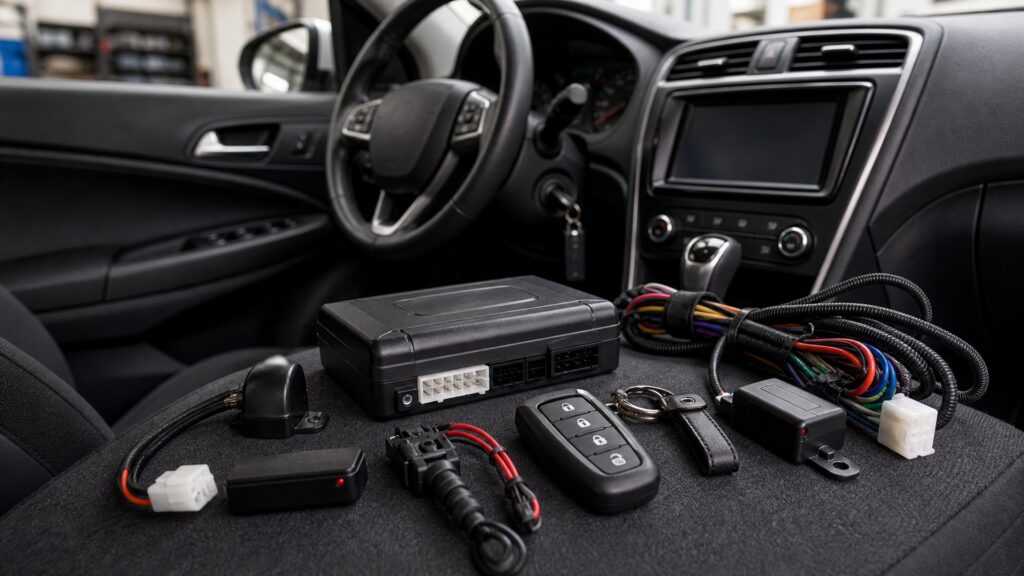
The mechanism links user intent, credential checks, sensor zones, timing rules, alarm outputs, immobilization, remote notification, faults, and authorized disarming.
Tip: For every security feature, identify the protected boundary, the sensor or credential, the decision rule, the output, and the authorized recovery path.
These terms describe separate mechanisms often hidden behind one security indicator.
The controller condition in which specified zones, credentials, and timing rules are actively monitored for unauthorized events.
A recognized physical key, transponder, remote, phone key, code, or cryptographic token permitted to unlock or enable starting.
A monitored boundary such as a door, hood, hatch, trunk, or supported glass opening.
A device that detects supported movement, pressure, glass breakage, interior motion, or another cabin-related change.
An authorization mechanism that prevents normal engine or propulsion enable when a valid credential is not recognized.
The logic that combines state, zone inputs, credentials, delays, exclusions, history, and faults to choose a response.
Tip: Use owner documentation for the exact vehicle because arming, delays, sensor exclusions, and emergency access vary.
Locking method, door and hood status, key location, occupancy features, valet settings, and countdown timing can determine whether the controller arms fully, partially, or not at all. Indicators should make the resulting state visible.
Security begins with an explicit state, not an assumption after pressing lock.
A remote may unlock doors while a transponder, phone key, or other credential authorizes propulsion. Controllers validate supported identity and freshness before releasing locks or immobilizer commands; failure modes may leave one function available and another denied.
Separating the two decisions makes lockouts and theft resistance easier to understand.
Perimeter switches, interior motion, tilt, glass, voltage, or network messages can create events. The controller applies arming delay, entry delay, debounce, sensitivity, exclusions, and sequence logic before declaring an intrusion.
A sensor reading becomes an alarm only after state and rules agree.
Horn and lamps attract attention; logs preserve event context; telematics contacts an account or service; immobilization blocks normal starting authorization. A vehicle can have one layer without the others, and each can fail independently.
Layered response improves resilience without creating certainty of prevention or recovery.
A valid key, remote, phone, code, or service method should disarm specified zones, stop outputs, preserve useful history, and restore permitted starting. Lost credentials, weak batteries, network outages, or faults require documented fallback.
A security design is incomplete without an owner-safe recovery path.
Audible or visual alarms call attention to a detected event; immobilizers control starting authorization. Either may exist without the other, and neither makes theft impossible.
Independent credentials, zones, notifications, logs, and immobilization create multiple hurdles and more diagnostic evidence.
Clear state feedback reduces accidental arming and false-alarm confusion.
Keys can be stolen, vehicles can be towed, sensors can be bypassed, communications can fail, and determined attackers can adapt.
Physical practices, credential protection, updates, and insurance remain part of risk management.
These myths collapse several state and authorization layers into one siren.
The indicator meaning depends on vehicle state and design. It may show arming delay, armed status, immobilizer activity, or a fault; open zones, valet settings, sensor exclusions, or credential presence can alter actual protection.
An audible alarm and a passive immobilizer are separate functions. Some vehicles combine them, while others provide only one layer. Confirm starting authorization behavior from exact owner information rather than assuming the horn controls propulsion.
Locking method, door state, interior occupancy settings, double-lock commands, valet mode, and product design can change monitored zones or sensitivity. Observe arming feedback and test supported entry methods under controlled conditions.
Delivery depends on vehicle power, radio coverage, account state, servers, permissions, and correct contact settings. A message can aid response, but it neither prevents movement nor guarantees location accuracy, police action, or recovery.
Tip: Identify which layer actually acted before diagnosing or relying on it.
These answers clarify armed states, false alarms, key batteries, immobilizers, and safe testing.
Use the exact locking method, close required zones, wait through the specified delay, and observe documented indicators or confirmations. A horn chirp alone may represent locking rather than full sensor and immobilizer readiness.
Misadjusted hood or door switches, interior motion, pets, open windows, tilt changes, weak vehicle batteries, voltage disturbance, water intrusion, vibration, wireless interference, or configuration can trigger supported sensors. Event logs help isolate the zone.
Remote range or button operation may degrade while a passive transponder or emergency key still works, depending on design. Follow owner instructions for backup entry, start procedure, battery replacement, and credential resynchronization.
Try documented authorized credentials and emergency procedures, observe security indicators, protect battery voltage, scan supported modules, and use qualified service information. Avoid repeated random programming attempts or bypass advice that can worsen lockout or security.
Use an authorized owner or service procedure in a controlled location, protect hearing, warn nearby people, keep keys and emergency access available, test one zone at a time, and confirm disarm, logs, faults, and recovery afterward.
Vehicle security systems work by coordinating arming state, credentials, perimeter and intrusion sensors, timing and decision rules, alarm outputs, immobilization, event records, notification, and authorized recovery.
Each layer has a different purpose and failure mode. Verify the exact vehicle's state feedback and emergency procedures, protect credentials, and remember that layered deterrence reduces risk without making theft impossible.
The related explainers show how controller records can support authorized fault isolation and how diagnostic access should be protected.
Trace how an authorized scan retrieves module faults, status, and live evidence without treating codes as a bypass guide.
Control connector, command, credential, electrical, and cybersecurity risks during service access.
Choose a retailer
Prices checked regularly. We may earn a commission at no cost to you.