
Complete Ride System
A bicycle setup that can roll, steer, brake, balance, and carry the rider outdoors.
- It includes more than pedaling.
- It handles route conditions.
- A trainer narrows this system.
Bicycles differ from indoor bike trainers because a bicycle is the whole outdoor ride system, while a trainer is a support device that holds or loads a bicycle indoors.
The bicycle has to steer, brake, balance, roll over surfaces, and carry the rider through space. The trainer mainly changes where and how that same bike can be pedaled.
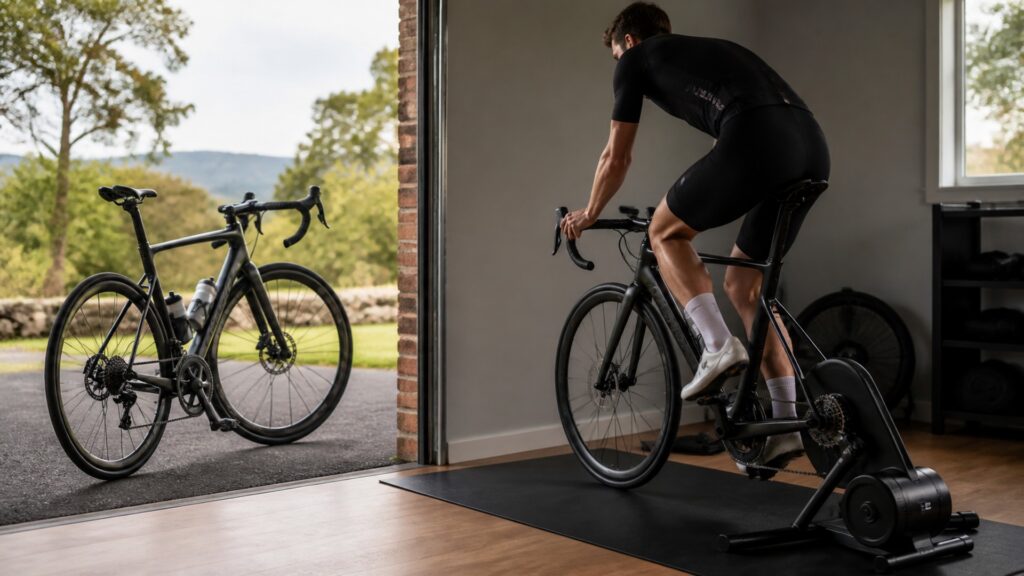
This comparison keeps a complete bicycle separate from a trainer that depends on one.
Tip: Look for dependency: the trainer usually needs a bike, but the bike does not need the trainer to be a bicycle.
These definitions connect the main idea to the variables, limits, and practical signals readers need to compare options.
A bicycle setup that can roll, steer, brake, balance, and carry the rider outdoors.
The axle, cassette, roller, frame, or wheel contact point used by an indoor trainer.
A trainer condition where the rear of the bicycle is held in place.
The trainer part or system that creates pedaling load indoors.
A software-controlled load meant to represent climbing or terrain.
Steering, braking, scanning, line choice, and surface response during outdoor riding.
Tip: Use these terms to separate outdoor ride systems from indoor trainer interfaces and simulated load.
The bicycle includes frame, drivetrain, wheels, brakes, steering, tires, fit, and balance in one outdoor machine.
The bicycle must solve outdoor motion, not just pedaling.
Many indoor trainers require an axle, cassette, wheel contact, or frame interface that matches the bicycle.
Trainer usefulness starts with compatibility.
A trainer can preserve pedaling but usually removes route scanning, cornering, ordinary braking, and road-surface balance.
Indoor training is narrower than riding the bike outside.
A smart trainer can simulate grade or load, but the bicycle outside still faces wind, turns, traffic rules, surface changes, and braking moments.
Indoor metrics are useful but not the same as outdoor control.
Use the bicycle for outdoor transport or outdoor riding practice; use the trainer for controlled indoor pedaling when space, weather, or repeatability matters.
The comparison is about category function.
The comparison explains why trainers support indoor pedaling while bicycles remain complete ride systems.
It clarifies dependency and compatibility.
It separates outdoor control from indoor resistance.
It does not rank workouts by calorie burn.
It does not promise safety or training outcomes.
Common shortcuts and misunderstandings can make the topic seem simpler than it is.
Most trainers are not bicycles; they hold or load a bicycle.
Pedaling can carry over, but steering, braking, balance, and terrain are changed.
It can simulate load, but outdoor routes add surface, wind, line choice, and stopping.
Axles, cassette standards, tire contact, and frame limits can affect compatibility.
Tip: Treat strong claims as starting points for comparison, not final answers.
Concise answers to common questions readers may have after the main explanation.
A bicycle is the ride system; an indoor trainer is a device that supports indoor pedaling with a compatible bike.
It can replace some pedaling sessions, but it does not recreate every outdoor control task.
The trainer must match axle, cassette, tire, frame, or sensor requirements.
They are useful readings, but accuracy depends on the device, setup, and calibration.
When steering, braking, terrain, transport, or outdoor route practice is the point.
Bicycles are complete ride systems; indoor trainers are support devices for controlled indoor pedaling.
The right choice depends on whether the rider needs outdoor control or indoor repeatability.
Use these Review Streets paths to connect the explainer to related categories, comparisons, and next decisions.
Use this for the complete bicycle mechanism.
Read this for the outdoor movement pattern that trainers simplify.
Browse bicycles after clarifying outdoor-versus-indoor use.
Choose a retailer
Prices checked regularly. We may earn a commission at no cost to you.