What Makes Car Stereo Head Units Different from Car Audio Systems

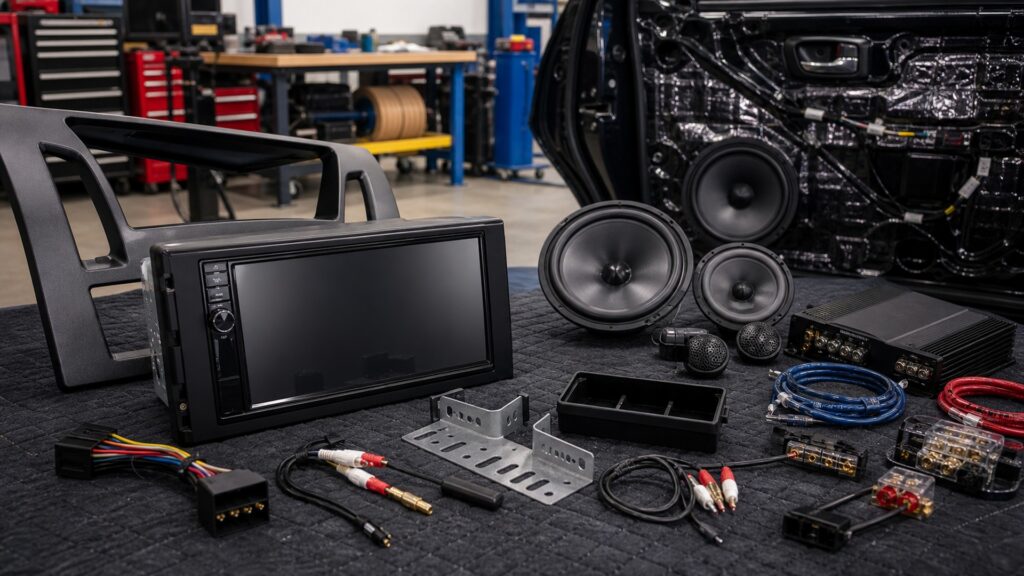
A car stereo head unit is a component: the upstream place where sources, user commands, volume, and selected signal processing converge. A car audio system is the complete installed chain, including any factory interfaces, processors, amplifiers, wiring, speakers, enclosures, mounting conditions, and the cabin that shapes what listeners finally hear.

That scope difference explains why the terms should not be used interchangeably. Replacing a receiver can change connectivity and signal outputs without changing speaker capability or door acoustics. Conversely, adding an amplifier or subwoofer can change acoustic output while leaving the original dashboard controls intact. The correct boundary follows responsibility, not visibility.

By: Review Streets Research Lab
Updated: September 2, 2026
Explainer · 8-12 min read
car stereo head units different from car audio systems explainer hero image for Review Streets
What You'll Learn

Place the Receiver inside the Complete Sound-Producing System

The comparison assigns acquisition, control, power, transduction, and acoustic responsibilities to their actual scope, then uses those boundaries to interpret features and faults.

  • Which functions normally begin at the head unit
  • Where the receiver hands signals downstream
  • Why system power is distributed beyond the dashboard
  • How speakers and enclosures complete electrical conversion
  • Why the cabin belongs to the heard result
  • Where factory interfaces blur component labels
  • How component and system acceptance tests differ

Tip: Draw a boundary around the receiver connectors; anything required after those outputs to create sound belongs to the wider system evaluation.

Definitions

Key Concepts That Define Car Stereo Head Units and Car Audio Systems

These concepts locate the receiver boundary and the downstream work needed before electrical signals become a cabin listening result.

Upstream Control Point

The location where a user selects sources, enters commands, manages ordinary volume, and accesses available receiver settings.

  • It may be physical or screen-based
  • Steering commands can enter remotely
  • Control does not equal power capacity

Preamplifier Handoff

The low-level signal boundary where a receiver feeds an external processor or amplifier.

  • Output voltage affects gain matching
  • Channel count constrains routing
  • Noise can enter at the interface

Distributed Amplification

Power stages located inside or outside the receiver that supply current and voltage to assigned speaker loads.

  • Factory amplifiers may be remote
  • Channels can have different duties
  • Cooling and supply set headroom

Speaker Network

The connected drivers, passive components, wiring, polarity, and crossover assignments reproducing separate frequency bands and locations.

  • Loads must suit the amplifier
  • Polarity affects summation
  • Damage can isolate one band

Enclosure Loading

The acoustic control imposed by a door cavity, dashboard location, sealed box, vented box, or other mounting volume around a driver.

  • Leaks alter low-frequency output
  • Volume must suit the driver
  • Mount rigidity prevents loss and noise

End-to-End Verification

Testing from selected source through every electrical and acoustic handoff to the intended listening positions.

  • Component tests can pass independently
  • Vehicle states can change behavior
  • Acceptance includes retained functions

Tip: Use scope language precisely: a receiver feature can influence the system without performing every downstream function itself.

Receiver Boundary

The Head Unit Owns Acquisition, Command, and Available Outputs

The receiver selects broadcasts or connected devices, decodes supported content, interprets user commands, applies ordinary level control and available processing, then exposes internal speaker channels or preamp outputs. Its job can be tested at those connectors before the rest of the system is judged.

  • Verify each source independently
  • Document control and processing state
  • Measure or monitor clean outputs
  • Identify accessory and integration connectors

The head-unit boundary ends where another device or speaker load receives its output.

System Boundary

The Audio System Continues through Power, Loads, and the Cabin

After the receiver, interfaces may reshape factory signals, amplifiers raise voltage and current, crossovers divide bands, speakers move air, enclosures control radiation, and cabin surfaces alter arrival and response. Those downstream functions determine whether a clean source becomes useful sound.

  • Map every amplifier and channel
  • Record speaker loads and crossover bands
  • Inspect mounting and enclosure conditions
  • Evaluate output at occupied seats

A complete system includes the acoustic environment that a receiver specification cannot describe.

Specification Meaning

The Same Feature Has Different Weight at Each Scope

A receiver's preout voltage or internal power rating describes one interface. System headroom also depends on external supply, amplifier capability, speaker sensitivity and impedance, crossover choices, distortion limits, and acoustic efficiency. Screen features say even less about downstream capability.

  • Tie every rating to its test condition
  • Identify the stage the number describes
  • Avoid adding unlike power figures
  • Compare the measured system bottleneck

Component specifications become meaningful only after their location in the chain is known.

Fault Assignment

Symptoms Upstream and Downstream Require Different Tests

Lost source connectivity, a frozen interface, or absent preout signal can belong to the head unit. One distorted speaker, thermal shutdown, bass cancellation, enclosure noise, or uneven seat response can occur downstream while the receiver works correctly.

  • Reproduce the exact source and channel
  • Check the receiver output boundary
  • Continue through amplification and wiring
  • Separate electrical output from acoustic behavior

The first failed boundary defines the fault scope; the most visible device does not.

Change Management

A Component Swap Can Have System-Wide Consequences

Although narrower in scope, the receiver may host factory chimes, cameras, microphones, settings, data-bus control, or amplifier signals. Replacing it can disturb the wider system, while a downstream upgrade can overload power, change tuning, or expose source limitations.

  • Inventory retained functions before changes
  • Model the new input and load relationships
  • Preserve baseline settings and measurements
  • Retest the complete chain after the component test

Different scope does not mean isolation; every changed interface must still be reverified end to end.

Quick Reality Check

Scope Clarifies Responsibility but Integration Creates Dependencies

The head unit remains a component even when software and vehicle networks make it influential across many systems.

What the Boundary Explains Well

It distinguishes source and control faults from amplification, speaker, enclosure, wiring, and cabin-response problems.

It prevents receiver features or ratings from being treated as complete-system performance claims.

Where Simple Labels Fail

Factory receivers can be integrated with amplifiers, warnings, cameras, climate controls, and networked settings, so their removal may have broad effects.

Some compact systems place amplification inside the receiver, but speakers, mounting, and acoustics still remain outside the dashboard component.

Common Myths

Misconceptions About Car Stereo Head Units and Car Audio Systems

These misconceptions treat component visibility, screen size, or one power rating as a description of the whole sound-producing chain.

The head unit is the car audio system

The receiver can be its upstream control center, but the system also includes integration, amplification, wiring, crossovers, speakers, enclosures, mounting, and cabin acoustics. Those downstream stages can change sound even when the head unit remains untouched.

A premium head unit guarantees premium sound

A receiver may provide clean sources and flexible outputs, yet unsupported amplifier loads, weak speakers, poor mounting, cancellation, rattles, or cabin noise can dominate the result. End-to-end performance cannot be guaranteed by the upstream component.

External amplifiers make the head unit irrelevant

The amplifier still needs a suitable input, source level, channel assignment, volume control, and often a remote command from upstream. A poor or clipped receiver output can limit the system before external power is applied.

Factory audio cannot be a complete system because it uses one screen

The visible receiver may control hidden factory amplifiers, processors, speakers, microphones, and alert paths distributed through the vehicle. One interface can represent a system whose operating components are located elsewhere.

Tip: Locate the specification or symptom before deciding whether it describes the receiver or the complete installed system.

FAQ

Frequently Asked Questions About Car Stereo Head Units and Car Audio Systems

These answers clarify receiver scope, downstream responsibilities, power ratings, fault isolation, and why integration makes a narrow component consequential.

Is a head unit always required for car audio?

A system needs some source and control method, but it may be an original receiver, aftermarket receiver, integrated vehicle computer, phone-connected processor, or another architecture. The functional role matters more than whether one removable dashboard box exists.

Does the head unit power all speakers?

Sometimes its internal amplifier drives speakers directly. Other vehicles use one or more external factory or aftermarket amplifiers, and mixed systems can divide duties. Wiring diagrams and output tests identify where each channel receives power.

Which measurements belong to the complete system?

Seat-position frequency response, maximum clean acoustic output, channel arrival, noise during operation, thermal stability, retained alerts, and shutdown behavior depend on several blocks. Receiver voltage alone cannot establish those end-to-end outcomes.

Can changing speakers improve sound without changing the receiver?

Yes, when the new drivers fit the mounting, load, sensitivity, frequency assignment, and existing amplifier capability. Results still depend on door sealing, polarity, crossover behavior, factory processing, and whether the original source has sufficient clean output.

How do I decide which scope has the fault?

Confirm a known source and inspect the receiver output first. If it is correct, continue through processor, amplifier, wiring, speaker, mounting, and acoustic response. The first missing or corrupted handoff defines the likely responsibility.

Bottom Line

A car stereo head unit is the upstream source-and-control component; a car audio system is the complete distributed chain that produces sound at the seats.

Keep the scopes distinct when reading specifications, diagnosing symptoms, or planning changes. Then respect their dependency: any receiver, amplifier, speaker, enclosure, or integration change requires verification across the interfaces it affects.

Next Steps

Test the Component Boundary against Operation and Project Scope

These explainers show the receiver's internal sequence, the wider system mechanism, and the conditions that justify changing one component or several linked blocks.

How Car Audio Systems Work

Follow the complete information, power, transducer, and cabin path that defines the broader car audio system.

Quick Summary

Car Stereo Head Units and Car Audio Systems Explained

  • The receiver boundary ends at its outputs and attached interfaces.
  • The system continues through power, speakers, enclosures, and the cabin.
  • A component rating describes only its own stage and test conditions.
  • The first failed handoff assigns diagnostic scope.
  • Narrow components can still have wide integration consequences.