When to Use Car Audio Systems Instead of Car Stereo Head Units

Choose a car audio system project instead of a head-unit replacement when the missing result lies beyond source selection and dashboard control. Weak output, limited bass extension, poor speaker coverage, unsafe clipping, factory-amplifier constraints, damaged drivers, or acoustic leakage usually involve several downstream blocks that a new receiver cannot repair by itself.

Choose the narrower head-unit scope when the primary need is a compatible media source, radio reception, phone integration, interface, preamp connection, or supported control feature and the existing amplifier, speakers, wiring, and cabin response already meet the goal. The decision starts with the failed function, not the size of the screen or the visibility of the dashboard component.

By: Review Streets Research Lab
Updated: September 2, 2026
Explainer · 8-12 min read
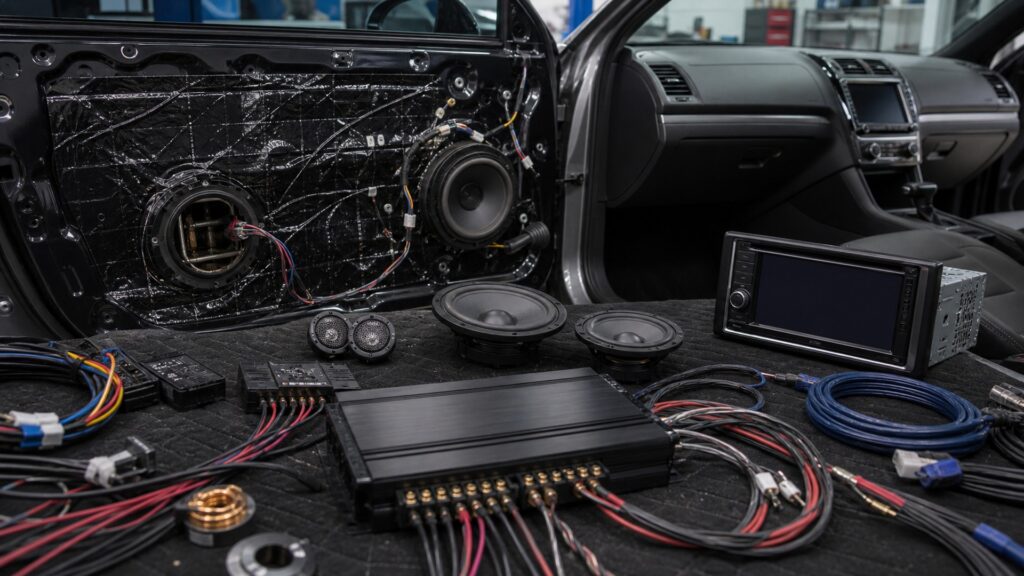
car audio systems instead of car stereo head units explainer hero image for Review Streets
What You'll Learn

Choose Scope by the First Proven Bottleneck

The article separates receiver-level needs from distributed audio limitations, then tests the integration, budget, installation, and verification conditions that can change the answer.

  • Which problems belong upstream at the head unit
  • Which symptoms point to amplification or speaker limits
  • Why bass goals often require enclosure work
  • How factory processing changes system scope
  • When a receiver upgrade is sufficient
  • Why retained vehicle features affect both choices
  • What evidence closes the scope decision

Tip: Bypass or measure one downstream block before enlarging the project; the first demonstrated limit defines the smallest credible scope.

Definitions

Key Concepts That Define Car Audio Systems Instead of Car Stereo Head Units

These terms identify where a complaint sits relative to the head unit and the rest of the source-to-seat chain.

System Bottleneck

The first component, interface, setting, load, or acoustic condition that prevents the requested output while earlier stages remain adequate.

  • Evidence precedes replacement
  • Several symptoms can share one cause
  • The bottleneck can move after an upgrade

Head-Unit Function

Source selection, decoding, user control, volume management, and available signal outputs located in the dashboard receiver.

  • Some units include internal amplification
  • Features vary by vehicle integration
  • It is only the upstream boundary

External Amplification

A separate power stage that accepts a source or processor signal and drives speakers with supported voltage and current.

  • Needs protected power wiring
  • Load and cooling set limits
  • Gain must match the input

Speaker-Acoustic Interface

The combined effect of driver capability, mounting, enclosure, door sealing, polarity, position, and cabin reflections.

  • Electrical output is not the final result
  • Leaks can reduce bass
  • Placement changes response

Factory Processing

Equalization, crossovers, delay, volume behavior, or channel shaping applied by original vehicle electronics.

  • Outputs may be band-limited
  • Processing can vary with volume
  • Integration may require summing or correction

Scope Acceptance Test

A before-and-after measurement or repeatable listening task tied to the stated goal rather than to equipment count.

  • Use identical source material
  • Record listening position
  • Confirm retained functions too

Tip: Do not call a system-level project 'better' by default; use these boundaries to select the least scope that resolves the proven need.

Source-Level Need

Use the Head-Unit Scope When the Missing Function Is Upstream

A receiver replacement is the focused choice when the existing playback chain is acceptable but lacks a supported tuner, media input, phone connection, control layout, preamp output, or integration feature. Confirm that the desired function actually belongs to the candidate unit and vehicle interface.

  • List the exact missing source or control
  • Verify phone and media compatibility
  • Confirm required preamp and accessory outputs
  • Test the existing downstream chain separately

Do not expand to speakers and amplifiers merely because the dashboard is already open.

Output-Level Need

Use a System Scope for Headroom, Coverage, or Driver Limitations

If the clean signal is adequate at the receiver output but the system clips, enters protection, lacks channel coverage, or reaches speaker excursion limits before the required listening result, the bottleneck lies in amplification, loading, drivers, wiring, or power delivery.

  • Measure clean output before the amplifier
  • Identify the channel that reaches its limit
  • Match amplifier capability to actual load
  • Protect speakers with suitable crossover bands

A new head unit cannot create downstream thermal capacity or repair a damaged voice coil.

Low-Frequency Goal

Bass Extension Usually Requires an Enclosure and Integration Plan

Deep bass output depends on a suitable driver, enclosure alignment, mounting, power, crossover, level, polarity, and cabin coupling. A receiver's equalizer or bass control cannot substitute for displacement or repair cancellation and air leakage.

  • Define extension and output separately
  • Choose an enclosure the driver supports
  • Plan protected power and secure mounting
  • Blend phase, level, and crossover at the seats

Bass is a system decision when the physical acoustic hardware is the limiting stage.

Factory Architecture

Complex Original Processing Can Make Either Choice Larger

A factory amplifier, active crossover, data-bus volume control, alert path, or processed speaker output can prevent a simple receiver swap and can also complicate a full system. The correct interface strategy follows the exact vehicle trim and retained functions.

  • Identify the original signal topology
  • Determine where volume and crossovers occur
  • Inventory chimes, microphones, cameras, and controls
  • Select integration before purchasing endpoints

Factory complexity is not automatically a reason to retain or replace everything; it is a mapping requirement.

Decision Gate

Select the Smallest Scope That Passes the Stated Test

Compare the requested source, usability, clean-output, frequency, coverage, and retained-function goals with measured system behavior. A head-unit project passes only if downstream capability is sufficient; a system project earns its scope only when it addresses a demonstrated downstream or integration limit.

  • Write the acceptance criteria first
  • Preserve a pre-change baseline
  • Estimate installation and recovery work
  • Verify every changed block after completion

Scope is justified by resolved functions and preserved vehicle behavior, not by the number of new boxes.

Quick Reality Check

A System Project Is Broader, Not Automatically Better

More components can solve distributed limitations, but they also add interfaces, tuning work, power demand, mounting obligations, and failure points.

When Broader Scope Is Defensible

Measured amplifier, speaker, routing, bass, or acoustic limitations prevent the current chain from meeting a defined clean-output goal.

The plan assigns every new component a necessary function and includes protected power, secure installation, integration, tuning, and verification.

When the Narrower Choice Wins

The complaint is primarily source compatibility or control, while the existing downstream system already delivers adequate clean sound and retained functions.

A factory system is deeply integrated and the requested benefit can be achieved through a supported receiver-level or interface-level change with less disruption.

Common Myths

Misconceptions About Car Audio Systems Instead of Car Stereo Head Units

These myths confuse a broad equipment category with a guaranteed improvement or assume the dashboard component controls every audible result.

A full car audio system always sounds better than a new head unit

Broader scope can address more limitations, but mismatched loads, weak installation, poor crossover choices, bad mounting, or careless tuning can reduce performance. Improvement depends on solving documented bottlenecks while preserving safe operation and vehicle functions.

A head unit cannot improve sound quality

A receiver can matter when the old source clips early, has noisy outputs, applies unwanted processing, lacks suitable crossovers, or provides poor integration. Its benefit stops where downstream amplifier, speaker, wiring, or acoustic limits begin.

More amplifier power proves a system-level project is needed

Power is relevant only when clean-output demand exceeds present capability and the speakers, wiring, electrical supply, cooling, and installation can support the change. Cancellation, rattles, or band-limited factory signals require different remedies.

Replacing the factory radio is the first step in every audio upgrade

Some vehicles integrate warnings, cameras, climate, settings, microphones, or amplified data-controlled signals into the original receiver. A processor, interface, speaker, or enclosure project may meet the goal with less functional disruption.

Tip: Demand one observed limit and one acceptance test for every proposed expansion beyond the head-unit scope.

FAQ

Frequently Asked Questions About Car Audio Systems Instead of Car Stereo Head Units

These answers help define the smallest project that can solve a verified source, power, speaker, bass, acoustic, or integration problem.

What counts as a car audio system project?

It changes multiple linked blocks or a distributed downstream block such as processing, external amplification, speaker channels, subwoofer enclosure, wiring, power delivery, mounting, or acoustic treatment. The defining feature is system scope, not a particular brand.

When is a head-unit-only upgrade enough?

It can be enough when the goal is supported source access, phone integration, controls, radio reception, camera display, or cleaner preamp connection and tests show the existing amplifier, speakers, wiring, and acoustic output already satisfy requirements.

Can speakers be upgraded without changing the head unit?

Often, but suitability depends on factory power, equalization, crossovers, impedance, mounting depth, connectors, sensitivity, and retained diagnostics. Verify the original output and intended speaker load before assuming a physical fit will perform correctly.

Why can factory processing complicate a full system?

The original amplifier may divide frequency bands, shape response, vary equalization with volume, or carry alerts. Integration may require compatible interfaces, channel summing, correction, or a different signal pickup point before downstream components receive usable inputs.

How should I define success before choosing scope?

Specify source behavior, control usability, clean listening level, frequency coverage, seat-to-seat balance, bass extension, noise, retained vehicle functions, cargo space, and shutdown behavior. Then choose the least intervention that can pass those tests.

Bottom Line

Use a car audio system scope when the proven bottleneck lies in distributed processing, power, speakers, bass hardware, wiring, installation, or cabin acoustics.

Use a head-unit scope when the need is upstream and the downstream chain already meets the goal. Map factory integration first, define acceptance criteria, and reject added components that have no necessary operating job.

Next Steps

Compare Scope, Mechanism, and Dashboard Function

These explainers develop the full audio chain, contrast it with the head unit, and show how the receiver itself performs its narrower upstream jobs.

How Car Audio Systems Work

Follow the complete source-to-seat mechanism before deciding which blocks the proposed system project must change.

How Car Stereo Head Units Work

See how a head unit acquires sources, processes controls, prepares audio outputs, and exchanges signals with vehicle interfaces.

Quick Summary

Car Audio Systems Instead of Car Stereo Head Units Explained

  • The first proven bottleneck determines project scope.
  • Source and control needs often remain at the head unit.
  • Power, speakers, enclosure, and acoustics require system-level work.
  • Factory processing can complicate either path.
  • Choose the least scope that passes written acceptance tests.