
Cargo body
A cargo body encloses space intended mainly for goods or equipment.
- Example: a van compartment with rear and side loading doors
- Check: the actual loading openings and interior
- Limit: it does not identify the propulsion system
Commercial electric vehicle describes work use and an electric powertrain. Cargo van describes an enclosed body intended mainly for goods or working equipment. These are not mutually exclusive: an electric cargo van combines both. Other commercial EVs may use passenger, truck, or specialized bodies that serve different jobs.
The useful distinction is between the load-carrying arrangement and the systems that move and replenish the vehicle. Inspect cargo access, usable space, and loading limits on one side; inspect propulsion, charging, and service requirements on the other. Neither description supplies the missing details of the other.
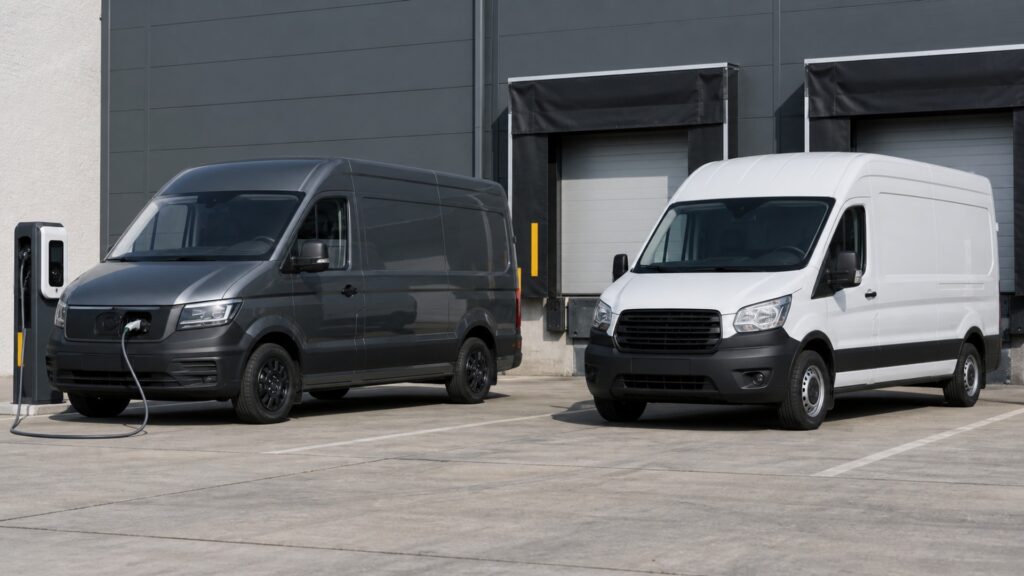
Understand which specifications belong to the body and which belong to the powertrain.
Tip: Compare exact completed vehicles, including body options and installed equipment.
Each attribute answers a different inspection question.
A cargo body encloses space intended mainly for goods or equipment.
An electric powertrain uses an electric motor or motors to produce driving force.
Usable cargo space is the area available for the intended load after accounting for shape and installed equipment.
Payload allowance concerns the mass the vehicle can carry within its applicable limits.
Energy replenishment restores the energy available for the next assignment.
Auxiliary equipment supports work beyond moving the vehicle itself.
Tip: A good body match and a good energy match are separate findings.
The categories overlap because they describe different features. Mercedes-Benz’s eSprinter is an example of an electric vehicle offered as a cargo van. That does not make every electric commercial vehicle a cargo van, or every cargo van electric. Identify the body and propulsion separately before comparing candidates or interpreting an advertisement.
For cargo work, the appropriate comparison normally starts with vehicles that can accommodate the same goods and equipment.
Reference: Mercedes-Benz eSprinter cargo vehicle.
Measure the goods and trace their loading path through the vehicle. Account for doors, wheel housings, shelves, partitions, and tie-down arrangements. Two vehicles that look similar outside can offer different usable layouts. A tall cabinet may fit once inside but fail to pass through the intended doorway, while shelving can reduce the width available for a bulky delivery.
Electric propulsion does not answer these dimensional questions; the cargo configuration does.
Assess the completed vehicle with occupants, permanent equipment, and the intended load. Use its actual loading information and relevant axle limits rather than a maximum figure for another configuration. Do not assume all electric cargo vans carry less or more than all conventional vans. The result depends on the particular vehicles being compared.
Ford’s loading guidance explains why the mass of the actual loaded vehicle matters. A lightly filled compartment can still contain a heavy load.
Reference: Ford vehicle loading guidance.
A battery-electric cargo van stores propulsion energy in its traction battery and replenishes it through suitable charging. A conventional van uses its applicable fuel arrangement. This changes the support needed between assignments even when the cargo body serves the same job. Parking location and available charging time therefore belong in the electric candidate’s operating assessment.
A plug-in hybrid has another energy arrangement because it retains an engine; it should not be treated as a battery-only vehicle without checking its exact operation.
Battery-electric drive removes certain engine-related tasks but leaves other vehicle systems and equipment needing care. Added working equipment must suit the exact vehicle’s attachments and supported electrical interfaces. A shelving or power package that worked in a conventional model is not automatically approved for an electric version with similar bodywork.
The Department of Energy distinguishes the reduced routine maintenance of all-electric vehicles from the engine-related needs retained by hybrids.
Reference: Department of Energy EV maintenance comparison.
An electric cargo van needs satisfactory answers to both.
Can the intended load pass through the doors and fit the working interior?
Can its mass be carried within the applicable limits?
Can the energy and charging arrangement support the assignment?
Are service and equipment interfaces appropriate to this vehicle?
Avoid inferring specifications from a category name.
Electric cargo vans belong to both descriptions.
Check the exact configured vehicles and loading limits.
Body volume and propulsion describe different characteristics.
The equipment needs a supported and compatible supply arrangement.
Tip: Keep measurements, ratings, and compatibility evidence tied to the actual vehicle.
Clarify the design and operating distinction.
Yes. That combination provides an enclosed cargo body with a battery-electric powertrain.
Not simply because it carries goods. Its actual body design determines whether it is a van or another vehicle form.
Use the exact completed vehicle’s relevant total and axle limits, including people and permanent equipment.
The cargo requirements remain, while energy replenishment, service support, and equipment compatibility need assessment for the electric candidate.
The one whose body, load capacity, energy arrangement, and support can deliver that specific service.
Cargo van identifies an enclosed load-carrying body; commercial electric vehicle identifies electric propulsion used for work.
Evaluate their overlap through exact body specifications, loading limits, energy support, and equipment compatibility.
Use these Review Streets paths to compare related categories and practical next decisions.
Apply the distinction to a replacement decision.
Check equipment compatibility on the exact vehicle.
See a manufacturer example of an electric cargo van.
Choose a retailer
Prices checked regularly. We may earn a commission at no cost to you.