Why Commercial Electric Vehicles Fitment Matters

Equipment fitted to a commercial electric vehicle must suit the exact vehicle’s structure, electrical interfaces, load limits, and service needs. An apparently simple shelf, floor attachment, or powered accessory can interact with systems that are not visible from the cargo compartment. Similar exterior dimensions to a conventional vehicle do not prove that the same installation method is appropriate.

EV fitment is therefore a completed-vehicle decision. Confirm the permitted attachments, supported power supply, installed mass, access, and effect on the intended duty. Use model-specific manufacturer information and qualified installers rather than transferring an old installation on appearance alone.

By: Review Streets Research Lab
Updated: October 6, 2026
Explainer · 8-12 min read
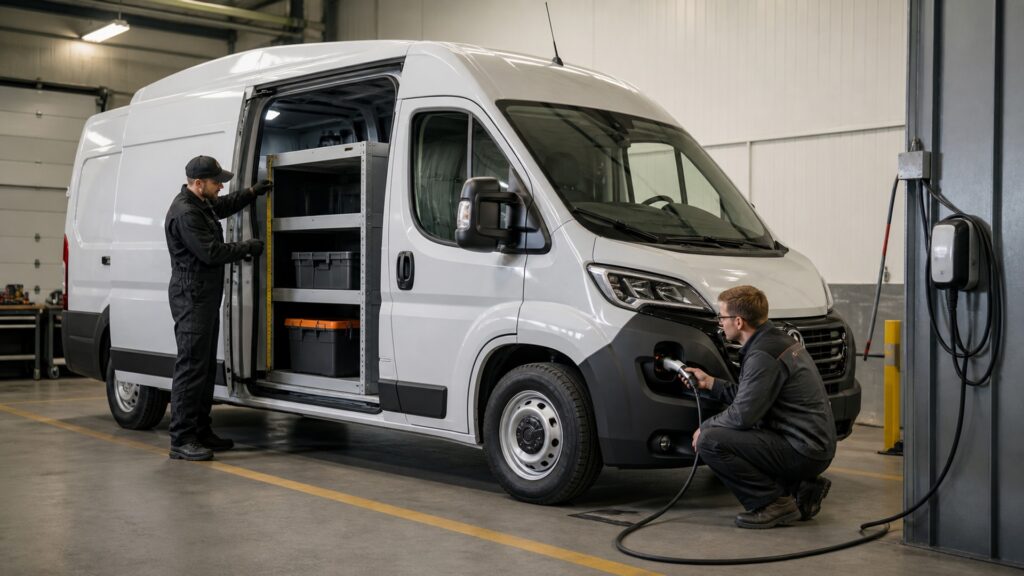
commercial electric vehicles explainer hero image for Review Streets
What You'll Learn

Check the Equipment Against the Exact EV

Include the systems beneath and around the working body.

  • Why model, year, battery version, and body configuration matter
  • How protected areas affect attachment decisions
  • Why a large traction battery is not an unrestricted accessory supply
  • How equipment adds mass and may add energy demand
  • What should be checked and documented at handover

Tip: Give the installer the exact vehicle configuration and intended equipment use before selecting an installation package.

Definitions

Six Fitment Concepts for Commercial EVs

Each check addresses a different part of compatibility.

Exact EV configuration

Exact EV configuration identifies the vehicle variant relevant to an installation.

  • Example: a particular model year, body length, and battery version
  • Check: vehicle identity and applicable manufacturer documentation
  • Limit: a shared badge does not establish identical installation requirements

Protected mounting area

A protected mounting area is a region where manufacturer restrictions limit attachment or modification.

  • Example: a floor area above protected battery components
  • Check: the applicable body-builder instructions
  • Limit: empty-looking interior space does not show what lies underneath

Auxiliary power interface

An auxiliary power interface is a supported connection for specified added equipment.

  • Example: a manufacturer-supported connection for working equipment
  • Check: its ratings, controls, and installation requirements
  • Limit: traction battery capacity does not authorize a direct connection

Installed mass

Installed mass is the weight added by the completed equipment package.

  • Example: shelves, brackets, tools, and a powered unit
  • Check: the completed vehicle’s relevant weight and axle limits
  • Limit: a remaining empty shelf does not establish spare payload

Service clearance

Service clearance is space required to inspect, maintain, or access vehicle and equipment components.

  • Example: access needed around a service point after cabinetry is fitted
  • Check: the vehicle and equipment service requirements
  • Limit: a neat installation may still obstruct necessary access

Installation acceptance

Installation acceptance confirms the completed vehicle meets the agreed requirements before use.

  • Example: documented functional checks and operating instructions at handover
  • Check: the actual installed combination and unresolved restrictions
  • Limit: delivery of equipment is not proof of completed compatibility

Tip: Separate physical space, structural attachment, electrical support, and operational suitability.

Configuration

Start with the Vehicle’s EV-Specific Documentation

Confirm model year, body, battery or powertrain variant, and relevant options. Use the applicable manufacturer body and equipment guidance together with the accessory maker’s instructions. Ask the installer to identify which requirements differ from a conventional version. If equipment is being transferred, reassess the receiving vehicle instead of assuming the old approval transfers with the hardware.

  • Record the exact vehicle and equipment variants.
  • Use the appropriate model-year and market documentation.
  • Resolve compatibility before ordering repeated installations.

Manufacturer body-builder libraries, such as GM’s, organize information by vehicle and year. Broad category descriptions are insufficient for an installation decision.

Reference: GM body-builder manual library.

Attachments

Respect Battery and Underbody Protection Requirements

A floor or body panel may sit near battery components, wiring, cooling systems, or structural protection. The installer must establish where and how equipment may be attached using the manufacturer’s requirements. Do not treat unused floor space as permission to drill or weld. Fitment review also needs to preserve required clearances around protected components.

  • Have permitted attachments confirmed from the correct documentation.
  • Keep protected components and required clearances unobstructed.
  • Use qualified installation support for unresolved questions.

Mercedes-Benz’s eSprinter supplemental body guidance restricts modifications around the high-voltage battery and its mounts. This model-specific example illustrates why the applicable manufacturer instructions must be checked rather than copied to another vehicle.

Reference: Mercedes-Benz eSprinter supplemental body guidance.

Electrical support

Use the Approved Power Interface for the Equipment

Specify what the accessory needs to do, when it operates, and which supported supply it will use. The traction battery is part of an engineered high-voltage system, not an unrestricted connection point. Confirm the interface, controls, limits, and installer competence appropriate to the task. Similar plugs or a large battery capacity do not establish accessory compatibility.

  • Describe the equipment’s power and control requirements.
  • Confirm the manufacturer-supported connection arrangement.
  • Keep high-voltage work within qualified service responsibilities.

Ford’s available upfit integration systems illustrate supported vehicle interfaces, while NHTSA emphasizes specialized training for high-voltage work. Neither implies that every EV has the same accessory provisions.

Reference: Ford supported upfit integration overview, NHTSA EV service guidance.

Completed duty

Review Both Added Weight and Operating Demand

Include equipment and its mountings in the completed vehicle’s loading assessment, together with people and carried goods. Check relevant total and axle limits. If the equipment draws from the vehicle’s energy supply, assess that demand during the actual duty, including stationary work. Also review access, loading paths, overall dimensions, and service clearances.

  • Assess mass and placement after installation.
  • Include applicable auxiliary energy demand in the route plan.
  • Check operating and service access, not only stowed fit.

An electrically powered refrigeration arrangement may require both a load assessment and a duty-energy assessment. Passing one does not answer the other.

Reference: Ford vehicle loading guidance, DOE fleet EV auxiliary-load considerations.

Handover

Accept the Vehicle as an Installed Combination

Agree on required checks before the installation begins and retain evidence of the completed work. Record the equipment, supported operating conditions, limits, and maintenance instructions. Make changes visible to those assigning and using the vehicle. Before repeating the package elsewhere in the fleet, confirm the next vehicle shares the relevant configuration.

  • Record the accepted vehicle and equipment combination.
  • Provide users with the required operating instructions.
  • Reassess after changes to the vehicle or equipment.

A well-documented installation gives the next owner, technician, or fleet manager a basis for evaluating future repairs and transfers.

Quick Reality Check

Cargo-Space Fit and EV-System Compatibility

Both must be established before the vehicle returns to work.

Visible placement

The equipment fits through the doors and within the working space.

Its moving parts can operate in the intended arrangement.

System compatibility

Mounting, electrical supply, protected areas, and load limits are respected.

Service access, operating demand, and required documentation are addressed.

Common Myths

Misconceptions About Commercial EV Fitment

A familiar body shape does not establish installation approval.

A conventional-van installation always transfers to its electric version

Check the receiving EV’s exact structure, systems, and instructions.

An unused floor area is safe to modify

Components and protected areas may lie beneath it.

A large traction battery can supply any accessory directly

Use only supported interfaces and appropriate qualified installation.

Equipment fitment ends when the hardware is attached

The completed load, functions, access, instructions, and acceptance checks remain important.

Tip: Standardize only combinations whose compatibility has been established and documented.

FAQ

Questions About Fitting Equipment to Commercial EVs

Answers before adding or transferring working equipment.

What should be identified before ordering an upfit?

The exact vehicle configuration, equipment variant, intended use, and representative load.

Can existing floor holes be reused automatically?

No. Their suitability for the new equipment and vehicle must be established through the applicable installation requirements.

Does adding equipment affect the route plan?

It may add mass and, if powered by the vehicle, energy demand. Assess the completed duty.

Who should resolve high-voltage compatibility questions?

The manufacturer or appropriately qualified vehicle and equipment specialists, using the correct technical information.

What should the fleet retain after handover?

The accepted configuration, installation and verification records, relevant limits, and operating and maintenance instructions.

Bottom Line

Commercial EV fitment requires the installed equipment to respect the exact vehicle’s attachments, electrical interfaces, protected systems, and operating limits.

Verify the completed combination and preserve its documentation before repeating or transferring the installation.

Next Steps

Go Deeper or Compare Your Options

Use these Review Streets paths to compare related categories and practical next decisions.