
Commercial use
Commercial use is vehicle use in support of an organization’s work or service.
- Example: a company shuttle carrying staff
- Check: the actual assignment and applicable requirements
- Limit: the label does not identify a body style
Commercial electric vehicles and passenger vans describe different attributes. Commercial use concerns the work a vehicle performs, electric propulsion concerns how it moves, and a passenger-van body concerns how it accommodates people. A battery-electric shuttle van can satisfy all three descriptions. An electric delivery truck, however, does not become suitable for a group journey merely because it is commercial and electric.
For passenger transport, assess the occupied cabin and the energy arrangement separately, then bring them together. The vehicle needs the appropriate seats, restraints, access, and baggage accommodation, while its battery and charging plan need to support the actual passenger service.
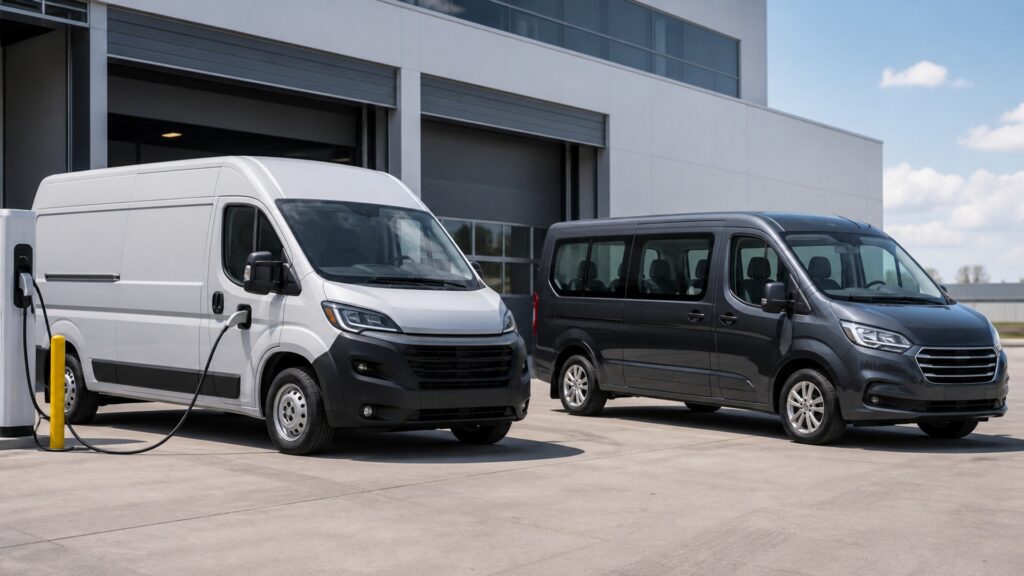
Use each description for the question it can answer.
Tip: Start with the required passenger arrangement. Electric propulsion cannot compensate for missing or unsuitable seating.
These ideas describe different parts of the same vehicle and service.
Commercial use is vehicle use in support of an organization’s work or service.
Battery-electric propulsion uses stored electrical energy to drive the vehicle’s electric motor or motors.
Passenger configuration is the installed arrangement of designated seats and related cabin equipment.
Traction energy is the energy used to propel the vehicle along its route.
Auxiliary demand is energy used by equipment other than propulsion.
Charging dwell is time parked with usable charging access between required movements.
Tip: One candidate can meet all the labels while still failing a particular seating or schedule requirement.
A passenger van can use different propulsion systems, and commercial electric vehicles can take different physical forms. Identify the exact candidate rather than comparing the broad labels as opposites. For a group trip, compare vehicles that can accommodate the required group and belongings first. Only then compare their energy arrangements and other operating differences.
An electric cargo van and a combustion-engine passenger van may share exterior dimensions while answering entirely different seating needs.
Count the designated seating positions and inspect the relevant restraints and access arrangement. Plan luggage with the group aboard, keeping entrances and exits usable. Where passengers need adapted access, select an appropriately equipped vehicle rather than inferring accessibility from a tall roof. Seats and baggage also contribute to the loaded vehicle, regardless of propulsion.
NHTSA explains that airbags supplement belts. Electric propulsion does not replace the need for an appropriate occupant-protection arrangement.
Reference: NHTSA occupant restraint and airbag guidance, Ford vehicle loading guidance.
A battery-electric passenger van replenishes its traction battery through charging. Its location, parking periods, and next departure therefore belong in the operating plan. Confirm the charging arrangement for the exact vehicle and service. Plug-in hybrids have a different energy arrangement because they also retain an engine; do not apply battery-only assumptions to them without checking the candidate.
A shuttle’s long overnight stop at its depot presents a different opportunity from a vehicle that moves between remote pickup points all day.
Inspect heating, cooling, lighting, and other passenger equipment in the actual occupied cabin. For the electric candidate, include relevant auxiliary demands in the service assessment. A shuttle waiting for delayed passengers may still need cabin conditioning even though it is not covering distance. Understand the fitted equipment’s supply and operation rather than assuming every conversion draws power in the same way.
The Department of Energy includes heating, cooling, and auxiliary loads in fleet EV selection. Road distance is only part of the energy question.
Reference: Department of Energy fleet EV duty assessment.
Imagine an airport shuttle with an acceptable seating arrangement but too little baggage space for the booked group. Charging readiness cannot solve that physical mismatch. Now imagine a van that accommodates the group well but lacks usable charging before its next required run. It has a different mismatch. A suitable electric passenger vehicle needs satisfactory answers to both.
If the passenger task is suitable for electric operation, a commercial electric passenger van may satisfy both needs. If the energy arrangement is unresolved, another suitable passenger vehicle may be required.
Passenger accommodation and energy support must both work.
Designated seats, restraints, access, and luggage accommodation.
An occupied arrangement within the relevant loading limits.
Energy capability for the route and onboard demands.
Usable charging and preparation before the next departure.
A power source and a body design are not opposing categories.
An electric passenger van used for work can be both.
The actual seating, restraints, access, and load accommodation must be suitable.
Check the occupied layout and relevant loading limits separately.
Cabin and other equipment may continue consuming energy while stationary.
Tip: Assess the real passengers and schedule, rather than relying on category names.
Clarify the overlap before selecting a shuttle or group vehicle.
Electric identifies propulsion, while passenger van identifies an arrangement intended for carrying people; commercial identifies the work context.
Cargo floor space is not a designated passenger position. Use a vehicle with appropriate seating and restraints.
Access, space, airflow, and passenger equipment can differ from the driver’s experience.
Yes. The plan must fit its actual parking locations, energy needs, and required departures.
When the electric candidate cannot meet the cabin requirements or its energy and support arrangement cannot yet serve the required trip.
Commercial electric vehicles describe work use and propulsion; passenger vans describe how people are accommodated.
An electric passenger van can combine both, provided the occupied cabin and the energy arrangement suit the same service.
Use these Review Streets paths to compare related categories and practical next decisions.
Understand seats, restraints, running gear, and cabin services.
Connect route needs to charging and handover.
Review duty and energy considerations.
Choose a retailer
Prices checked regularly. We may earn a commission at no cost to you.