
Eau de Toilette
A common fine-fragrance descriptor typically associated with a lower aromatic proportion than EDP.
- Use: Find lighter-format options
- Variable: brand practice and formula
- Tradeoff: The term does not guarantee freshness or short wear
Eau de toilette differs from eau de parfum most directly in market positioning and typical fragrance concentration: EDT commonly sits lower and EDP higher. The ranges overlap, however, and international standards do not impose one fixed percentage definition for either label.
The more important distinction is the finished composition. A brand may brighten an EDT with more lift and transparency while reshaping the related EDP around richer or more persistent facets. Spray output, dose, skin, fabric, weather, and setting can make those versions perform differently from the expected hierarchy. Neither format is inherently better. Compare the exact pair side by side for scent character, projection, comfort, longevity, reapplication, bottle price, and the situations in which it will be worn.
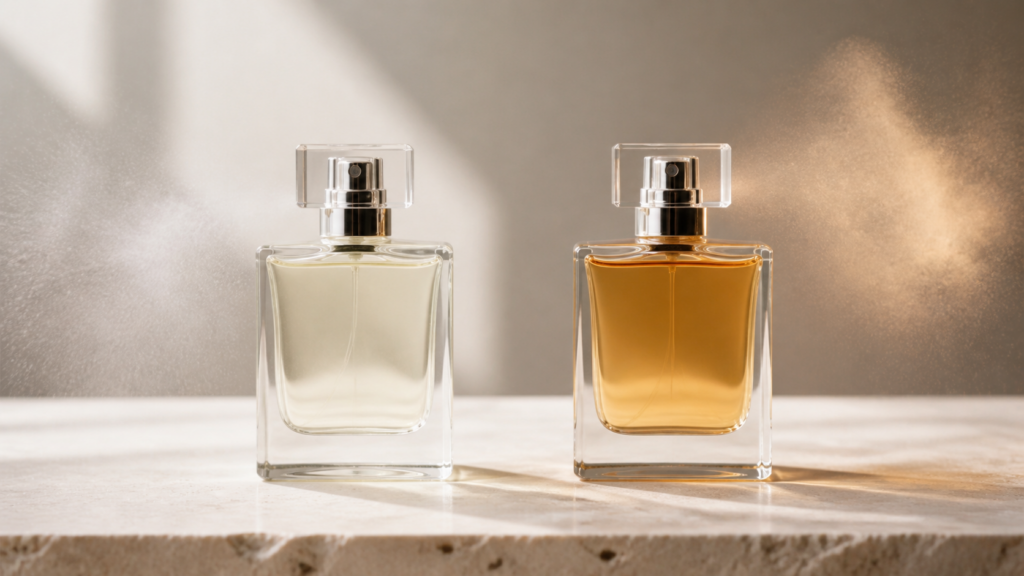
EDT and EDP labels establish broad expectations, but direct wear reveals whether the versions differ in character, reach, persistence, dose, and value.
Tip: Use one version per wrist only when the spray outputs and cross-contamination can be controlled.
These concepts distinguish label convention, formula identity, early diffusion, late character, and usable value.
A common fine-fragrance descriptor typically associated with a lower aromatic proportion than EDP.
A descriptor typically associated with a higher aromatic proportion than EDT.
A related version sharing a name or identity while using a distinct formula.
The brightness and airborne presence soon after application.
The density, texture, and closeness of later wear.
The satisfying use obtained from the sprays and money spent.
Tip: Normalize the dose and follow the drydown before choosing a format.
IFRA describes EDT as commonly around five to fifteen percent and EDP around ten to twenty percent in ethanol-based products. These are typical practices, not strict universal definitions, so the label cannot verify an exact load.
The shared middle of the ranges prevents acronym-only ranking.
Increasing every material proportionally can distort balance, solubility, safety limits, and wear. Related EDT and EDP formulas may shift citrus, floral, woody, sweet, musky, or amber effects to preserve a different creative identity.
Same name does not mean same composition at another dilution.
An airy EDT can create a larger early impression, while a denser EDP may remain detectable longer but closer to skin. Others' perception, not repeated wrist sniffing, is needed to assess the surrounding scent cloud.
A quieter long drydown and a bright short opening solve different jobs.
Warm weather, commuting, exercise, offices, close seating, and fragrance-sensitive company can reward a controlled EDT dose. An EDP may suit cooler air, longer events, or fewer applications, but formula matters more than the category stereotype.
Lighter can be more usable; richer can be more efficient.
EDT may offer more volume or a lower entry price, whereas EDP may feel complete with fewer sprays. Calculate value using enjoyable wears, not price per milliliter alone, and consider samples or travel sizes first.
The cheaper milliliter is wasteful when the fragrance is not worn.
EDP usually signals a higher aromatic proportion, but formula design determines whether it is richer, sweeter, quieter, longer-lasting, or simply different.
Choose the EDT when its lift, transparency, dose flexibility, or lower entry price fits the routine.
Choose the EDP when its character, later wear, spray efficiency, or reduced reapplication fits better.
Typical ranges overlap, and atomizers can deliver unequal volumes per spray.
Neither label guarantees quality, projection, skin tolerance, compliments, or value.
Day-versus-night rules and stronger-is-better claims ignore formula design, setting, and delivered dose.
EDP usually has a higher aromatic proportion, but brands may alter the formula and atomizer. The result can be richer, sweeter, smoother, quieter, or longer-lasting—not simply the EDT amplified at every stage.
Time-of-day rules are conventions, not performance facts. Dose, formula, venue, weather, distance from others, and personal comfort determine suitability; a restrained EDP can easily be quieter than an oversprayed EDT.
Projection depends on volatile materials, spray output, application area, heat, and airflow. A highly diffusive EDT may travel farther early, while a concentrated EDP can remain dense and close for longer.
Many EDTs feel bright in heat, but sweetness, spice, woods, musk, dose, and humidity can overturn the label. Test the exact formula outdoors and in air-conditioned indoor spaces before deciding.
No concentration guarantees all-day detection. Wear duration varies with formula, dose, surface, environment, and adaptation; some users may still prefer a small, controlled refresh rather than a heavier morning application.
Tip: Prefer the scent and wear pattern, not the more prestigious acronym.
A fair comparison controls dose while leaving room for each version's realistic use.
Start with the character that fits the intended setting, then sample its counterpart on another day. If longevity is the main concern, test both at controlled spray counts through the complete expected wear period.
Yes. A brand may change materials and proportions, so note emphasis, sweetness, texture, opening, and drydown can diverge. Treat related concentrations as flankers until side-by-side wear proves them closely equivalent.
Equal counts simplify a first comparison only when atomizer output is similar. Also note plume width and wetness; after the baseline, adjust each product conservatively to the dose you would genuinely wear.
A lower typical aromatic proportion does not guarantee tolerance because formulas and individual sensitivities differ. Follow directions, avoid irritated skin, test cautiously when appropriate, and stop after rash, burning, swelling, or breathing symptoms.
Choose the exact version that remains comfortable at a low dose and close conversational distance. Test after commuting and indoor heating or cooling; shared-space suitability cannot be inferred from EDT or EDP alone.
Compare the sizes available, price, realistic sprays per wear, likely reapplication, and which formula you prefer. A smaller EDP may outlast a large EDT in ownership—or remain unused because it feels too dense.
Eau de toilette and eau de parfum differ in typical concentration positioning, but their ranges overlap and brands often rebalance the formulas. EDP is not automatically a superior or merely stronger EDT.
Sample each finished version through a complete wear. Choose by character, early reach, late presence, setting, comfortable dose, reapplication needs, available size, and cost per satisfying wear.
These guides extend the comparison into beginner sampling and long-wear testing.
Compare scent families, concentrations, testing methods, sizes, and first-purchase tradeoffs.
Evaluate composition, format, wear, bottle size, setting, and value before buying perfume.
Test wear duration, projection, fabric use, climate, and reapplication without relying on concentration alone.
Choose a retailer
Prices checked regularly. We may earn a commission at no cost to you.