
Crank Circle
The pedal route on a bike repeats around an axle.
- It keeps the feet on a circular path.
- The saddle fixes the rider's support point.
- It is not a climbing step.
Exercise bikes and stair machines differ before intensity is considered. A bike places the rider on a saddle and asks the feet to turn a crank circle; a stair machine keeps the user upright and asks for repeated stepping against moving treads or pedals.
That distinction changes balance, contact points, control language, and the way the machine fits into a room. The difference is not that one is automatically easier or harder. They ask for different movement tasks.
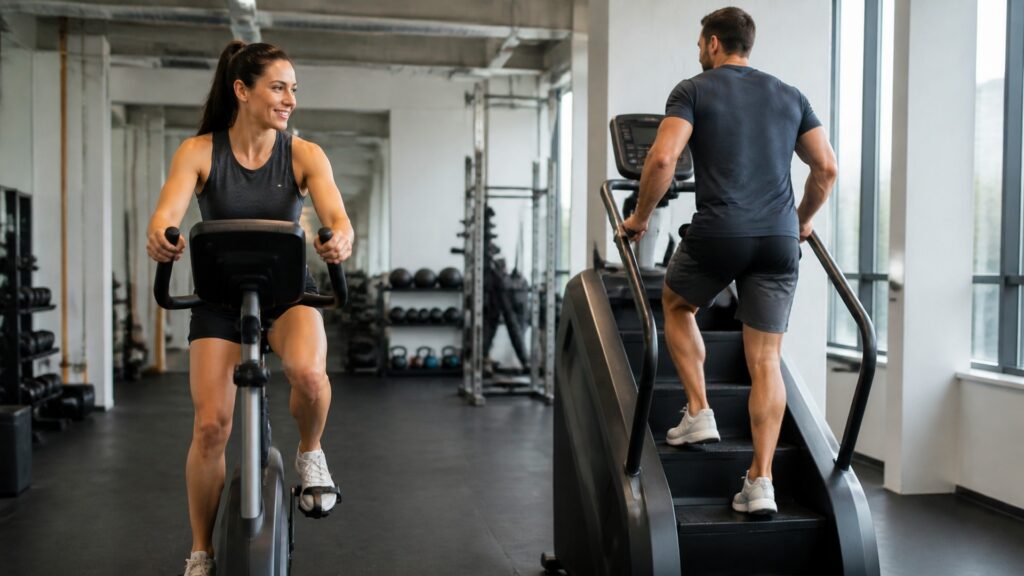
A useful comparison starts with the body's job: seated circular pedaling versus upright repeated stepping.
Tip: Compare the posture and path first; effort labels come later and are not shared units across machines.
These definitions connect the main idea to the variables, limits, and practical signals readers need to compare options.
The pedal route on a bike repeats around an axle.
The surface a stair machine asks the foot to press or follow.
The saddle carries part of the rider's body weight.
The user remains standing on the stair machine.
Bike cadence counts pedal revolutions.
A stair machine imitates repeated upward stepping.
Tip: Keep the bike on its crank path and the stair machine on its stepping path; that prevents false equivalence.
The bike's defining action is rotation around a crank. The stair machine's defining action is repeated foot placement into a simulated climb.
The first difference is the path the machine gives the feet.
On a bike, the saddle is a working part of the setup. On a stair machine, the user stays upright, so balance, rail contact, and body position remain part of the task.
Support is not a comfort side note; it changes what the machine asks the person to control.
Bike resistance acts against crank rotation. Stair-machine difficulty often appears through tread speed, step depth, or climbing rhythm, so settings should not be compared as matching numbers.
The machines use different control languages, so their numbers need context.
A bike needs mounting clearance around the saddle and pedals. A stair machine needs upright clearance, step-on access, and enough confidence around moving treads.
The better fit may be decided by the user's room and entry path before workout features matter.
The comparison can explain posture, path, and controls, but it cannot prove which machine is safer, more effective, or better for a specific body.
A responsible difference article describes machine behavior without turning it into a universal prescription.
The bike-versus-stair comparison is strongest when it stays with movement path, posture, control language, and setup conditions.
It shows why seated circular pedaling and upright stepping feel different even when both are cardio equipment.
It explains why resistance levels and step rates cannot be compared as shared measurements.
It does not decide injury risk, rehabilitation value, calorie burn, or training results.
Those claims require evidence outside the equipment-category distinction.
Common shortcuts and misunderstandings can make the topic seem simpler than it is.
It is a different movement pattern, not a bike with more intensity added.
The rider still turns the crank and controls cadence; the saddle simply changes the support task.
Cadence counts crank revolutions, while step rate belongs to a stepping pattern.
Height may come from the stair mechanism or frame, not from better training value.
Tip: Treat strong claims as starting points for comparison, not final answers.
Concise answers to common questions readers may have after the main explanation.
The bike uses seated circular pedaling; the stair machine uses upright repeated stepping.
Usually the stair machine asks more from standing balance, but rails and product design matter.
No. Bike resistance and stair-machine level settings describe different mechanical tasks.
The saddle sets body position around the crank, which is central to how a bike works.
No. It explains equipment differences, not individualized health outcomes.
Exercise bikes differ from stair machines because they organize the body around a seated crank circle instead of upright repeated stepping.
That difference changes support, controls, access, and interpretation of metrics before any claim about effort or results can be made.
Use these Review Streets paths to connect the explainer to related categories, comparisons, and next decisions.
Use this to examine the crank-circle side of the comparison in more detail.
Read this when access, mounting, and moving parts are part of the buying decision.
Browse bike types after the bike-versus-stair boundary is clear.
Choose a retailer
Prices checked regularly. We may earn a commission at no cost to you.