What Makes Free Weights Different from Weight Machines

Free weights and weight machines both ask the body to produce force against an external load. Their central difference is not whether one creates real strength. It is who controls the movement path and how much positioning, support, and failure management the equipment supplies.

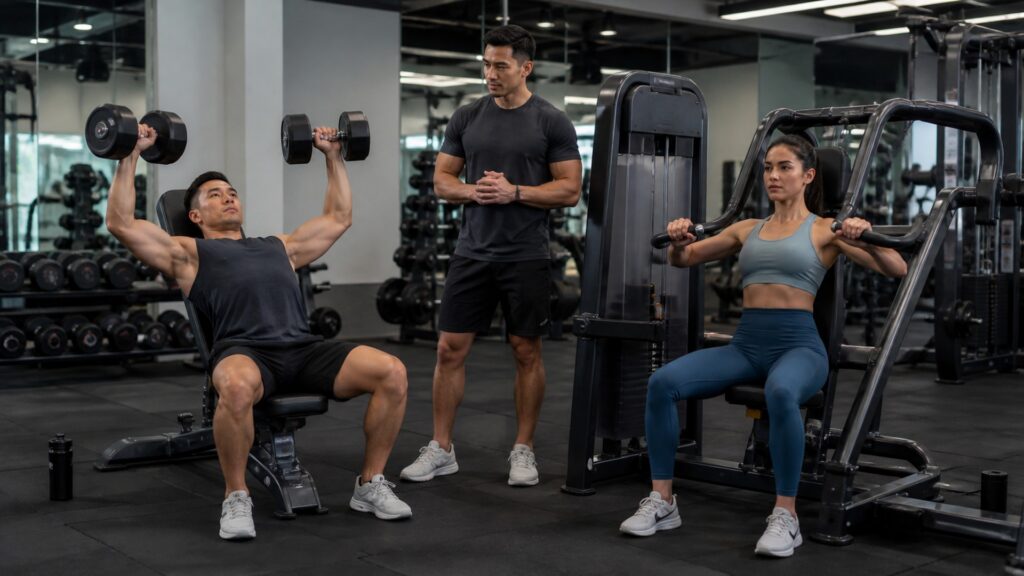
A dumbbell can travel through open space and adapt to the user's chosen path. A machine routes force through its pivots, rails, cables, and pads. Those constraints change setup, stabilization, resistance across the range, and the situations in which each tool is practical. It also explains why the two categories can complement one another inside the same plan.

By: Review Streets Research Lab
Updated: August 26, 2026
Explainer · 8-12 min read
free weights explainer hero image for Review Streets
What You'll Learn

Two Ways to Organize External Resistance

The comparison becomes useful when movement freedom, support, resistance profile, setup, progression, and failure management are separated.

  • What the user controls with a free weight
  • What the frame controls on a machine
  • Why stabilization demands differ
  • How gravity, cams, and pulleys shape resistance
  • Where adjustment and body proportions matter
  • How load changes are made and tracked
  • When each tool solves the simpler training problem

Tip: Compare the same movement job—such as pressing or rowing—then identify which directions the user must control and which the equipment constrains.

Definitions

Key Concepts That Define Free Weights and Weight Machines

Six concepts explain the mechanical distinction without turning it into a false natural-versus-artificial debate.

Free Weight

A movable external load, such as a dumbbell, barbell, kettlebell, or plate, whose path is controlled by the user rather than a machine rail.

  • Path: Moves through open space
  • Resistance: Usually relies on gravity
  • Control: Requires the user to organize orientation and balance

Weight Machine

A framed device that routes resistance through levers, cables, cams, rails, or linkages along a constrained movement path.

  • Path: Shaped by fixed geometry
  • Resistance: Often supplied by a stack or plates
  • Support: Seats and pads establish body position

Degrees of Freedom

The directions in which a load can move. Free weights permit more path variation; machines intentionally remove some movement options.

  • Freedom: Allows self-selected path adjustments
  • Constraint: Makes repetitions easier to reproduce
  • Tradeoff: Changes coordination and fit demands

External Stability

Support supplied by a bench, backrest, pad, rail, or machine frame rather than created entirely by the user.

  • Purpose: Reduces unwanted movement
  • Effect: Can let local force production become the main limiter
  • Limit: Does not guarantee compatible joint alignment

Resistance Profile

The way external challenge changes through the exercise range because of gravity, moment arms, pulleys, or shaped machine cams.

  • Free weights: Depend strongly on orientation to gravity
  • Machines: Can alter leverage through linkages
  • Meaning: Equal starting loads need not feel equal throughout

Failure Management

The method used to end a repetition or set when the load can no longer be controlled through the intended path.

  • Free weights: May require racks, safeties, or a spotter
  • Machines: Often return to a stop or stack
  • Planning: Depends on exercise position and equipment design

Tip: The most visible difference is the frame, but the decisive difference is the movement and stability problem that frame creates.

Load Path

Gravity-Dominant Loads Versus Routed Machine Resistance

Free weights usually resist motion through gravity acting on the implement, so body and load orientation determine the challenge. Machines transmit a stack or plate load through cables, levers, and cams that can redirect force.

  • A dumbbell remains pulled vertically by gravity
  • Body position changes the free-weight moment arm
  • Pulleys can redirect a machine's line of pull
  • Cams can reshape resistance across the arc
  • Friction and linkage ratios affect displayed machine loads

Both provide external resistance, but they deliver it through different mechanical routes.

Movement Path

Self-Selected Travel Versus Guided Geometry

With free weights, the user continually controls where the implement travels. A machine narrows the possible path, making repetitions easier to reproduce while asking the body to conform to the device's geometry.

  • Open paths allow small adjustments between repetitions
  • Guided rails reduce sideways deviation
  • Fixed pivots may fit some body proportions better than others
  • Cable machines can sit between fully free and tightly guided movement
  • Path freedom adds coordination without guaranteeing better technique

The better path is the one that fits the intended movement and can be controlled consistently.

Stability

Where Support Comes From Changes the Limiting Factor

Benches and machine pads can support the torso or limbs, reducing balance and positioning demands. Free-weight exercises often leave more stabilization to the user, which may limit load before the targeted motion does.

  • External support can focus effort on a local joint action
  • Standing free-weight work requires whole-body positioning
  • Stabilization is task-specific rather than a single quality
  • More stability can be useful for accumulating controlled repetitions
  • More freedom can be useful when controlling the implement is part of the goal

Support changes what ends the set; it does not decide whether the resistance is legitimate.

Setup and Progression

How Each Tool Changes the Practical Workflow

Machines often use a selector pin and recorded seat setting, while free weights require loading, carrying, racking, and sometimes assembling plates. Increment size and available equipment affect how gradually the workload can change.

  • Weight stacks permit quick changes between sets
  • Plate-loaded machines may need the same handling as barbells
  • Dumbbells provide fixed jumps between pairs
  • Microplates can make barbell changes smaller
  • Machine seat and start settings should be recorded alongside load

A repeatable setup is part of progression, because an altered position can change the exercise itself.

Decision Boundary

When Movement Freedom or External Support Is More Useful

Free weights make sense when controlling an implement through open space is part of the desired skill and suitable racks or clear space exist. Machines make sense when a guided path, stable body position, or rapid load change simplifies the session.

  • Use free weights when path control is an intentional training demand
  • Use machines when support helps isolate the planned force task
  • Check machine fit before assuming guidance is comfortable
  • Plan safeties or spotting for free-weight exercises that can trap the load
  • Mixing tools is reasonable when each has a distinct program role

The choice belongs to the exercise objective, environment, and user context—not to a universal hierarchy.

Quick Reality Check

Where Each Tool Is Strong—and Where It Adds Friction

Both tools can load muscles progressively; their differences appear in control, fit, setup, and the way a set ends.

What the Distinction Clarifies

Free weights expose implement control and allow self-selected paths, while machines provide repeatable guidance and external support.

Using both categories can separate movement-skill practice from additional supported volume when a program has a reason for each.

What the Labels Do Not Decide

Neither category guarantees sound technique, compatible range of motion, or an appropriate workload.

Specific machines vary widely, and cable stations or plate-loaded leverage devices blur a simple free-versus-machine split.

Common Myths

Misconceptions About Free Weights and Weight Machines

These corrections separate free weights are always more functional from machines require no technique, two shortcuts that distort free weights and weight machines.

Free weights are always more functional

Function depends on the target task. Open-path control may transfer well to some activities, while supported machine work can efficiently develop force in a planned motion. The label alone does not establish relevance.

Machines require no technique

A guided path reduces movement options, but seat position, joint alignment, range, tempo, and contact with pads still require attention. Poor setup can make a repeatable path consistently awkward. The guided path still needs a compatible starting position.

Machine stack numbers equal free-weight loads

Pulley ratios, levers, cams, friction, and linkage geometry change the force delivered to the user. A stack label should not be converted directly into an equivalent dumbbell or barbell load.

Free weights train every stabilizer automatically

Stabilization depends on the exercise, body position, load, and direction of travel. A supported dumbbell exercise may demand less whole-body control than an unsupported cable or machine movement. The exercise configuration decides which structures stabilize the load.

Using machines makes strength less real

Muscles still produce force against external resistance on a machine. The adaptation reflects the trained movement and support conditions, just as free-weight adaptation reflects its own technique and stability requirements.

Tip: Check each claim against free weight and the article's movement path explanation.

FAQ

Frequently Asked Questions About Free Weights and Weight Machines

These answers resolve remaining questions about free weight, weight machine, and their practical limits.

Can free weights and machines train the same muscles?

Often, yes, when exercises share similar joint actions. The distribution of support, path freedom, leverage, and range can still change which muscles work hardest and what coordination the movement requires.

Which is easier for tracking progression?

Machines offer quick load selection and fixed settings, while barbells allow standardized plates and small increments. Either can be tracked well if setup, range, repetitions, and equipment remain consistent. Consistency matters more than whether changes use pins or plates.

Why can a machine feel uncomfortable despite being guided?

Its pivot, seat, pad, or handle geometry may not align well with the user's proportions or preferred path. Adjustment helps, but a fixed design cannot accommodate every body equally. Another machine path may fit the same person better.

Do machines make a spotter unnecessary?

Many machines let the stack return safely or include stops, but designs differ. Plate-loaded leverage machines and certain positions can still create pinch, entrapment, or setup concerns that require planning.

Are cable exercises free weights or machines?

They occupy a middle ground. The cable routes resistance from a stack or plates, while the handle may move through open space, combining redirected force with substantial user-controlled path. That mixed design explains why the categories overlap.

Can a program use both categories?

Yes. A program may use free weights for open-path skill and machines for supported repetitions, or reverse those roles depending on the task. The value comes from distinct jobs, not variety alone.

Bottom Line

Free weights and weight machines differ mainly in how resistance is routed and how much movement control and support the equipment provides.

Free paths expand the coordination task; guided paths make the setup more repeatable. Choose by fit, objective, environment, and failure management rather than by category loyalty.

Next Steps

Continue from Free Weights and Weight Machines to Related Fitness Explanations

Each destination extends the article's load path or decision boundary model into a nearby fitness question.

Why Strength Training Matters

Understand why repeated force practice, recoverable workload, and movement specificity matter regardless of resistance tool.