What Makes Heavy Duty Pickup Trucks Different from Compact Pickup Trucks

Heavy-duty and compact pickups share a cab-and-bed layout, but they are designed around different priorities. HD pickups generally devote more vehicle size and mechanical capacity to substantial carrying and towing duties. Compact pickups offer an open bed in a smaller vehicle, often with a stronger emphasis on everyday passenger use, parking, and modest loads.

The distinction extends through structure, drivetrain, load ratings, hitch options, and access to the bed. It is not a judgment that one is a 'real truck' and the other is not. A compact can be well suited to useful work within its limits, while a heavy-duty pickup can be unnecessarily cumbersome for the same assignment.

By: Review Streets Research Lab
Updated: October 5, 2026
Explainer · 8-12 min read
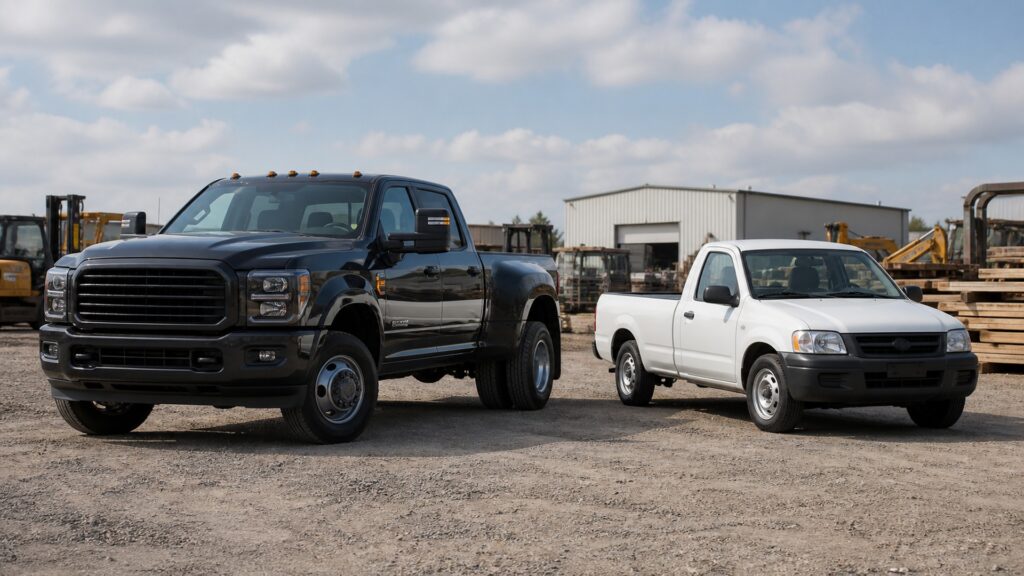
heavy duty pickup trucks explainer hero image for Review Streets
What You'll Learn

The Design Differences Behind Compact and HD Pickups

Compare how the two types support loads and everyday use, rather than relying on their appearance.

  • Understand structural approaches without treating them as ratings
  • Compare payload, towing, and hitch capability separately
  • Recognize how drivetrain layout varies
  • Evaluate bed access and vehicle footprint
  • Choose design priorities that match the recurring work

Tip: Keep market labels separate from the exact vehicle's loading label and towing documentation.

Definitions

Six Design Differences Worth Understanding

These concepts explain why similarly shaped vehicles can serve very different roles.

Compact pickup

A compact pickup packages passenger seating and an open bed into a relatively small vehicle.

  • Example: a truck used for commuting and carrying garden supplies
  • Check: compare actual exterior and bed dimensions
  • Limit: compact is a market description, not one fixed payload limit

Heavy-duty pickup

An HD pickup is engineered and rated for demanding load-carrying and towing assignments.

  • Example: a configured truck supporting substantial trailer pin weight
  • Check: use the precise build's ratings
  • Limit: not every HD configuration has the same capability

Unibody construction

Unibody construction uses an integrated body structure to carry vehicle loads.

  • Example: the Ford Maverick's integrated structural design
  • Check: confirm the construction and approved attachment points
  • Limit: unibody does not mean the vehicle has no structure or cannot tow

Body-on-frame construction

Body-on-frame construction places the body on a separate load-bearing frame.

  • Example: a conventional HD pickup with cab and bed mounted to frame rails
  • Check: check the manufacturer's approved equipment and mounting arrangements
  • Limit: a separate frame alone does not authorize any particular load

Drivetrain layout

Drivetrain layout describes how propulsion reaches the driven wheels.

  • Example: a front-drive-based compact compared with a rear-drive-based HD truck
  • Check: identify the actual two-wheel, all-wheel, or four-wheel-drive arrangement
  • Limit: traction features and operating restrictions vary by model

Cargo access

Cargo access is the practical ability to load, reach, secure, and remove items from the bed.

  • Example: lifting a toolbox over a bed side
  • Check: try access with the equipment you normally carry
  • Limit: bed volume alone does not describe ease of use

Tip: Construction explains part of the engineering; ratings and the specific setup decide permissible use.

Structure

Different Platforms Can Support the Same Basic Bed-and-Cab Idea

Many contemporary compact pickups use integrated body construction, while conventional HD pickups use a separate frame. These are different ways to organize structural loads and package the vehicle. Neither label should be stretched into a universal claim: compact trucks across markets and model years are not all built alike, and a frame does not eliminate load limits.

  • Check construction for the exact model being compared.
  • Use approved mounting points for equipment.
  • Do not infer towing capability from the presence of a separate frame.

The structure must be considered with the suspension, axles, tires, brakes, and manufacturer ratings.

Loads

HD Design Offers a Different Range of Work Configurations

HD product families can provide configurations intended for substantial bed loads and heavy trailers, including compatible fifth-wheel or gooseneck arrangements. Compact pickups commonly address lighter cargo and conventional-trailer needs. A compact's bed can still handle meaningful tasks, but its available space is not proof that a dense load or large hitch load is acceptable.

  • Separate the allowance for carried weight from the rating for a trailer.
  • Include people, installed equipment, and hitch load.
  • Compare approved hitch types as well as maximum weights.

For example, carrying a few tools is a different requirement from carrying those tools plus the pin load of a large trailer.

Propulsion

Driven-Wheel Layout Does Not Decide the Whole Comparison

Compact pickups may use front-drive-based layouts with available all-wheel drive, while HD models commonly use rear-drive-based layouts with available four-wheel drive. Specific offerings vary. Traction systems help deliver power under particular conditions, but they do not establish payload, braking ability, or permission to exceed ratings.

  • Read how the fitted traction system is intended to operate.
  • Do not assume all-wheel drive includes a low-range transfer case.
  • Match tires and vehicle equipment to the actual surface.

A useful driveway or trail feature should not be mistaken for additional load capacity.

Packaging

More Truck Can Mean More Work to Load and Park

An HD truck's dimensions can support larger equipment, yet its height, length, and width also affect daily tasks. A compact may be easier to position near a building or use for frequent small collections. Test the bed reach and loading process rather than assuming the larger vehicle is always more convenient.

  • Measure mirror clearance and overall parking length.
  • Check whether normal cargo fits with the tailgate closed.
  • Test access to tie-downs and stored equipment.

A lower, reachable bed can be a practical advantage when the cargo already fits the compact's limits.

Tradeoffs

Choose Around the Design You Will Actually Use

Heavy hauling can justify the HD truck's additional size and ownership demands. Regular passenger travel with occasional supplies can favor a compact's packaging. Ride quality, energy use, insurance, tires, and service costs depend on the actual candidates, so broad class stereotypes are less useful than a comparison of specific builds.

  • Describe the normal load and the largest realistic load.
  • Price ownership using the same mileage and operating pattern.
  • Consider a midsize or light-duty full-size truck if neither extreme fits.

The meaningful difference is the balance each design offers, not which badge appears more rugged.

Quick Reality Check

What Each Design Prioritizes

The overlap is an open bed; the engineering and ownership compromises differ.

Compact Priorities

A manageable vehicle for everyday travel with useful open-bed cargo capability.

Work and recreation loads that fit its specific ratings and approved equipment.

HD Priorities

Configurations for demanding carrying and towing, supported by appropriate chassis and running gear.

Greater work capability where the owner can accommodate the corresponding size and equipment needs.

Common Myths

Misconceptions About Compact and Heavy-Duty Pickups

A visual comparison misses much of the engineering.

A unibody pickup is not a real pickup.

It still provides passenger transport and an open cargo bed. Its approved capability is what matters for a job.

All compact trucks use the same construction.

Designs differ across models, markets, and years. Verify the actual vehicle.

HD is always the better vehicle.

Additional capability may be unnecessary while the size and costs remain.

All-wheel drive makes a compact equivalent to HD.

Driven wheels address traction. They do not transform the structure, equipment, or load ratings.

Tip: Ask which difference affects your use rather than treating every difference as an advantage.

FAQ

Questions About HD and Compact Truck Design

Answers that separate physical layout from practical capability.

What is their biggest difference?

Their intended balance of load capability, dimensions, and everyday usability. Exact specifications decide how that balance applies.

Can a compact pickup do paid work?

Yes. Service visits, light equipment, and smaller deliveries can fit its capabilities; the work's actual requirements decide.

Does body-on-frame automatically mean better towing?

No. Towing requires an approved combination of structure, drivetrain, cooling, brakes, tires, hitch equipment, and ratings.

Is a bigger bed always more useful?

Only when the extra space is needed and the cargo remains within the truck's limits. Access and loading height also matter.

How should I compare two examples?

Use their actual loading labels, towing documentation, bed measurements, access requirements, and operating costs.

Bottom Line

Heavy-duty pickups differ from compact pickups in the design priorities and equipment used to support their intended work.

Choose the combination of capacity, dimensions, and everyday usability that fits the assignment, rather than treating size as a quality ranking.

Next Steps

Go Deeper or Compare Your Options

Use these Review Streets paths to compare related categories and practical next decisions.

Manufacturer references: Ford Maverick construction and equipment; Ford Super Duty technical specifications; Ford towing information and model-year guides. Use the manual and ratings for your own model year and configuration.