
Cabin Capture Path
A route carrying particles, dissolved soil, and moisture from interior material into vacuum, towel, extractor, or disposable media.
- Liquid application stays bounded
- Recovery media needs capacity
- Waste leaves the cabin
Interior cleaning is a bounded capture process inside the weather seals. Vacuum airflow removes dry debris; compatible chemistry loosens film or stains; towels and extractors transfer contamination out; ventilation dries porous layers. Liquid must be restrained because foam, carpet backing, electronics, displays, adhesives, belts, and airbag zones can sit just beneath a visible surface.
Car wash equipment serves an open-rinse environment. Pumps, hoses, nozzles, brushes, blowers, and reclaim systems move larger water volumes across paint, glass, wheels, trim, and underbodies toward drainage. Exterior output depends on pressure, flow, nozzle geometry, supply, and runoff control. That capacity becomes a liability when applied indiscriminately inside a cabin.
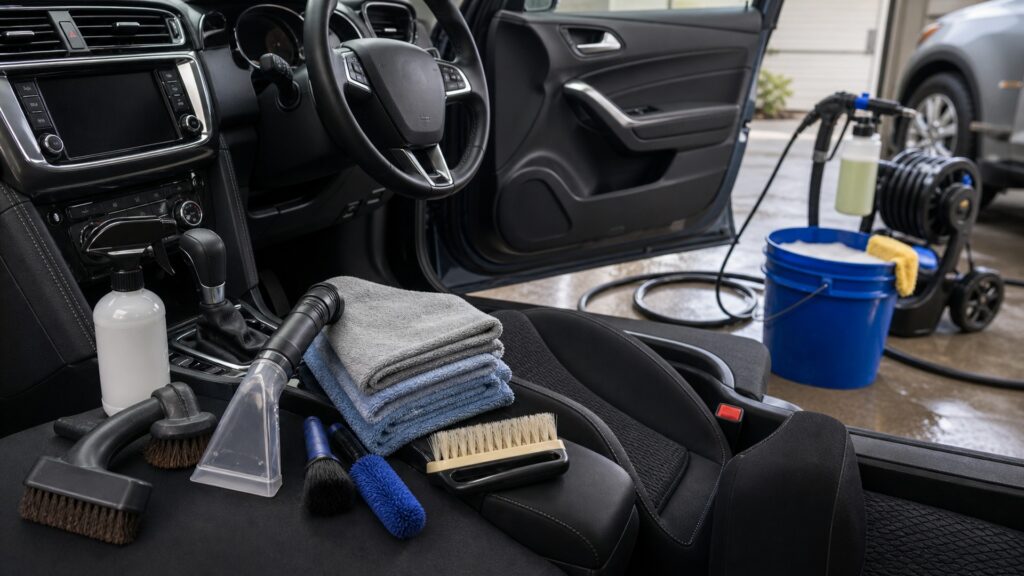
The categories differ in soil exit path, liquid volume, energy, hidden construction, site controls, and proof of completion.
Tip: A wet-and-dry vacuum may appear in both workflows, but its assignment changes: exterior recovery handles bulk wash liquid, while interior recovery must protect material backing and hidden systems.
These terms describe why the same water or suction tool has different limits inside and outside a vehicle. Evidence includes cabin capture path, open-rinse path, dry particulate vacuuming, metered chemistry, towel transfer, extractor recovery, hidden foam moisture, weather-sealed surface, pressure-jet energy, runoff destination, restraint-system boundary, and closure drying gate.
A route carrying particles, dissolved soil, and moisture from interior material into vacuum, towel, extractor, or disposable media.
A route using flowing water to wet, release, dilute, and transport exterior contamination toward collection, treatment, or approved drainage.
Water retained in foam, backing, seams, cavities, ducts, or mechanisms after the visible face appears dry.
Localized hydraulic force created by pump output, nozzle orifice, fan angle, distance, and flow at the target.
An exterior assembly intended to shed environmental water when intact and used within design limits.
The evidence threshold for closing a vehicle after interior work, including surface and underlying dryness, odor, residue, and electrical function.
Tip: Classify the surface and soil exit path before selecting power; capability without containment is not useful cleaning.
Cabin debris is vacuumed or transferred into towels and recovery tanks. Exterior equipment uses rinse flow to carry loosened contamination off broad surfaces, making drainage and overspray part of the mechanism.
Cleaning is incomplete until contamination reaches its planned destination.
Interior brushes, towels, vacuums, and extractors use small-area control. Pressure washers and arches trade precision for coverage; their spray can penetrate seams, damage trim, and saturate cabin layers.
The suitable energy scale follows construction, not speed.
Seat covers can overlay airbags and sensors; carpet overlays wiring; screens have coatings; belts retract into mechanisms. Exterior panels normally present a more inspectable water-shedding boundary.
Visible material is only the first layer of cabin fitment.
A wash bay controls supply, hose paths, footing, overspray, and drainage. Cabin cleaning controls vapor, access, humidity, recovery, airflow, and the time before mats, seats, and doors return to use.
The correct tool can still be wrong for the available environment.
Both need clean, undamaged surfaces, but cabin acceptance also verifies non-slip controls, clear displays, dry textiles, unobstructed restraints, working electronics, and no returning odor after closure.
A clean appearance cannot close an interior job by itself.
Interior methods constrain liquid and capture it; wash equipment assumes inspectable exterior surfaces, open transport, and drainage.
Dry debris, dissolved soil, and limited moisture enter known recovery media; materials remain stable; underlying layers dry; and cabin controls, visibility, restraint systems, and odor pass reinspection.
Chemistry, brushes, towels, vacuum tools, extraction, ventilation, and time are matched surface by surface rather than maximizing spray, heat, or liquid.
Water supply, pressure, flow, nozzle, reach, chemistry, weather-sealed surfaces, overspray boundary, drainage, reclaim, drying, and maintenance support repeatable exterior coverage.
Exterior capacity does not authorize cabin rinsing; interior equipment does not automatically provide the water transport needed for heavy mud, underbodies, wheels, or repeated exterior volume.
Comparison myths confuse shared water and suction with shared operating envelopes.
A recovery vacuum cannot capture water driven behind trim, into foam, wiring, ducts, retractors, sensors, or adhesives. Cabin work meters liquid at the surface and verifies drying rather than flooding first and hoping to recover later.
High throughput helps broad rinseable areas, but setup, drainage, masking, and damage risk can overwhelm any speed advantage on small cabin surfaces. Interior cleaning gains efficiency through dry removal, correct chemistry, organized tools, and controlled transfer.
Incidental moisture tolerance is not permission for open rinsing. Electronics, foam, adhesives, connectors, displays, belts, and insulation can retain or be damaged by liquid even when visible plastics appear unaffected.
Wheel particles, road film, exterior dressing, cabin oils, food, dye, and biological soil create incompatible contamination. Dedicated, labeled media prevent grit transfer, chemical cross-use, staining, odor, and unsafe residues on controls.
Tip: Trace energy, contamination, hidden construction, recovery, and acceptance before crossing the weather-seal boundary.
These answers address wet vacuums, pressure washers, mixed services, drainage, drying, and why equipment overlap does not erase the interior boundary.
A compatible vacuum, extractor, blower, or steamer may serve defined tasks in both categories, but tools, attachments, filtration, chemistry, contamination zones, liquid limits, and verification must be reassigned for each surface and soil path.
Remove compatible mats, identify their material, clean them in an appropriate controlled area, recover or drain water lawfully, dry them completely, and reinstall only after the cabin floor is dry. Never saturate installed carpet to imitate mat cleaning.
Intact paint, glass, trim, and related assemblies are designed to face weather, yet damage, seals, vents, sensors, decals, film edges, and openings still impose limits. Vehicle guidance and inspection determine the actual boundary.
Track application and recovery, inspect seams and backing, use airflow and adequate time, watch for wick-back or fogging, smell after warming, and recheck electronics. Surface touch alone cannot establish dry foam or underlay.
Relocate when exterior runoff, overspray, temperature, supply, or drainage is uncontrolled, or when cabin ventilation, electricity, safe access, recovery, and drying time are inadequate. Site feasibility precedes equipment convenience. safely
Interior cleaning captures contamination within a moisture-limited, material-specific cabin process. Car wash equipment moves bulk water, air, and soil across exterior weather surfaces toward controlled drainage.
Keep those exit paths distinct. Use shared machines only with appropriate attachments, chemistry, contamination separation, and verification; never let exterior delivery capacity substitute for cabin recovery and drying.
Related explainers trace cabin transport, define interior fitment, and show the exterior water-and-pressure mechanism being compared.
Follow dry capture, chemistry, agitation, transfer, extraction, drying, and cabin verification.
Match products, tools, moisture, recovery, and drying to cabin materials and safety systems.
Trace exterior supply, pump, nozzle, chemistry, rinse, drying, and wastewater handling.
Choose a retailer
Prices checked regularly. We may earn a commission at no cost to you.