
Top-Grain Leather
Hide material whose grain surface remains present beneath finishing layers.
- Finish chemistry affects cleanability
- Natural variation remains visible
- Repeated flexing tests coating adhesion
Leather and fabric seat covers create different contact surfaces even when their patterns fit the same seat. Leather or leather-like panels usually present a comparatively closed face that releases loose spills and wipes clean readily. Woven fabric creates a porous, textured face that manages heat, grip, and moisture differently while holding more particles within its structure.
Material label alone does not determine quality. Coating thickness, hide or polymer construction, weave, fiber, backing, foam, seams, fit, colorfastness, heat exposure, and cleaning method control performance. Both types must also respect seat-mounted airbags, occupant sensors, heaters, ventilation, adjustments, belts, and child-restraint instructions before comfort or appearance becomes relevant.
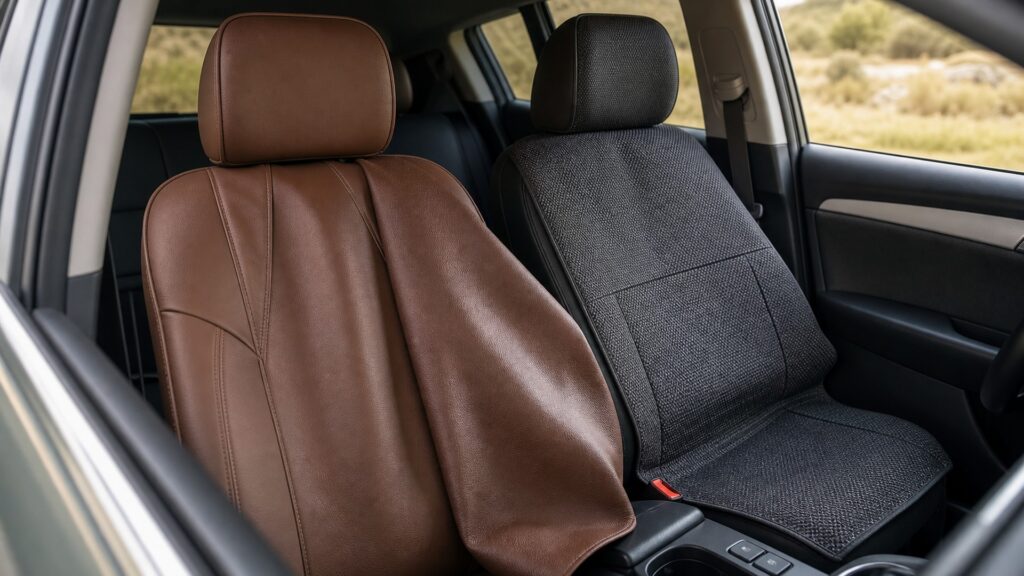
The useful distinction follows friction, heat, vapor, liquid, soil, cleaning, flexing, and the safety interfaces hidden beneath the cover.
Tip: Place a material sample against clean upholstery in cabin heat before installation; check color transfer, tack, imprinting, odor, and backing reaction rather than trusting a showroom touch.
These terms separate genuine material construction from appearance-oriented labels.
Hide material whose grain surface remains present beneath finishing layers.
Leather protected or visually standardized by a polymeric surface finish.
A polymer-faced textile engineered to resemble leather without using a hide face.
Interlaced yarns forming a porous textile face with defined weave and fiber properties.
The ease with which air, vapor, or liquid passes through a material assembly.
Tension and repeated flex concentrated where panels, thread, and openings join.
Tip: Ask for the face material, backing, coating, seam, and care specification; the word leather or fabric does not describe the complete cover assembly.
A smooth coated surface allows clothing to slide more easily but can become hot, cold, or slippery depending on finish. Textured fabric usually increases grip, which can support posture while also concentrating abrasion where occupants rotate across a bolster.
Comfort and wear emerge from the moving contact between occupant, clothing, and cover—not from softness at rest.
Closed faces can feel hotter in sun or colder in winter because the surface exchanges heat quickly with skin and limits moisture passage. Fabric and foam may buffer first contact and move vapor, yet they can retain sweat or spills longer.
The face material changes transient comfort, while backing, foam, airflow, and cabin control determine the longer experience.
Liquids may bead on an intact coated face until they reach seams, while fine dust, crumbs, and oils enter fabric voids. Leather-like surfaces favor prompt blotting and compatible wiping; textiles often need vacuuming, controlled agitation, extraction, and complete drying.
Easy wipe-down and deep cleanability are different advantages, and neither prevents contamination from crossing an edge or seam.
A coated panel can crack, peel, become tacky, or lose color; fabric can pill, snag, fade, stretch, or polish smooth. Heat, ultraviolet exposure, flex cycles, seam stress, trapped grit, and incompatible cleaners accelerate different failure paths.
Durability belongs to the assembled and installed cover under real exposure, not to a material family in the abstract.
Material preference cannot override a seat-mounted airbag deployment path, passenger classification, belt access, child-restraint rules, heater temperature, or ventilation flow. NHTSA warns that improper seat covers can interfere with safety systems.
A beautiful material is the wrong cover when its construction changes how the underlying seat protects or supports an occupant.
The categories create different tendencies, but construction, fit, exposure, and the seat system decide the real result.
A sound coated face can release loose soil and minor spills quickly, present a tailored appearance, and reduce embedded debris.
Lower surface drag can make entry easier for some occupants when the finish remains stable and the pattern does not shift.
Fabric can offer grip, moderated first-touch temperature, and varied breathability, but its structure can retain particles, oils, odors, and liquid.
Neither family guarantees airbag compatibility, colorfastness, ventilation, long life, or harmless contact with the original upholstery.
These myths mistake a material name for a complete performance specification.
Surface temperature depends on solar absorption, color, glazing, cabin heat, coating, thickness, airflow, and time. Leather may feel more abrupt at first contact, while fabric can retain heat and moisture within its layers.
Many textiles use stain-resistant fibers, coatings, or removable washable construction. They still require prompt blotting, seam inspection, extraction limits, and thorough drying because liquid can enter the weave, backing, foam, or original seat.
A closed intact face resists some absorption, but odors can remain in stitching, perforations, backing, foam, trapped debris, cleaners, or the seat below. Contamination must be removed from every layer it reached.
The specific seat geometry, deployment seam, attachments, occupant sensors, and orientation determine compatibility. NHTSA does not universally approve seat covers, so a generic label cannot replace documented vehicle-specific evidence and installation.
Tip: Compare the actual face, backing, seams, fit, care, heat exposure, and vehicle approval before choosing a tactile preference.
These answers address genuine leather, synthetic surfaces, pets, ventilated seats, cleaning, and long-term material inspection.
Read the material breakdown for seating faces, side panels, backing, and coating rather than relying on the title. Genuine leather may cover only selected panels, while synthetic material completes the assembly.
Choose around claw resistance, hair release, traction, liquid cleanup, seam strength, and restraint compatibility. A smooth face may wipe easily but scratch; a tough textile may grip well while trapping hair.
Only if both vehicle and cover documentation permit it. Perforated faces, open backing, aligned holes, minimal foam, and stable fit can preserve more airflow, but every added layer creates resistance.
Follow the cover maker's care instructions and the vehicle guidance for any exposed original surface. Vacuum first, test a hidden area, minimize liquid, avoid harsh solvents or dressings, and dry completely.
Look for sliding, wrinkles, seam whitening, loose thread, peeling, cracking, pilling, dye transfer, backing imprint, blocked perforations, strap abrasion, or changed passenger-airbag indication. Remove the cover immediately to inspect underneath.
Leather and fabric seat covers differ through surface structure: closed or coated faces favor wipeability and sliding, while woven faces emphasize texture, grip, and different moisture exchange.
Choose the actual construction for climate and use, then verify fit, seams, care, heat, ventilation, airbags, sensing, belts, and restraints on the exact seat.
These explainers place the surface comparison inside the full safety, wear, climate, and posture decisions created by an added seat layer.
Review how any seat protector interacts with abrasion, spills, airbags, occupant sensing, child restraints, heaters, and ventilation.
See how cushions and added layers change posture, pressure, reach, visibility, and airbag distance.
Place seat covers within the wider rules for cabin fit, retention, power, materials, and crash behavior.
Choose a retailer
Prices checked regularly. We may earn a commission at no cost to you.