
Wear Layer
A replaceable surface that receives friction and minor contamination before the original upholstery.
- Its texture affects clothing and posture
- Edges can concentrate rubbing
- Fit determines whether it bunches
Seat protection matters because occupants concentrate friction, body oils, ultraviolet exposure, spills, pet claws, cargo edges, and repeated cleaning on surfaces that are expensive to repair. A suitable barrier can receive abrasion or contamination first, distribute contact, and make routine cleanup more predictable without permanently altering the upholstery.
Seats are also part of the restraint and sensing system. Covers, cushions, waterproof layers, and protectors can obstruct seat-mounted side airbags, change passenger-occupant classification, hide belt buckles, affect child-restraint installation, trap heat, or reduce heater and ventilation performance. Protection is worthwhile only when the exact vehicle and seating position permit the added layer and every safety interface remains functional.
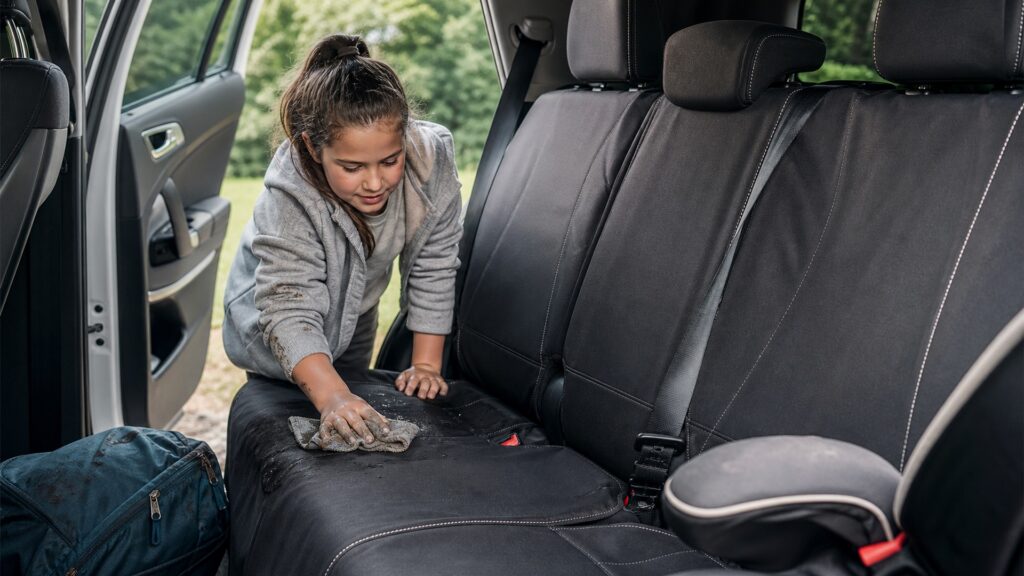
Seat protection works at a material interface where friction, pressure, moisture, sensors, restraints, airbags, and temperature must all remain within acceptable boundaries.
Tip: Before covering a front seat, locate its side-airbag labels, read occupant-sensing warnings, operate every adjustment, and confirm the vehicle manufacturer permits the proposed product.
These terms identify the different jobs and hazards hidden inside the phrase seat protector.
A replaceable surface that receives friction and minor contamination before the original upholstery.
A low-permeability layer intended to delay liquid reaching the seat beneath.
A designed seat-cover region through which a seat-mounted airbag is intended to deploy.
A passenger-seat system that interprets seat loading for airbag decisions.
Air movement through perforations and internal channels intended to manage occupant heat and moisture.
A crash-protection system attached by seat belt or lower anchors and used according to both manuals.
Tip: Do not use a generic airbag-compatible claim as a substitute for exact vehicle documentation and correct orientation.
Sliding loads polish or abrade high-contact areas, ultraviolet exposure changes color and polymer properties, oils attract soil, and liquids carry dye or dissolved material into seams. Protection works by receiving or slowing those exposures before they reach the original surface.
The best barrier addresses the dominant exposure instead of sealing every surface indiscriminately.
A loose cover slides and rubs; a tight cover can load seams, controls, or bolsters. Hooks and straps may contact wiring or mechanisms beneath the seat. Backing texture can imprint or transfer color during heat and pressure.
A protector that moves or concentrates pressure can become the source of the damage it was purchased to prevent.
Seat-mounted airbags must break through a designed path, while passenger classification can respond to how load reaches the cushion. NHTSA materials warn that improper covers may interfere with deployment or sensing, so exact vehicle instructions control.
Safety compatibility is a tested interaction with the specific seat, not a decorative tag or a visible opening alone.
A waterproof membrane slows spills but also slows vapor and airflow. Heated seats raise local temperature; ventilated seats need open passages. Thick cushions can insulate the occupant from both systems and change pressure distribution.
Maximum liquid resistance can reduce breathability and thermal function, so the correct balance depends on the actual seat.
A child restraint needs stable installation, accessible anchors, and adherence to both manuals; an extra protector may be prohibited. Pet and cargo barriers need secure containment. Cleaning should remove contamination without saturating foam or damaging coatings and sensors.
Seat protection is not a substitute for correct restraint, cargo securement, or material-specific care.
A cover can reduce wear only while preserving the seat's sensing, restraint, airbag, heat, ventilation, and adjustment functions.
Targeted barriers can absorb abrasion, pet contact, minor spills, dye transfer, and cleaning cycles that would otherwise reach costly upholstery.
Removable products can match temporary uses such as work clothing, child transport, outdoor equipment, or rented vehicles when compatibility is established.
A cover or cushion that affects an airbag, occupant sensor, belt, child restraint, heater, ventilation path, or seat control is not an acceptable trade.
Waterproofing cannot contain every seam or edge, and hidden liquid, grit, dye, or backing transfer can continue damaging the original surface underneath.
These myths treat the seat as passive upholstery instead of a layered comfort and protection assembly.
Seat-mounted airbag location, deployment seam, cushion geometry, occupant sensors, and attachment paths vary. NHTSA does not provide a universal approval program for covers, so vehicle-specific instructions and credible compatibility evidence remain essential.
Liquid can pass through stitching, openings, edges, attachment holes, or a saturated top layer, then remain trapped against upholstery. Remove the cover promptly, inspect underneath, blot contamination, and dry both surfaces fully.
Extra padding can change child-restraint stability, belt routing, buckle access, and compression during installation. Use a protector only when both the vehicle and child-restraint instructions permit that specific type and placement.
Thickness, insulation, waterproof membranes, backing, poor fit, and unknown material temperature limits can alter heat transfer or create hot spots. Follow the vehicle and product instructions, and stop use if temperature becomes uneven.
Tip: Check the exact seat's airbags, sensors, restraints, heat, airflow, mechanisms, and materials before selecting a barrier.
These answers address airbags, ventilated seats, child restraints, leather-like upholstery, and inspection beneath a cover.
Only when the vehicle manufacturer permits it and the product is specifically documented for the exact seat and orientation. Improper coverage can obstruct deployment; do not cut or modify a generic cover around the label.
It may reduce airflow, especially if it uses foam, dense fabric, or a waterproof membrane. Use only permitted ventilated-seat designs, align perforations, keep passages clean, and confirm actual airflow after installation.
Check both the vehicle and child-restraint manuals. An unapproved layer can alter installation tightness, recline, or buckle access. Correct restraint installation and post-installation movement limits take priority over protecting upholstery.
Choose colorfast, heat-stable, nonreactive backing; clean both surfaces first; avoid trapped moisture; and inspect periodically, especially after high cabin temperatures. Stop use promptly if color, gloss, texture, or tackiness changes.
Inspect after initial use, spills, extreme heat, cleaning, and periodically thereafter. Look for trapped grit, dampness, dye transfer, pressure marks, strap abrasion, blocked perforations, warning lights, and shifted attachment hardware.
Seat protection matters because a compatible sacrificial layer can receive wear, contamination, and repeated cleaning before the original upholstery does.
It remains beneficial only when exact fit and materials preserve airbags, occupant sensing, belts, child restraints, adjustments, heaters, ventilation, posture, and inspection access.
These explainers connect upholstery protection to the accessory interfaces, safety evaluation, and care process that determine whether the added layer belongs in the vehicle.
Review the fit, retention, safety-system, electrical, material, and crash rules that apply across cabin accessories.
Understand why the presence of safety features or accessories does not substitute for broader crash and safety evidence.
Use material-specific cleaning and controlled drying to remove contamination without creating hidden moisture or surface damage.
Choose a retailer
Prices checked regularly. We may earn a commission at no cost to you.