
Tungsten Filament
Fine resistive wire heated to incandescence inside a halogen capsule.
- Its coil has defined dimensions
- Position sets optical focus
- Evaporation contributes to aging
LED and halogen headlights differ first in how they create light. A halogen bulb heats a tungsten filament inside a halogen-gas capsule until it glows. An LED moves current through a semiconductor junction, producing light at one or more small emitting surfaces while driver electronics regulate power.
That difference changes far more than energy use or color. Filament shape, LED chip position, reflector or projector geometry, heat flow, electrical controls, dimming behavior, failure modes, serviceability, and cost all interact. Neither label guarantees a better headlight: IIHS evaluates the complete low- and high-beam pattern because useful seeing distance and glare depend on the installed optical system.
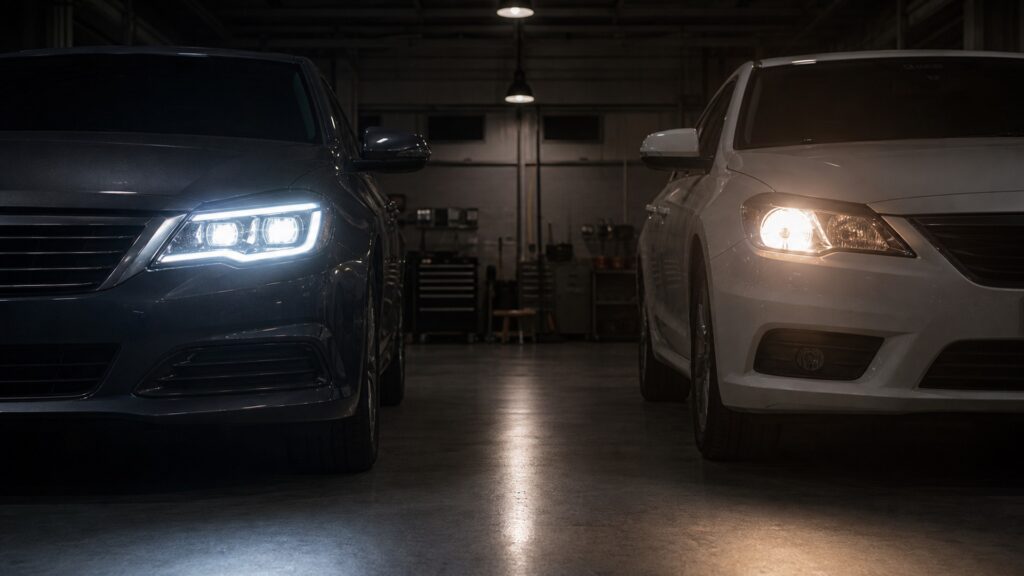
Emitter technology sets physical constraints, but designed optics, aim, thermal control, electronics, and maintenance determine the road result.
Tip: When considering a replacement, confirm that the complete lamp or exact source is approved for the housing and vehicle rather than assuming that a brighter-looking emitter preserves the designed beam.
These terms explain why an LED source is not a drop-in optical equivalent to a filament.
Fine resistive wire heated to incandescence inside a halogen capsule.
Semiconductor light-producing surface packaged with electrical and thermal connections.
Size, position, orientation, and distribution of the area that emits light.
Circuitry that regulates current and may provide dimming, diagnostics, or thermal protection.
Temperature at the active semiconductor region inside an LED.
Designed source location from which a reflector or projector forms its intended distribution.
Tip: Do not install an LED retrofit in a halogen housing unless the complete application is specifically lawful and verified; physical fit and a marketing claim do not establish compliant beam performance.
A halogen lamp passes current through a tungsten filament until heat makes it radiate. An LED produces photons in a semiconductor junction at much lower radiant temperature, although its junction and electronics still generate heat that must be removed.
LED efficiency reduces electrical waste, but it does not eliminate thermal design.
Reflectors and projector shields are designed around the emitting area's exact location and dimensions. A filament radiates around a coil; LED chips emit from flat surfaces. Substituting one geometry can move cutoff, hotspots, and glare even when the base fits.
A source can produce more light while delivering less useful light to critical road locations.
Halogen bulbs are comparatively simple resistive loads. LED lamps require current regulation and a conductive path to a heat sink or housing; some use fans. Diagnostics, pulse-width modulation, voltage transients, moisture, and cramped packaging can affect operation.
Long rated emitter life does not guarantee equal life for drivers, fans, seals, or housings.
Halogen filaments thin and eventually break, often making bulb replacement straightforward. LEDs can lose output or shift color gradually, while driver, solder, seal, or cooling failures may require a module or full assembly rather than an emitter.
Lower routine bulb replacement can be offset by higher component cost and less repairable construction.
Beam intensity at specific angles, curve illumination, high-beam reach, low-beam glare, aim, road surface, and driver vision determine performance. Well-designed halogen systems can outperform poorly designed LEDs, and either technology can be degraded by haze or misalignment.
The meaningful comparison is system performance under the same road task, not color or source wattage alone.
LEDs offer efficient, compact light generation and design flexibility; halogens offer standardized sources and often simpler service.
A purpose-designed LED assembly can combine precise optical elements, lower power draw, adaptive control, and long emitter life.
A sound halogen system can provide predictable source geometry, affordable bulb service, useful heat at the lens, and strong performance when its optics and aim are good.
LED does not automatically mean a longer or less glaring beam, and halogen does not automatically mean weak illumination.
Retrofit compatibility, winter lens clearing, module cost, color preference, and repairability depend on the exact vehicle and lamp design.
These myths treat LED and halogen as interchangeable bulbs distinguished only by brightness.
Some purpose-designed LED systems perform very well, but technology alone does not guarantee seeing distance or glare control. Beam pattern, aim, optics, thermal regulation, lens condition, road geometry, and driver vision determine usable performance.
Mechanical fit does not reproduce the filament's emitting geometry or prove legal compliance. Chip placement, shields, cooling hardware, and electronics can change cutoff, hotspots, dark zones, radio interference, diagnostics, and weather sealing.
LEDs produce less waste heat per unit of light than incandescent sources, but junctions and drivers still need an engineered cooling path. Insufficient cooling reduces output, changes color, triggers protection, or shortens component life.
Halogen is an older technology, yet a well-designed, clear, correctly aimed halogen lamp can provide useful controlled illumination. Poor performance may come from voltage loss, aged bulbs, haze, damaged reflectors, or incorrect aim.
Tip: Trace source geometry through optics, cooling, electronics, and the measured beam before deciding which system is better for a vehicle.
These answers address retrofits, winter use, lifespan, replacement, and evaluation.
Only when the exact source, housing, vehicle, installation, and jurisdiction allow it and the resulting beam is verified. A generic plug-in conversion can alter photometry even if it connects and appears brighter.
Efficient LEDs send less waste heat forward through the outer lens than a hot filament may provide. Housing airflow, lens shape, vehicle motion, ambient conditions, and dedicated heaters determine actual snow and ice behavior.
LED emitters can have long design lives, but the lamp also depends on drivers, cooling hardware, seals, connectors, and optics. Compare warranty, repairability, component availability, and real assembly cost rather than emitter hours alone.
Pair replacement can reduce visible mismatch when one aged bulb fails, but follow the vehicle and bulb-maker guidance. Diagnose voltage, grounds, moisture, reflectors, lenses, and aim when output differs substantially side to side.
Compare independent low- and high-beam measurements, glare, curve performance, aim tolerance, lens condition, adaptive functions, repair cost, winter behavior, and service access on the actual vehicle—not source color viewed against a wall.
LED headlights use semiconductor emitters, regulated electronics, and designed heat paths; halogen headlights use heated tungsten filaments with standardized optical geometry and simpler electrical loads.
The better system is the complete lamp that places adequate light where drivers need it while controlling glare, surviving heat and weather, remaining serviceable, and staying correctly aimed.
These explainers show how source geometry enters a projector or reflector and how the complete visibility system determines the result.
Compare projector and reflector optical architectures without assuming that either housing type guarantees performance.
Place source choice inside the larger system of aim, glazing, signaling, weather, installation, and human vision.
Review why LED headlights matter when their efficiency, controllability, packaging, and limitations are engineered into a purpose-built assembly.
Choose a retailer
Prices checked regularly. We may earn a commission at no cost to you.