
Reflector Bowl
Shaped mirrored surface that redirects rays from the source toward the road.
- Complex facets distribute intensity
- Surface damage reduces output
- Source location is critical
Reflector headlights use a shaped reflective bowl to collect light from a source and send it directly through an outer lens toward the road. Projector headlights use a compact reflector to gather light, a shield to define much of the low-beam cutoff, and a lens that projects the controlled pattern forward.
The projector's extra optical elements can support compact packaging and a sharp boundary, but they do not make every projector superior. Reflector surface design, source placement, lens clarity, shield geometry, aperture size, mounting rigidity, aim, and vehicle pitch determine where intensity lands. Either architecture can see well or perform poorly, and both must be evaluated as complete lamps rather than judged by appearance.
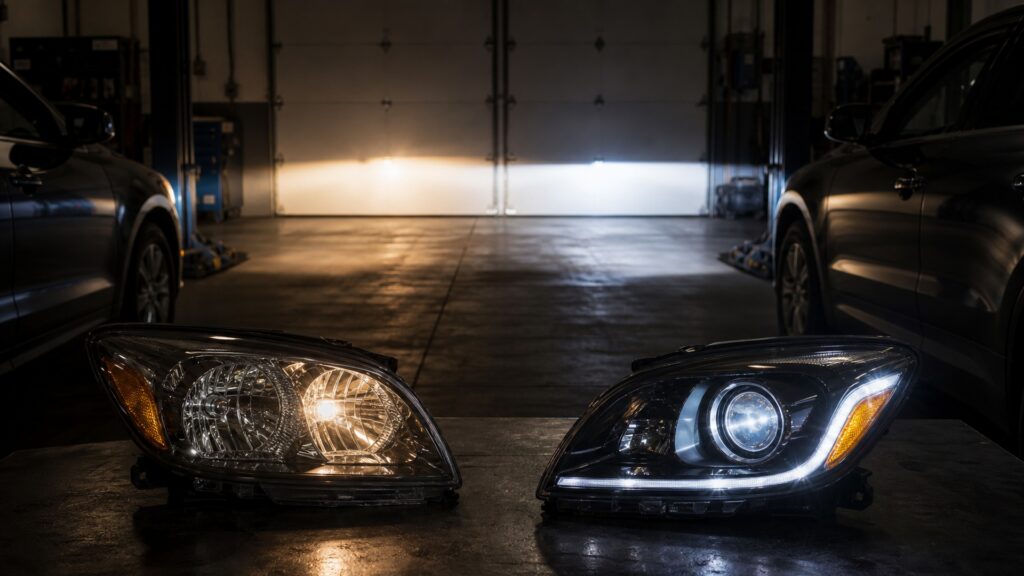
Compare collection, cutoff formation, projection, aim sensitivity, maintenance, and measured road illumination rather than treating a visible lens as proof of quality.
Tip: A sharp cutoff on a garage wall is only one feature; verify that adequate intensity reaches straight roads, curves, shoulders, and high-beam zones without excessive glare.
These terms describe the optical parts that distinguish the two architectures.
Shaped mirrored surface that redirects rays from the source toward the road.
Convex optical element that projects light gathered by an internal reflector and aperture.
Internal metal edge that blocks selected rays to control upper low-beam light.
Specific location where source and optical geometry interact to form the intended output.
Region of relatively high beam intensity intended to support useful seeing distance.
Reference direction through the lamp used to describe alignment and aiming.
Tip: Headlamp housings are not interchangeable based on shape alone; use the correct assembly, source, mounting, wiring, and aiming procedure for the vehicle.
A reflector places the source near a designed focus and uses parabolic or complex-surface sections to send different ray bundles to road zones. Fluting, facets, source shields, or the outer lens may further shape distribution.
Reflectors can distribute light efficiently over a large aperture, but source error is reproduced across the pattern.
A projector's internal reflector concentrates light near an aperture. For low beam, a shield blocks upper rays and its edge is projected by the front lens, creating a defined cutoff; a movable shield may expose more light for high beam.
The sharp boundary comes from an imaged internal edge, not from inherently greater total output.
Projectors can package controlled beams in smaller visible apertures and support adaptive shutters or modules. Reflectors can use a broader face and direct different facets independently. Styling, thermal space, cost, and desired distribution influence the choice.
Architecture gives designers different tools; it does not dictate the finished beam.
Vehicle pitch, damaged tabs, worn adjusters, incorrect source seating, internal haze, burned bowls, shield movement, and outer-lens oxidation alter both types. A projector cutoff makes vertical error conspicuous, while reflector scatter may appear less defined.
Aim cannot repair a damaged optical surface or an incorrectly positioned source.
Useful headlighting depends on intensity at road-relevant points, straight and curve reach, high-beam contribution, glare, aim, and maintenance. IIHS testing shows meaningful variation among complete systems rather than awarding performance by housing type.
Projector and reflector describe optical layouts, not quality grades.
The optical path differs, but source matching, condition, aim, and complete-beam design govern both.
Projectors can create compact, sharply controlled patterns and integrate shutters or adaptive modules.
Reflectors can use a large efficient aperture, simpler construction, broad distributions, and lower-cost service in some designs.
A sharp projector cutoff can coexist with short reach, weak curves, internal bowl damage, or expensive module replacement.
A reflector can scatter badly when its surface, source, lens, mounts, or aim deteriorate, yet a sound design can still perform strongly.
These myths confuse optical architecture with brightness, quality, and compatibility.
Projectors can concentrate and control light effectively, but lens aperture, reflector efficiency, source output, shield losses, beam distribution, and aim vary. A well-designed reflector can outperform a weak or degraded projector in useful road zones.
The cutoff mainly shows control of upper low-beam light. Seeing distance, width, curve illumination, foreground balance, high-beam output, glare below or around the cutoff, and correct aim still require evaluation.
Modern complex-surface reflectors use calculated facets to direct light into defined zones. They may lack a projected shield edge, but can still control distribution well when the source, coating, lens, mounting, and aim remain correct.
Projectors are designed around a precise source size, orientation, focal position, and sometimes a specific arc or filament shield. An incompatible emitter can create shadows, blur the cutoff, reduce hotspots, overheat components, or increase glare.
Tip: Inspect the path from source to road and compare measured performance instead of selecting a housing by visual style.
These answers address identification, retrofits, cutoff shape, maintenance, and choosing between systems.
Look for a distinct convex lens in front of a compact internal module. A reflector exposes a larger mirrored bowl. Some assemblies combine both architectures for separate low, high, fog, or signaling functions.
The shield edge is shaped to control glare while supplying useful light to selected road regions under the applicable beam standard. Pattern direction differs among traffic systems, so imported lamps may be unsuitable.
Cleaning the outer cover helps only if contamination is external. Internal projector lenses, reflectors, shields, or seals may also degrade. Opening a sealed assembly can compromise alignment and weather resistance, so follow approved repair procedures.
A properly engineered complete assembly can work, but inserting a projector requires structural alignment, sealing, thermal clearance, correct switching, photometric compliance, and accurate aim. An improvised conversion is not validated merely because it has a cutoff.
Choose the vehicle or approved lamp with stronger measured low- and high-beam performance, controlled glare, durable optics, acceptable service cost, and useful curve coverage. Housing architecture should be secondary to those outcomes.
Reflector headlights use shaped mirrored surfaces to direct source rays toward the road; projector headlights add a compact collector, cutoff shield, and front lens that projects a controlled image.
Neither architecture guarantees superior vision. Source compatibility, optical condition, mounting, aim, road-zone intensity, curve performance, glare, durability, and serviceability decide the finished result.
These explainers show why emitter geometry must match the housing and why the final beam is only one part of seeing and being seen.
Compare the filament and semiconductor source geometries that reflector and projector optics must be designed to accept.
See how beam architecture interacts with aim, glazing, signaling, weather, wiring, and driver vision in the complete system.
Extend headlamp pattern analysis to conspicuity, signals, reflectors, mirrors, cameras, and clean glazing.
Choose a retailer
Prices checked regularly. We may earn a commission at no cost to you.