
Beam Pattern
Distribution of light by angle and intensity across the road scene.
- It creates seeing zones
- Dark regions can be intentional
- Optics determine shape
Vehicle lighting and visibility products work by managing two directions of information. Headlamps, fog lamps, and auxiliary lamps send controlled light toward the road; marker, brake, turn, and reflective devices help other road users detect and interpret the vehicle. Glazing, mirrors, cameras, wipers, washers, and defogging systems preserve the driver's receiving path.
Performance depends on the full optical system rather than raw brightness. Source position, reflector or projector geometry, lens condition, aim, mounting height, voltage, weather, road reflectance, windshield contamination, and human adaptation determine useful contrast and glare. A product that adds light but scatters it into fog, mirrors, or oncoming eyes can reduce visibility instead of improving it.
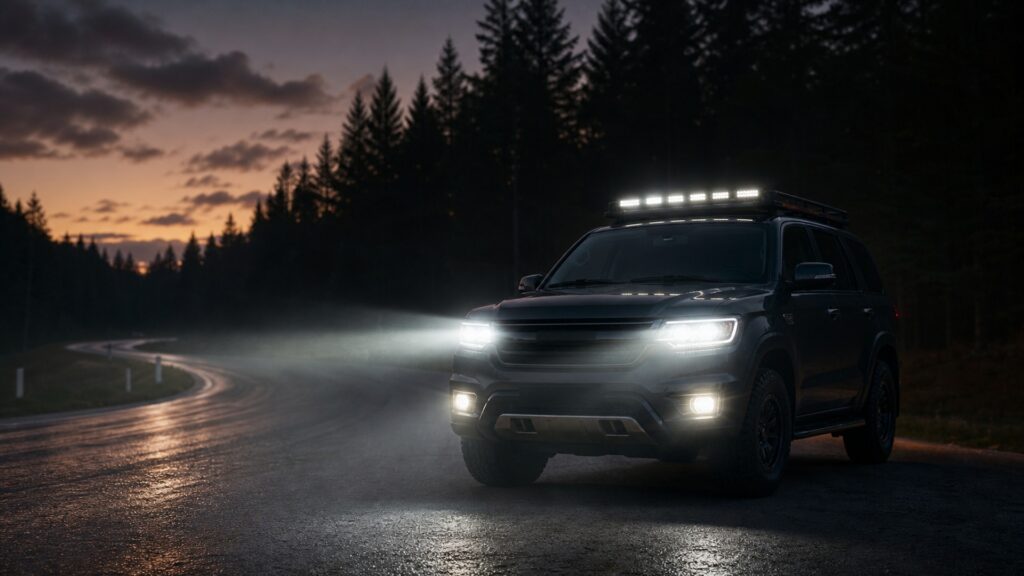
The system must reveal hazards and communicate vehicle intent without creating disabling glare or masking required signals.
Tip: Evaluate changes on a dark level surface with the vehicle loaded normally, then verify real road performance without staring into lamps or exposing other road users to an untested beam.
These terms explain why more emitted light is not automatically more usable vision.
Distribution of light by angle and intensity across the road scene.
Controlled upper boundary in many low-beam patterns that limits upward light.
Angular orientation of the complete lighting unit relative to the vehicle and road.
Difference in luminance or color that makes an object distinguishable from its background.
Light that causes discomfort or reduces another person's ability to see.
Ability of a vehicle or signal to stand out and be recognized in context.
Tip: Do not infer legality from a DOT or SAE marking alone; verify the complete lamp, installation, aim, switching, color, location, and local operating rules.
Halogen filaments, LEDs, and other sources create light at defined positions. Reflectors, projector lenses, shields, and outer lenses collect and distribute it. Moving the source even slightly changes where rays leave the housing.
The useful product is the complete photometric system, not the bulb or diode by itself.
Headlamps reveal road targets, while turn, brake, marker, and hazard lamps communicate presence and intent. Retroreflectors return light toward its source without power. Each function needs distinct color, location, intensity, and timing to remain recognizable.
Adding one bright device must not erase the visual meaning of another required signal.
Light must also pass through clean glazing to the driver or camera. Scratches, haze, films, water, frost, interior residue, poor wiper contact, and condensation scatter light and turn otherwise acceptable lamps into glare.
A headlamp upgrade cannot compensate for a degraded receiving path.
Suspended droplets and snow scatter light back toward the driver; wet pavement can absorb or redirect illumination and produce reflections. Lower, controlled patterns and reduced speed can improve contrast, while excessive high-angle light creates a bright veil.
Adverse-weather visibility is a combined optical and driving-speed problem, not a contest for maximum lumens.
A lamp needs rigid mounting, correct electrical protection, legal switching, controlled aim, thermal management, watertight connections, and ongoing lens care. Suspension, tire, cargo, crash, or body repairs can alter vehicle attitude and aim.
Verification must test both the driver's view and the burden placed on every other road user.
Lighting, signaling, glazing, weather, and driver adaptation form one optical system.
Well-shaped and aimed beams reveal road edges and hazards while required signals make the vehicle's presence and intent legible.
Clean glazing, effective wiping, clear lenses, and maintained electrical supply preserve the designed optical paths.
Wrong sources, poor aim, excessive intensity, high mounting, dirty optics, or unapproved auxiliary lamps can increase glare and reduce contrast.
No lighting product overcomes unsafe speed, dense fog, obscured glazing, fatigue, or a driver's visual limitations.
These myths isolate brightness from optics, aim, weather, and human vision.
Useful seeing depends on beam placement, contrast, glare control, road geometry, weather, and the driver's adaptation. Excess foreground or upward light can constrict pupils, scatter from moisture, and hide darker distant targets.
The source's emitting position, size, orientation, and shield relationship determine how reflector or projector optics distribute light. A source that physically fits can still move the focal geometry and create glare or dark zones.
A transparent outer lens can coexist with broken adjusters, internal haze, degraded reflectors, wrong bulbs, voltage problems, water intrusion, poor aim, or weak output. Performance requires optical and electrical inspection.
Auxiliary lamps should not substitute for failed, degraded, or mis-aimed required lighting. Repair the certified headlighting and signaling system first, then add lawful equipment only for a defined unmet condition.
Tip: Judge the complete beam and the visibility of others, not a source specification in isolation.
These answers cover aim, color, lens restoration, glare, and weather operation.
Check after collision or body repair, suspension or tire changes, lamp replacement, heavy load changes, broken mounts, or persistent glare complaints. Use the vehicle's prescribed aiming method on a suitable level setup.
No. Spectral appearance can influence contrast and preference, but beam distribution, intensity, glare, weather scatter, road surface, eye adaptation, and color rendering all matter. Extremely blue appearance may add discomfort without useful reach.
Some surface oxidation can be refinished with a compatible process and renewed ultraviolet protection. Cracks, deep crazing, internal damage, failed seals, burned reflectors, or severe material loss may require assembly replacement and aiming.
Clean the windshield inside and out, repair scratches or haze, keep eyeglasses clean, dim interior displays appropriately, use correct lamp aim, and address vision concerns. Avoid unapproved films or accessories that reduce requisite visibility.
Use low beams and properly designed fog lamps when lawful and helpful; avoid high beams that illuminate suspended droplets. Slow enough for the visible distance, keep glazing clear, and do not expect lamps to restore normal-weather sight range.
Lighting and visibility products work by shaping emitted light, preserving the driver's optical path, and presenting recognizable signals to other road users.
Treat sources, optics, aim, glazing, weather, electrical installation, and human vision as one system; more light is useful only when it increases contrast without creating glare or masking required information.
These explainers deepen source technology, vehicle conspicuity, and low-mounted adverse-weather lighting.
Examine how drivers see the road and how other road users detect a vehicle through lighting, reflectors, glazing, and maintenance.
Compare LED and halogen systems through source geometry, thermal behavior, optics, electronics, service, and real beam performance.
See why fog lamps use a low, broad, controlled pattern and why their usefulness remains bounded by weather and speed.
Choose a retailer
Prices checked regularly. We may earn a commission at no cost to you.