
Diagnostic Session
A bounded exchange in which a tool connects, identifies communication, addresses modules, requests records, and may issue supported commands.
- Vehicle state matters
- Coverage limits access
- Reports preserve results
OBD tools and car audio systems may share vehicle power or a dashboard workspace, but they answer different questions. A scanner requests controller information, decodes codes and parameters, preserves fault context, and supports tests that narrow a cause. Its primary output is evidence for a diagnosis, not entertainment, guidance, or an incident record.
Car Audio Systems selects media and produces cabin sound. Its chain begins with sources, decoding, signal processing, amplification, and speakers and ends with controlled acoustic output. Combined products or shared screens can blur that boundary, yet each function keeps separate inputs, failure modes, and proof. Choose the system that creates the missing artifact, then verify shared power, controls, mounting, and vehicle behavior.
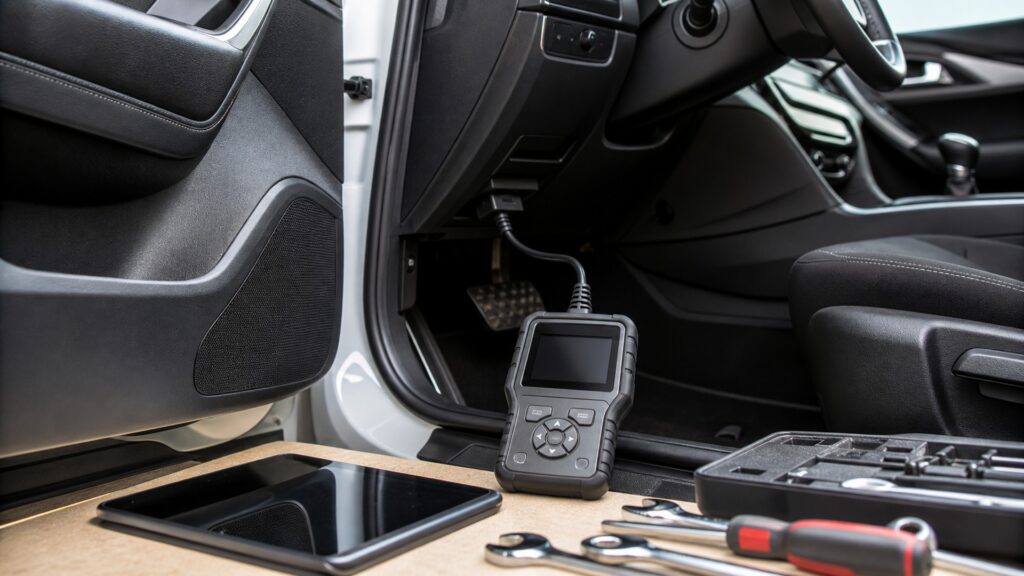
The decisive question is whether the job needs controller diagnostic evidence or controlled acoustic output.
Tip: State the output you must be able to save or experience after the test; that sentence usually identifies the responsible system.
These definitions keep controller evidence separate from the neighboring system's artifact.
A bounded exchange in which a tool connects, identifies communication, addresses modules, requests records, and may issue supported commands.
Codes, status, freeze frame, live values, monitor results, or command feedback supplied by vehicle modules.
An indication of whether an applicable emissions self-test has completed since reset conditions.
The result that justifies the system: diagnostic evidence for OBD or controlled acoustic output for car audio systems.
A display, phone, power feed, mount, speaker, or control used by more than one function.
A test that proves the OBD diagnostic path and the car audio systems path separately before evaluating their interaction.
Tip: Use the artifact name when writing requirements or diagnosing an interaction.
The tool establishes communication, retrieves structured records, graphs values, and sometimes commands supported routines. Those outputs help locate a fault or document state; they are not a substitute for the other system's primary artifact.
Diagnostic value ends where unsupported inference begins.
Its useful result is controlled acoustic output, built from sources, decoding, signal processing, amplification, and speakers. Even when an OBD-connected product displays related information, that does not transfer the neighboring system's complete role or proof.
A shared display can show two artifacts without making them equivalent.
A dongle, receiver, camera, or phone may share supplies, wireless links, mounting space, or network access. Poor integration can create battery drain, communication faults, audio interruptions, blocked controls, or cybersecurity exposure.
Interaction testing follows independent function tests.
Choose OBD capability for codes, status, live data, active tests, or diagnostic reports. Choose car audio systems for controlled acoustic output. If both outputs matter, define two requirement lists rather than accepting one broad feature label.
Clear selection criteria prevent one purchase from being judged against another job.
For OBD, scan required modules, save data, reproduce a condition, and confirm a supported test. For car audio systems, evaluate source switching, frequency balance, channel behavior, level, noise, and retained alerts. Then observe startup, shutdown, interaction, and recovery together.
Two complete tests expose hidden tradeoffs better than a combined demo.
Both may use electronics, a display, a phone, or vehicle power, but OBD produces controller evidence while car audio systems produces controlled acoustic output.
Diagnostic data can help isolate an integration fault without becoming the neighboring function.
Shared alerts or displays can be coordinated when priorities and recovery are tested.
An OBD report cannot deliver controlled acoustic output.
Car Audio Systems cannot prove a controller fault merely by showing a symptom.
These myths mistake shared components for shared purpose or treat diagnostic access as automatic certainty.
Electronic construction does not define purpose. OBD equipment requests and interprets module evidence, while car audio systems selects media and produces cabin sound. Neither chain produces the other's required artifact without additional dedicated hardware and software.
A stored condition can identify communication, voltage, or module observations, but it does not automatically assign physical cause. Inspect shared power, wiring, interfaces, software state, and the neighboring system before drawing that conclusion.
A visible menu shows only that selected interface state. OBD coverage requires module requests and evidence capture; the neighboring function requires its own source-to-output test. Startup, failure, sleep, and recovery also need evaluation.
An adapter may load the connector, remain powered, communicate on vehicle networks, pair wirelessly, or alter cable clearance. Remove it using instructions, inspect for new faults, and verify the neighboring system and vehicle sleep afterward.
Tip: Return every claim to its producing chain.
These answers help assign symptoms, choose equipment, and test combined installations without blurring responsibilities.
Buy for the unresolved output. Choose OBD equipment when you need controller codes, status, parameters, reports, or supported tests. Choose car audio systems when you need controlled acoustic output. If both matter, budget and verify them independently.
They can when supported apps, permissions, wireless behavior, power, privacy, and attention demands remain controlled. Test reconnection, background behavior, calls, updates, and failure recovery; never perform distracting diagnostic interaction while driving.
Save the vehicle state, disconnect one accessory safely, restore a known configuration, and repeat startup, operation, shutdown, and sleep checks. Compare voltage, communication, and the neighboring output before changing several variables together.
It may reveal related module faults, voltage, network status, or supported parameters, but it cannot prove every physical path. Complete the neighboring system's own functional test and use independent measurements for decisive conclusions.
Record vehicle identity, tool and software versions, module scan, saved evidence, accessory connections, power state, configuration, test conditions, and both acceptance results. That baseline makes later updates or intermittent interactions much easier to isolate.
OBD diagnostic tools differ from car audio systems because they interrogate vehicle controllers and organize diagnostic evidence; the neighboring system selects media and produces cabin sound.
Choose by the missing artifact, not the shared screen or plug. When both are installed, prove each source-to-output chain independently and then verify power, controls, networks, sleep, and recovery together.
These explainers deepen the two production chains and the fit controls that keep them from interfering.
Trace the diagnostic request, response, decoding, context, and confirmation path.
Follow the complete car audio systems mechanism and its own acceptance evidence.
Check connector, protocol, module, function, power, and workflow compatibility.
Choose a retailer
Prices checked regularly. We may earn a commission at no cost to you.