
Polyurethane Film
A flexible sheet supplying replaceable physical thickness above paint.
- It absorbs limited impact energy
- It has visible coverage boundaries
- Damaged sections can be replaced
Paint protection film is a flexible polyurethane sheet with adhesive and a functional topcoat. Its measurable thickness can receive small stone strikes, scuffs, and abrasion before the clear coat. Ceramic coating begins as a liquid and cures into a far thinner surface layer that changes water behavior, gloss, contamination release, and chemical resistance.
They therefore address different exposures. Film is the stronger physical barrier in selected impact zones; coating improves surface behavior across complex shapes with little added impact thickness. Either requires sound, corrected paint and compatible care. They can be layered when product instructions permit, but the coating does not turn film into permanent armor and film does not make washing optional.
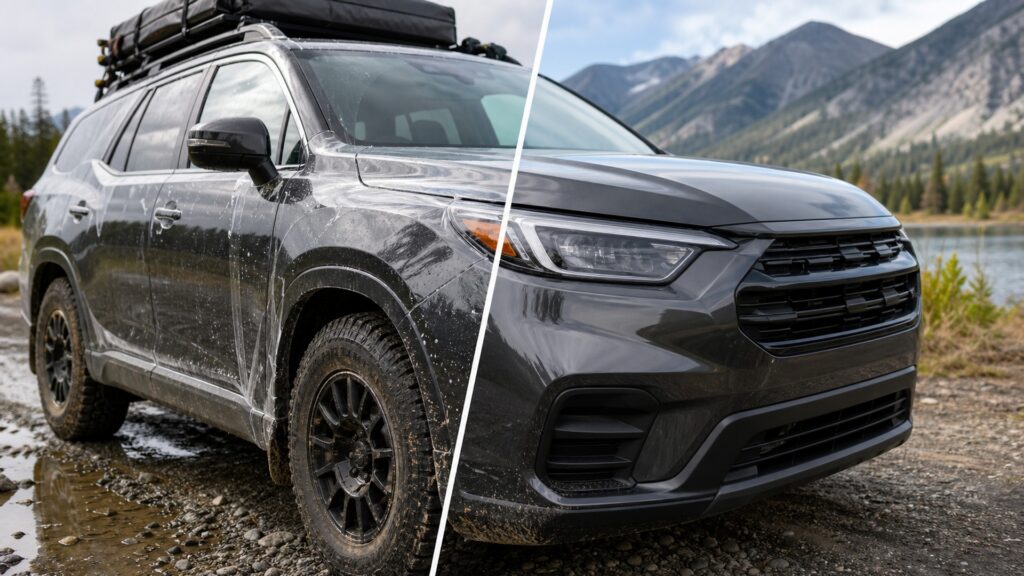
The distinction becomes clear by tracing what each layer does when struck, soiled, washed, aged, and eventually repaired or removed.
Tip: Ask the installer to identify every layer in order—paint, film adhesive, polyurethane, film topcoat, and any coating—because maintenance and correction depend on which surface is actually exposed.
These terms prevent hydrophobic behavior from being mistaken for stone-impact protection.
A flexible sheet supplying replaceable physical thickness above paint.
A cured thin film designed to alter surface energy and contamination behavior.
The bonding layer that attaches PPF through prepared contact and pressure.
Interaction used by coating makers to describe durable attachment to a prepared surface.
The physical boundary at which sheet film ends.
A surface property influencing wetting, beading, and how contamination adheres or releases.
Tip: Product names vary; use technical construction, thickness, coverage, cure, warranty, and approved maintenance to compare real systems.
PPF flexes and distributes some small-impact energy through a polyurethane layer. A ceramic coating may resist light chemical or wash-related effects, but its thinness cannot provide equivalent cushioning against gravel or a sharp physical strike.
Impact protection is the clearest mechanical difference between the two categories.
A sound coating can make water bead or sheet differently and reduce adhesion of some grime, insects, mineral residue, or chemicals. Contamination still lands, water spots still form, and improper washing can still scratch the underlying finish.
Easier release reduces cleaning effort; it does not eliminate contact washing or environmental damage.
Film must be cut, positioned, stretched, squeegeed, and adhered around curves. Coating is leveled as a liquid across prepared panels and cures without sheet seams, though missed areas, high spots, and uneven application can remain.
The installation defects differ because one system manages a shaped sheet and the other manages a reacting liquid.
Damaged PPF is commonly removed and replaced by section, while a coating may require decontamination, polishing, or reapplication. Paint repair normally requires removing both systems from the affected area and rebuilding the protection afterward.
Serviceability depends on knowing the layer stack and the condition of the paint beneath it.
Compatible coating can be applied over certain films to change gloss, slickness, water behavior, or stain resistance. It remains an outer maintenance layer; the polyurethane still provides the meaningful chip barrier and its edges and adhesive still age.
Layering combines distinct jobs only when every product in the stack is designed for the arrangement.
The systems can complement each other because their construction, failure modes, and maintenance jobs are fundamentally different.
Use PPF where gravel, scuffs, door contact, loading, or abrasion makes sacrificial thickness valuable.
Use ceramic coating where broad-area water behavior, contamination release, gloss retention, and easier maintenance are the central goals.
Neither repairs defective paint, prevents dents, eliminates washing, resists every chemical, or remains permanent without inspection.
Layering increases cost and service complexity, and incompatible preparation or products can undermine adhesion, appearance, correction, or warranty support.
These myths collapse two distinct protective mechanisms into one marketing hierarchy.
Coating changes surface behavior but adds too little thickness to cushion stones like polyurethane film. It can complement PPF for maintenance and stain resistance, yet it does not reproduce the film's physical impact layer.
Film protects only covered zones and its exposed topcoat still collects water spots, insects, grime, and stains. A compatible coating may improve maintenance, but the added benefit must justify another layer and care system.
Hardness tests describe particular material behavior under defined conditions, not resistance to every road projectile. Chip outcomes depend on energy, shape, angle, substrate, thickness, and flexibility—areas where sheet film has a different mechanism.
Films age and eventually require controlled removal; coatings wear, contaminate, and may be polished away or reapplied. Climate, washing, storage, chemistry, installation, and product-specific guidance determine actual service life throughout ownership.
Tip: Match the layer to impact, contamination, maintenance, and service needs instead of seeking a universal winner.
These answers address combining systems, existing defects, cost logic, matte finishes, and post-installation care.
Often, when both manufacturers approve the combination and the film has completed its required adhesion period. Use film-safe preparation and recognize that coating maintenance, film edges, impact damage, and eventual removal remain separate concerns.
When compatible systems are layered, PPF generally bonds to properly prepared paint before coating is applied over approved exposed surfaces. Coating beneath film can impair adhesion, so follow the exact film and coating instructions.
Neither is a reliable defect repair. Film and coating can emphasize chips, texture, haze, sanding marks, or contamination under strong light. Inspect and correct the paint appropriately before protection, while preserving adequate clear-coat thickness.
Gloss film or coating can alter matte appearance, while dedicated matte products aim to preserve or deliberately change sheen. Test a representative area and use installers experienced with non-polishable matte paint and edge visibility.
Use the maintenance instructions for the outermost layer, gentle tools, suitable chemistry, careful edge technique, and prompt drying. Inspect film lift, coating behavior, staining, impact marks, and hidden contamination rather than relying on water beading alone.
Paint protection film differs from ceramic coating because polyurethane supplies sacrificial physical thickness, while a cured coating mainly changes the chemistry and maintenance behavior of the exposed surface.
Choose by the dominant damage path, prepare sound paint, understand coverage and service methods, and layer only compatible systems whose separate roles, edges, cure, care, and eventual renewal remain documented.
These explainers deepen each side of the comparison and place both within the complete finish-care system.
Study PPF impact response, adhesive preparation, pattern edges, care, and removal as a complete film lifecycle.
Review ceramic-coating surface chemistry, preparation, contamination behavior, and maintenance limits.
Return both products to the larger process of cleaning, correction, exposure control, and ongoing inspection.
Choose a retailer
Prices checked regularly. We may earn a commission at no cost to you.