
Sacrificial Protection
A renewable layer intended to receive environmental and washing exposure before the finish beneath it.
- Includes several liquid-product families
- Consumes or changes over time
- Needs inspection and renewal
Paint protection matters because a vehicle's visible finish faces several unrelated threats: ultraviolet exposure, detergent and weathering, bird waste and insects, mineral deposits, wash abrasion, road grit, and stone impacts. No single thin product addresses those mechanisms equally, so protection begins by naming the damage worth preventing.
Waxes, sealants, and coatings modify the exposed surface and sacrifice themselves under chemical and cleaning stress. Paint protection film adds a much thicker physical layer that can absorb or spread some impact and abrasion, but it introduces seams, edges, installation cost, aging, and replacement. All systems still depend on prompt cleaning, compatible maintenance, sound paint, and realistic coverage decisions.
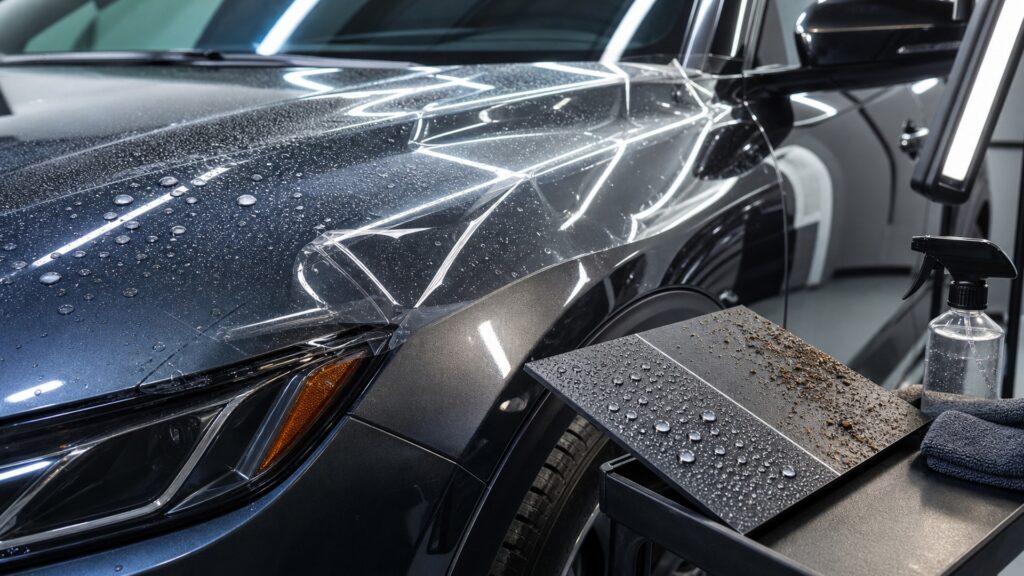
Protection is an engineered stack: choose surface chemistry for weathering and maintenance, physical film for selected impacts, and disciplined care for contamination no passive layer can ignore.
Tip: List the vehicle's actual exposure—highway mileage, outdoor storage, winter salt, tree contamination, washing method, and repair history—before pricing a protection package.
These terms distinguish environmental, contact, and impact protection rather than treating every glossy layer as a shield.
A renewable layer intended to receive environmental and washing exposure before the finish beneath it.
A transparent polymer film adhered over paint to resist selected chips, scratches, stains, and weathering.
Motion energy transferred when grit or debris strikes the vehicle surface.
A film surface engineered to reduce some fine marks when polymer mobility is activated, often by warmth.
Film applied to selected high-exposure zones rather than the entire painted vehicle.
Loss of adhesion or contamination at a film boundary that causes an edge to rise from the panel.
Tip: Ask what failure the layer is designed to interrupt and what happens when that layer ages, stains, lifts, or must be removed.
UV and oxidation change polymers over time; acidic or alkaline contamination reacts locally; washing introduces sliding contact; road debris strikes with concentrated energy. A useful plan does not collapse these failures into generic exposure.
Protection becomes rational only after the damage mechanism has one clear home.
These products can improve repellency, release, gloss, and resistance to some contaminants while taking part of the weathering burden. Their thin films remain vulnerable to abrasion, minerals, strong chemistry, and impacts.
Surface chemistry can make maintenance easier without becoming a physical bumper for the paint.
Paint protection film inserts a flexible polymer layer thick enough to deform under some debris and contact events. Adhesive couples it to paint, while a topcoat controls stain, gloss, and maintenance behavior.
Film can sacrifice itself to an impact that a molecular-scale coating could not meaningfully absorb.
Front bumpers, hood leading areas, mirrors, rocker panels, and door edges receive different exposure. Partial coverage lowers price but leaves transition lines and unprotected regions that may age or chip differently.
A protection package is a map of accepted risk, not a promise that the entire vehicle receives equal defense.
Contamination can stain any exposed layer, aggressive washing can abrade coatings or lift film edges, and aging film may need removal before adhesive or appearance deteriorates further. Maintenance preserves serviceability and reveals failure early.
Protection succeeds when the sacrificial layer can be maintained and replaced without sacrificing the finish it was meant to preserve.
Chemical layers and physical film solve different parts of the damage spectrum while maintenance remains an active control.
A maintained liquid layer can make routine contamination and washing easier to manage, preserving appearance through renewable surface behavior.
Well-installed film on high-strike zones can reduce many chips and light abrasions by deforming and sacrificing material above the paint.
Severe impacts, deep cuts, panel deformation, neglected chemicals, failed paint, poor installation, and incompatible washing can defeat or damage any protection system.
Coverage, formula, environment, storage, mileage, maintenance, and removal timing prevent universal durability or resale-value guarantees.
Paint-protection myths ask one product to solve impact, chemistry, scratching, aging, and maintenance simultaneously.
A cured coating is far thinner than paint protection film and cannot absorb substantial road-debris energy. It may add surface and chemical benefits, but impact resistance requires a mechanism with meaningful thickness and deformation.
Film still collects minerals, insects, tar, road film, and wash marks; its edges and topcoat require compatible cleaning and inspection. Neglect can stain the surface or allow lifted areas to worsen.
Film reduces selected risks but cannot prevent panel deformation, deep penetration, pre-existing failure, moisture at damaged edges, or installation cuts. Removal condition also depends on paint quality, repairs, adhesive, age, and technique.
Some products make specific weathering or UV claims, but gloss alone does not prove absorption, film continuity, or retained performance. Use documented product capabilities and physical exposure controls rather than appearance as evidence.
Tip: Match the layer to the threat and include its own failure, inspection, and replacement path.
These answers address new vehicles, film over repainted panels, partial coverage, coatings over film, and practical inspection intervals.
Early protection can preserve a clean finish, but first inspect carefully for transport damage, contamination, dealer-installed products, and repairs. Protecting unresolved defects makes later correction or warranty documentation more disruptive.
Sometimes, after the refinish system has cured and the installer confirms adhesion compatibility, but removal risk may differ from factory paint. Obtain guidance from the painter, film maker, and installer in writing.
Yes when highway debris concentrates on the bumper, hood edge, mirrors, or fenders and full-body cost is unjustified. Accept visible seams and different aging across protected and unprotected boundaries before installation.
Many film and coating systems permit compatible top products for repellency or cleaning, but chemistry, cure, matte appearance, edge behavior, and warranty requirements vary. Follow both manufacturers' instructions rather than assuming universal compatibility.
Inspect during routine washes and after severe contamination, winter exposure, pressure washing, or impacts. Look for staining, lost water behavior after cleaning, chips, edge lift, bubbling, cuts, haze, and changed gloss.
Paint protection matters because clear coat, liquid protectants, and physical film occupy different layers and interrupt different damage mechanisms.
Define the threat, choose enough film or surface chemistry to address it, map coverage honestly, maintain the exposed layer, and plan safe renewal or removal. No transparent product eliminates observation and care.
Use correction, coating, and product-comparison guides to choose what the paint needs before deciding where physical film earns its cost.
Assess and refine defects before transparent protection preserves the visible starting condition.
Understand bonding, curing, surface behavior, and maintenance for a durable chemical layer.
Choose between renewable sealant and ceramic-spray formats when impact film is unnecessary or already installed.
Choose a retailer
Prices checked regularly. We may earn a commission at no cost to you.