
Panel Preparation
Cleaning that removes polishing oils, residues, and contamination before coating application.
- Reveals the true finish
- Supports direct surface contact
- Chemistry must suit paint and film
Ceramic coatings matter because they form a thin cured layer that changes how automotive paint interacts with water, grime, ultraviolet exposure, and some chemicals. Compared with short-lived sacrificial products, a well-bonded coating can retain water repellency and cleaning ease longer, making careful maintenance more consistent for owners who value that behavior.
The coating is not armor. Its performance depends on clean, compatible paint, uniform application, adequate cure conditions, real-world exposure, and maintenance chemistry. It cannot stop stone impacts, prevent every water spot, repair scratches, or replace washing. The useful decision weighs preparation cost, installation skill, cure logistics, expected environment, and the difference between a coating's intact film and its gradually changing hydrophobic top behavior.
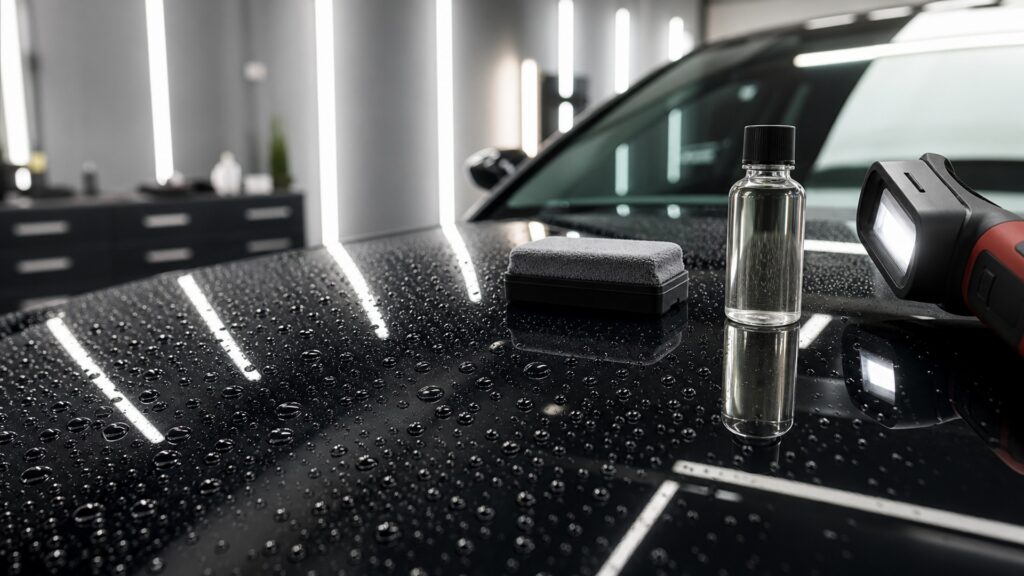
Ceramic-coating value comes from adhesion, crosslinking, uniform film formation, controlled cure, and maintainable surface behavior—not from hardness numbers or water beads alone.
Tip: Inspect and photograph the paint under direct light before coating; after cure, the coating will preserve the prepared condition more readily than it will hide unresolved defects.
These terms explain coating formation, visible behavior, and installation failure modes.
Cleaning that removes polishing oils, residues, and contamination before coating application.
Chemical reactions that connect coating precursors into a more continuous network.
A surface property influencing how liquids spread, adhere, or bead.
The angle at the edge of a liquid droplet on a surface.
An uneven area where excess coating partially cures before leveling.
The controlled period during which the applied film develops resistance before exposure.
Tip: Separate the cured film from water repellency: surface behavior can weaken from contamination even while some coating remains.
Washing and decontamination remove soil; correction addresses selected defects; a compatible panel preparation removes oils and residue. The coating then contacts the actual paint or clear coat rather than an unstable film left by prior products.
Coating over a hidden residue turns the residue into the weakest layer of the system.
The installer distributes a small amount over a defined area, watches the product's flash behavior, levels residue, and allows reactive ingredients to crosslink. Too little, too much, or late leveling can create incomplete coverage or visible excess.
Uniformity comes from repeatable application control, not from pouring on a thicker-looking layer.
Initial wipe-off is not full cure. The developing film can remain vulnerable to water, condensation, detergent, or abrasion for a specified period. Environmental conditions change working time and reaction rate, so instructions must guide release.
Cure management is part of installation, not an optional aftercare suggestion.
Lower wetting and easier release can reduce how strongly ordinary grime remains during washing. Water droplets can still retain minerals, and tight beading may concentrate deposits if water dries on a hot or neglected panel.
Repellency changes cleaning behavior; it does not make water or debris harmless.
Sun, abrasion, road film, detergents, industrial fallout, mineral deposits, and washing technique affect the top surface. Periodic decontamination may restore water behavior when residue masks it, while physical erosion or chemical damage requires another remedy.
Maintenance preserves access to the coating's surface; it does not reset consumed film thickness.
A ceramic coating can improve repellency and maintenance, but its film is thin and preparation-sensitive.
A properly prepared and cured film can provide longer-lived water behavior, chemical resistance, gloss retention, and easier routine cleaning than many shorter-duration protection products.
The maintained surface can release ordinary grime more readily, helping owners use gentler wash processes and preserve a corrected finish.
The coating does not absorb meaningful stone impacts, stop deep scratches, prevent every mineral deposit, or compensate for failed clear coat and poor washing.
Durability claims vary with product, preparation, film, environment, storage, mileage, detergent, abrasion, and maintenance, so no universal lifespan applies.
Ceramic-coating myths turn one lab value or dramatic water video into a complete protection claim.
Pencil-hardness references do not mean a thin automotive coating resists keys, grit, branches, wash brushes, or stone impact like structural armor. Abrasion and penetration depend on load, particle, substrate, film, and test method.
Beading shows current wetting behavior, which can come from coating, topper, residue, or contamination patterns. It does not independently prove film thickness, adhesion, chemical resistance, or remaining service life by itself.
The surface still collects road film, salts, minerals, insects, oils, and fallout. Regular compatible washing removes contamination before it masks repellency or attacks the finish; the coating changes maintenance, not the need for it.
Some systems permit layers, but bonding windows, solvent behavior, leveling, total film, and product compatibility govern the result. Additional applications can waste product or trap defects without delivering a linear lifespan increase.
Tip: Judge bonding, cure, exposure, maintenance, and the exact damage mechanism instead of treating ceramic as a synonym for invulnerable.
These answers address paint correction, new vehicles, water spots, toppers, and recognizing contamination versus coating failure.
Not always. Correction improves defects but removes material, so a new or acceptable finish may need only cleaning and decontamination. The coating preserves what is underneath and will not conceal swirls that remain.
Yes when inspection shows sound, clean, compatible paint, but new vehicles can still carry transport film, rail dust, dealer-applied products, repairs, or defects. Preparation should respond to measured condition rather than vehicle age.
Droplets can leave minerals or pollutants as water evaporates, and heat can accelerate deposition or etching. Repellency changes droplet behavior but does not remove dissolved solids, so prompt drying and suitable spot treatment remain important.
Compatible maintenance products can alter slickness, gloss, or water behavior and may protect the exposed surface temporarily. They can also mask the coating's own condition, so follow system guidance and avoid uncontrolled product stacking.
Wash thoroughly, use compatible chemical decontamination where justified, and compare water behavior across protected areas. Persistent wetting, staining, roughness, or visual damage after cleaning may require installer assessment rather than immediate recoating.
Ceramic coatings matter because a prepared and cured thin film can change surface wetting, chemical exposure, gloss retention, and the effort required for routine cleaning over an extended period.
Their value depends on honest preparation, uniform application, cure control, exposure, and maintenance. They preserve a finish; they do not replace paint correction, impact film, careful washing, or realistic expectations.
Use the detailing workflow, paint-correction guide, and coating-versus-wax comparison to decide whether the surface, goal, and maintenance commitment justify a ceramic system.
Follow the inspection, cleaning, decontamination, correction, preparation, protection, and maintenance sequence that a coating depends on.
Understand paint-thickness limits, test spots, defect removal, and finish inspection before preserving the surface under a coating.
Compare ceramic coatings with wax by film chemistry, application effort, durability, appearance, and maintenance behavior.
Choose a retailer
Prices checked regularly. We may earn a commission at no cost to you.