Material Change
Correction Alters the Surface Plane; Interior Cleaning Preserves the Material while Exporting Soil
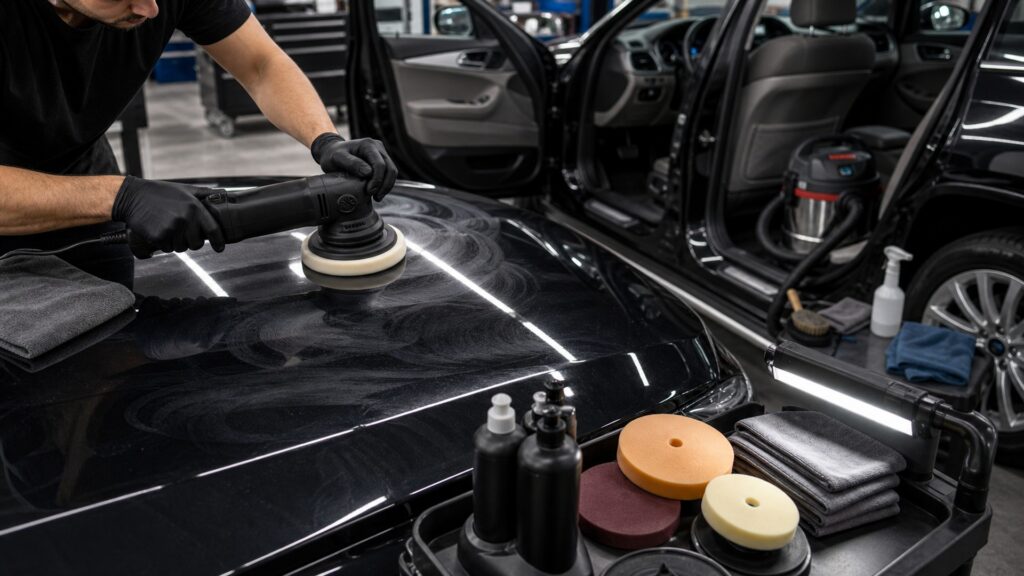
One spends a controlled coating margin around a defect; the other transfers particles, dissolved contamination, residue, and moisture into filters, towels, recovery tanks, and ventilation. Evidence checkpoint 1 pairs intentional coating removal with material-safe chemistry; clear-coat thickness margin is the limiting observation. Record cross-light defect proof before changing exterior protection follow-up, then repeat the intentional coating removal reading after the system reaches a stable cooled, cleaned, powered, or tuned state. For row 224, captured cabin contamination establishes the input condition and hidden moisture retention identifies the expected transformation. If odor and function proof moves outside its limit first, hold material-safe chemistry constant and diagnose that interface instead of adding unrelated passes, pressure, gain, chemistry, or equalization. Boundary check 1 follows intentional coating removal to its destination and contrasts it with material-safe chemistry. Because clear-coat thickness margin belongs to a different material path, evidence for cross-light defect proof cannot close exterior protection follow-up; the operator must apply the category-specific drying, cooling, residue, or function test. The paired inspection records captured cabin contamination on exterior paint and hidden moisture retention inside the weather seals. A change in odor and function proof identifies which workflow failed and prevents abrasive-pad logic from being used to solve hidden moisture or cabin contamination.
- Identify intended removal
- Identify captured waste
- Separate media
- Verify destinations
The categories move different material for different reasons.
Energy Scale
Abrasive Pad Contact and Panel Heat Differ from Moisture-Limited Cabin Agitation
Correction concentrates friction and motion on paint; cabin work meters chemistry, brush action, suction, and liquid to protect coatings, dyes, adhesives, foam, electronics, and restraints. Evidence checkpoint 2 pairs captured cabin contamination with panel heat accumulation; occupant-contact residue is the limiting observation. Record odor and function proof before changing cabin drying release, then repeat the captured cabin contamination reading after the system reaches a stable cooled, cleaned, powered, or tuned state. For row 224, abrasive-pad interface establishes the input condition and clear-coat thickness margin identifies the expected transformation. If exterior protection follow-up moves outside its limit first, hold panel heat accumulation constant and diagnose that interface instead of adding unrelated passes, pressure, gain, chemistry, or equalization. Boundary check 2 follows captured cabin contamination to its destination and contrasts it with panel heat accumulation. Because occupant-contact residue belongs to a different material path, evidence for odor and function proof cannot close cabin drying release; the operator must apply the category-specific drying, cooling, residue, or function test. The paired inspection records abrasive-pad interface on exterior paint and clear-coat thickness margin inside the weather seals. A change in exterior protection follow-up identifies which workflow failed and prevents abrasive-pad logic from being used to solve hidden moisture or cabin contamination.
- Control machine energy
- Test interior materials
- Limit cabin moisture
- Monitor surface change
Tool motion suitable for paint can destroy interior finishes.
Hidden Risk
Paint Has Finite Film Build; Cabins Hide Foam, Wiring, Adhesive, and Mechanisms
Correction risk lies in thin edges, repairs, heat, and breakthrough. Interior risk lies behind the visible face, where liquid and residue can remain or reach sensitive systems. Evidence checkpoint 3 pairs abrasive-pad interface with hidden moisture retention; cross-light defect proof is the limiting observation. Record exterior protection follow-up before changing intentional coating removal, then repeat the abrasive-pad interface reading after the system reaches a stable cooled, cleaned, powered, or tuned state. For row 224, material-safe chemistry establishes the input condition and occupant-contact residue identifies the expected transformation. If cabin drying release moves outside its limit first, hold hidden moisture retention constant and diagnose that interface instead of adding unrelated passes, pressure, gain, chemistry, or equalization. Boundary check 3 follows abrasive-pad interface to its destination and contrasts it with hidden moisture retention. Because cross-light defect proof belongs to a different material path, evidence for exterior protection follow-up cannot close intentional coating removal; the operator must apply the category-specific drying, cooling, residue, or function test. The paired inspection records material-safe chemistry on exterior paint and occupant-contact residue inside the weather seals. A change in cabin drying release identifies which workflow failed and prevents abrasive-pad logic from being used to solve hidden moisture or cabin contamination.
- Map paint history
- Locate cabin systems
- Protect edges and openings
- Stop on unknown construction
Invisible structure defines both boundaries differently.
Acceptance Evidence
Correction Requires Stable Defect Reduction; Interior Cleaning Requires Dry Safe Occupant Contact
Paint is cooled, cleaned of polish, and cross-lighted. Cabins are checked for dry textiles, no wick-back, neutral odor, clear glass, safe control grip, belts, warnings, and electronics. Evidence checkpoint 4 pairs material-safe chemistry with clear-coat thickness margin; odor and function proof is the limiting observation. Record cabin drying release before changing captured cabin contamination, then repeat the material-safe chemistry reading after the system reaches a stable cooled, cleaned, powered, or tuned state. For row 224, panel heat accumulation establishes the input condition and cross-light defect proof identifies the expected transformation. If intentional coating removal moves outside its limit first, hold clear-coat thickness margin constant and diagnose that interface instead of adding unrelated passes, pressure, gain, chemistry, or equalization. Boundary check 4 follows material-safe chemistry to its destination and contrasts it with clear-coat thickness margin. Because odor and function proof belongs to a different material path, evidence for cabin drying release cannot close captured cabin contamination; the operator must apply the category-specific drying, cooling, residue, or function test. The paired inspection records panel heat accumulation on exterior paint and cross-light defect proof inside the weather seals. A change in intentional coating removal identifies which workflow failed and prevents abrasive-pad logic from being used to solve hidden moisture or cabin contamination.
- Use category-specific proof
- Wait for stabilization
- Check function
- Document remaining limits
A glossy or clean appearance closes neither workflow.
Aftercare
Corrected Paint Needs Protection and Gentle Washing; Cleaned Cabins Need Dryness and Prompt Soil Control
The exterior plan preserves a reduced coating margin; the interior plan prevents moisture retention, residue, and recontamination while keeping occupant surfaces functional. Evidence checkpoint 5 pairs panel heat accumulation with occupant-contact residue; exterior protection follow-up is the limiting observation. Record intentional coating removal before changing abrasive-pad interface, then repeat the panel heat accumulation reading after the system reaches a stable cooled, cleaned, powered, or tuned state. For row 224, hidden moisture retention establishes the input condition and odor and function proof identifies the expected transformation. If captured cabin contamination moves outside its limit first, hold occupant-contact residue constant and diagnose that interface instead of adding unrelated passes, pressure, gain, chemistry, or equalization. Boundary check 5 follows panel heat accumulation to its destination and contrasts it with occupant-contact residue. Because exterior protection follow-up belongs to a different material path, evidence for intentional coating removal cannot close abrasive-pad interface; the operator must apply the category-specific drying, cooling, residue, or function test. The paired inspection records hidden moisture retention on exterior paint and odor and function proof inside the weather seals. A change in captured cabin contamination identifies which workflow failed and prevents abrasive-pad logic from being used to solve hidden moisture or cabin contamination.
- Protect refined paint
- Use low-abrasion washing
- Keep cabin materials dry
- Respond to spills promptly
Maintenance follows the physical change that occurred.