
Portable Power Station
Integrated removable battery appliance with regulated outputs, charging inputs, controls, and enclosure.
- Ports share internal limits
- Firmware may govern protection
- Repairability varies
Portable power stations and dual battery systems store energy for refrigeration, lighting, communications, electronics, and camp equipment, but they organize it differently. A power station is a removable enclosure with battery, protection, display, outlets, and charging inputs. A dual battery system distributes those functions through a vehicle installation.
That difference changes charging rate, wiring, output flexibility, repair, heat, security, portability, and starting-battery protection. Portable stations minimize installation and can move between vehicle, camp, and home. Dual systems can integrate higher-current DC loads and alternator charging, but require engineered fusing, conductors, battery chemistry controls, ventilation or thermal management, and isolation. The better choice follows an honest energy budget and installation tolerance.
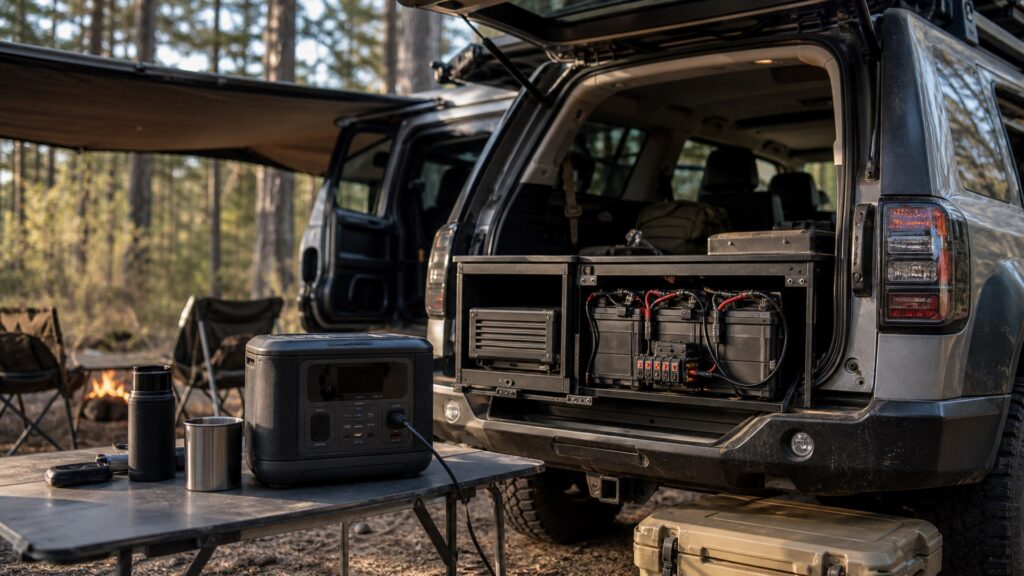
List continuous and peak power, daily watt-hours, trip duration, temperature, charging sources, starting reserve, portability needs, and acceptable installation complexity before comparing capacity labels.
Tip: Run the intended refrigerator, lights, communications, and highest-power appliance for a full simulated day, then recharge through the planned vehicle, solar, or mains source and record actual energy and time.
These terms describe energy capacity, output limits, charging control, and starting protection.
Integrated removable battery appliance with regulated outputs, charging inputs, controls, and enclosure.
Auxiliary battery dedicated to house or accessory loads rather than engine starting.
Unit of stored or consumed energy equal to one watt for one hour.
Short-duration output available for startup loads above continuous inverter rating.
Device regulating alternator or starter-battery energy into the service battery's required charge profile.
Electrical separation that prevents accessory consumption from disabling engine starting.
Tip: Lithium batteries can present fire, burn, and high-current hazards; use listed products, current recall information, manufacturer instructions, protected wiring, secure mounting, and qualified installation.
A portable station contains matched cells, BMS, charger, inverter, display, and sockets behind a warranty boundary. A dual system connects selected batteries, chargers, fuses, busbars, conductors, monitors, and outlets across the vehicle.
Convenience comes from pre-integration; customization comes with responsibility for every interface.
Direct DC loads avoid inverter conversion but need suitable voltage and connectors. AC appliances add inverter loss and high startup demand. Port-level, combined-output, cable, temperature, and low-voltage limits may stop a load before nominal capacity is empty.
A capacity number cannot prove that a specific outlet can start or sustain an appliance.
Portable stations accept defined adapters and input ceilings; some charge rapidly from mains but slowly from a vehicle socket. Dual systems can use a designed DC-DC charger sized to alternator, wiring, battery, temperature, and drive time.
Energy autonomy depends on replenishment per day, not merely storage on departure.
A station can be carried to camp or removed from heat and theft exposure but needs secure crash restraint and cable management. A dual battery preserves cargo space choices yet exposes components to vibration, water, heat, and installation damage.
Portable does not mean safe loose cargo, and installed does not mean maintenance-free.
Both systems estimate state of charge rather than measuring a fuel tank. A station may hide cell and board faults inside proprietary packaging; a dual system exposes replaceable components but requires understanding voltage, current, chemistry, and configuration.
The more critical the load, the more important transparent monitoring and a plan for partial failure become.
The distinction is appliance portability versus vehicle-level customization, charging, distribution, and service.
Loads fit its verified ports, charging opportunities match its input limits, portability matters, and a reversible low-installation solution is preferred.
The unit can be restrained, ventilated, protected from water and temperature extremes, updated, inspected for recalls, and removed for charging or other uses.
Permanent higher-current DC loads, faster controlled alternator replenishment, distributed outlets, and integrated monitoring justify engineered wiring and installation.
Neither architecture fixes an unrealistic energy budget, undersized charging, unsafe lithium storage, poor ventilation, damaged cables, or dependence on one critical electrical load.
These myths confuse nameplate capacity with usable system performance and safe integration.
Nominal arithmetic ignores inverter and DC conversion loss, standby consumption, temperature, battery protection reserve, cable drop, aging, and load variation. Measure actual outlet energy and preserve margin rather than planning to complete depletion.
Battery chemistry, low internal resistance, smart-alternator behavior, wiring, temperature, and charging voltage matter. Controlled DC-DC charging or other manufacturer-approved regulation may be necessary to protect alternator, starter battery, and service battery.
Their mass becomes a crash load, and impacts can damage lithium cells or terminals. Use secure manufacturer-compatible restraint, ventilation, protected cables, suitable temperature, and placement away from water, exits, and occupant strike zones.
Watts describe power rate, while watt-hours describe energy. A larger inverter may enable heavier appliances but can increase standby loss and drain the same battery faster; daily energy and recharge determine duration.
Tip: Compare measured load, output port, charging path, thermal environment, and failure boundary together.
These answers cover sizing, refrigerators, charging while driving, lithium safety, and starting protection.
Measure each device's running and startup power, daily duty cycle, voltage, and criticality; add conversion and temperature loss; choose usable energy reserve; then confirm every output and charging source can support the plan.
Either can work if its DC output, connector, cable drop, usable energy, low-voltage behavior, temperature, and charging rate are adequate. Permanent daily refrigeration often favors integrated wiring; shared occasional use may favor portability.
Many can, but vehicle-socket power may be limited and connectors can overheat. Use approved cables and input limits, secure the unit, preserve ventilation, verify ignition behavior, and avoid draining the starter battery while parked.
Check recalls, enclosure damage, swelling, unusual heat or odor, water exposure, connector condition, firmware, temperature limits, ventilation, and charging instructions. Stop using abnormal equipment and follow manufacturer and local hazardous-battery guidance.
A properly designed system isolates accessory loads and uses controlled charging, low-voltage disconnects, or approved relays so the starter battery retains reserve. Correct wiring, configuration, monitoring, and manual-override discipline remain essential.
Portable power stations combine storage, charging, protection, inverter, display, and outlets in a removable appliance; dual battery systems integrate a service battery and protected charging and distribution into the vehicle.
Choose by measured energy and power, recharge time, portability, installation tolerance, serviceability, thermal environment, and starting isolation—not headline capacity; engineer restraint, fusing, wiring, and lithium safety in either case.
These explainers place storage and charging choices inside payload, resource autonomy, mounting, access, and failure planning.
Place electrical storage alongside water, shelter, payload, navigation, communication, mobility, and field repair in a balanced remote-travel plan.
Evaluate whether a removable station solves the need more cleanly than permanent battery, charger, distribution, and body or electrical modifications.
Apply documented inspection, correct charging, recall checks, careful installation, and service records to long-term auxiliary-battery health.
Choose a retailer
Prices checked regularly. We may earn a commission at no cost to you.