
Terrain Envelope
Range of surfaces, grades, clearances, water, and weather the prepared vehicle can manage.
- Driver skill sets the boundary
- Tires define available traction
- Conditions can change rapidly
Off-road and overlanding gear works by extending the conditions a vehicle and its occupants can manage without outside infrastructure. Tires, protection, recovery tools, storage, shelter, water, power, navigation, communications, and repair supplies each address a specific failure or resource gap beyond paved-road assumptions.
The equipment becomes a system because every addition changes mass, center of gravity, clearance, electrical demand, access, braking, cooling, and recovery loads. Capability does not come from carrying every product. It comes from matching route hazards and trip duration to verified vehicle limits, arranging critical equipment by load and access, training before departure, and preserving enough payload, energy, water, traction, and mechanical margin for the unexpected.
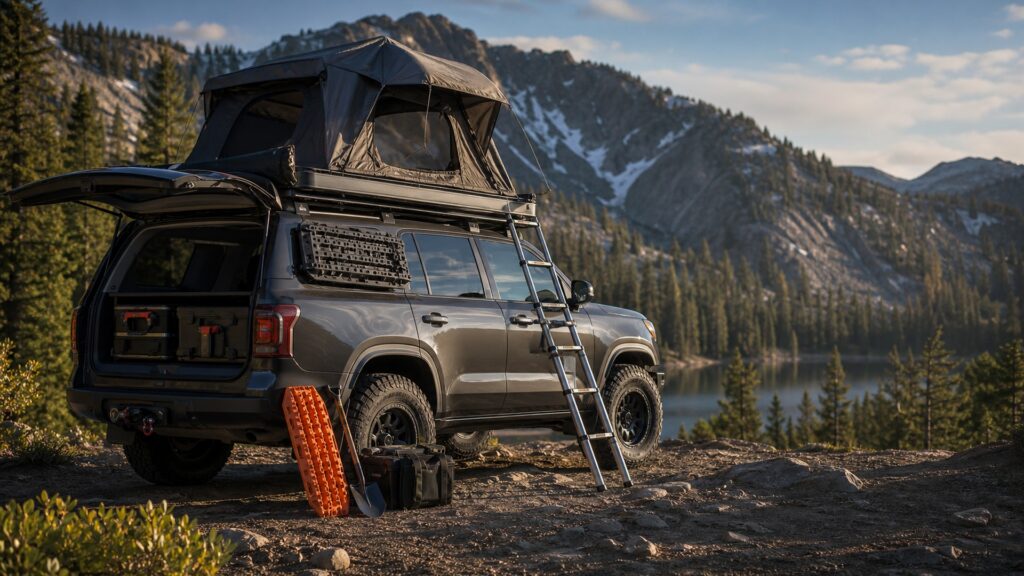
Define terrain, remoteness, weather, occupants, duration, and credible failures; then select compatible equipment whose combined mass and interfaces stay within vehicle limits.
Tip: Conduct a driveway systems test with the vehicle fully loaded: weigh axle loads, deploy shelter and recovery tools, run electrical consumers, access first aid and fire equipment, and simulate a tire problem.
These terms connect individual products to vehicle-level capability and limits.
Range of surfaces, grades, clearances, water, and weather the prepared vehicle can manage.
Unused allowable carrying capacity after occupants, fuel, accessories, cargo, and tongue load.
Route through which force travels from cargo or recovery equipment into vehicle structure.
Tire inflation selected for load, speed, surface, construction, and manufacturer guidance.
Estimate of electrical consumption, storage, charging input, conversion loss, and reserve over time.
Design feature preventing one fault from disabling unrelated critical systems.
Tip: Remote travel can expose occupants to severe weather, fire, wildlife, unstable terrain, isolation, and high-energy recoveries; route-specific training and emergency planning remain essential.
Tread, construction, load capacity, pressure, suspension travel, approach geometry, and underbody protection determine whether torque reaches the ground without striking or overheating components. Pressure changes the contact patch but also sidewall flex and bead security.
Recovery equipment cannot compensate for a vehicle repeatedly driven beyond its mechanical terrain envelope.
Shovels and traction boards reduce resistance; straps transfer vehicle momentum; winches apply controlled line pull. Rated recovery points, compatible connectors, safe zones, communication, inspection, and trained rigging keep force within intended paths.
A recovery is an engineered load case, not proof that a vehicle is indestructible.
Roof loads raise the center of gravity and increase wind sensitivity; rear overhang unloads the front axle; loose items become projectiles. Dense equipment belongs low and between axles when practical, with frequently needed safety items accessible.
Organization matters only after mass, structure, and crash restraint are correct.
Shelter manages heat, wind, precipitation, insects, and sleep; water supports drinking, cooking, and hygiene; electrical storage runs communications, refrigeration, lighting, and medical needs. Each requires replenishment, contamination control, and reserve.
Autonomy is the time until the first critical resource fails, not the size of the largest container.
Offline maps, route notes, satellite or radio communication, first aid, tools, spares, diagnostic information, and check-in plans support decisions when cellular service disappears. Repair kits help only when matched to likely faults and practiced skills.
The most valuable gear often provides information early enough to avoid using recovery equipment at all.
Mobility, recovery, load, shelter, water, power, information, and repair systems must reinforce one another without exhausting vehicle limits.
Equipment maps to specific route hazards, has compatible interfaces, fits within payload and axle ratings, remains accessible, and has been deployed in training.
Critical functions retain independent reserves: starting, navigation, communication, water, first aid, fire response, tire mobility, and an exit plan.
No accessory overcomes unsafe weather, closed routes, medical emergencies beyond training, structural damage, insufficient fuel or water, excessive load, poor judgment, or absent communication.
Adding mass can reduce the very clearance, cooling, braking, stability, range, and recovery capability the equipment was intended to improve.
These myths treat remote-travel preparation as accumulated products rather than managed vehicle and human limits.
Every item consumes payload, space, fuel, braking margin, suspension travel, and access while possibly raising the center of gravity. Capability rises only when equipment addresses a likely failure better than its added burden.
Four-wheel drive can increase traction until all four tires lose grip, the vehicle becomes high-centered, or terrain exceeds clearance. It may carry the vehicle farther from assistance, making rated recovery points and planning more important.
The roof, rails, rack, feet, crossbars, and fasteners each have limits. Elevated mass changes rollover resistance, crosswind response, clearance, and fuel use; dynamic and static ratings must not be confused.
A reliable stock vehicle with suitable tires, conservative routing, communications, water, basic recovery, maintenance, and skilled decisions can outperform a modified but overloaded system. Preparation should follow the actual route, not an aesthetic.
Tip: Evaluate what fails, how it is detected, how the response is practiced, and which reserve remains afterward.
These answers cover priorities, payload, redundancy, training, and departure decisions.
Start with vehicle maintenance, appropriate tires, pressure gauge and inflation, first aid, fire control, navigation, communication, water, weather protection, and route-compatible recovery. Comfort and convenience follow after mobility and survival margins.
Use the certification label and manual, then weigh the fully loaded vehicle and individual axles when possible. Include people, fuel, water, accessories, roof equipment, cargo, and trailer tongue weight against every applicable limit.
Prioritize independent backups for navigation, communication, fire starting where lawful, water containment, critical medication, lighting, and tire pressure measurement. Redundancy should not share the same battery, container, mounting point, or failure mechanism.
Training reveals missing adapters, inaccessible storage, confusing controls, damaged parts, unrealistic setup times, unsafe body positions, and procedures that fail during deployment in wind, darkness, rain, cold, fatigue, or limited space.
Turn back when weather, route condition, fuel, water, daylight, health, mechanical warnings, communications, driver fatigue, or recovery margin no longer support the planned exit. Reaching camp is never more important than preserving options.
Off-road and overlanding gear works by matching mobility, recovery, storage, shelter, water, power, navigation, communication, and repair systems to defined terrain, duration, and failure modes.
Keep the complete vehicle within payload, axle, roof, electrical, thermal, and structural limits; secure and practice every critical tool; preserve independent reserves; and turn around before equipment margins disappear.
These explainers deepen the highest-consequence subsystems rather than offering another generic packing list.
Build a recovery equipment system around resistance reduction, rated connections, stored energy, safe zones, and practiced communication.
See how a roof top tent affects dynamic roof load, parked stability, ladder forces, weather, deployment, and daily vehicle use.
Compare portable power stations with integrated dual-battery systems through energy, power, charging, isolation, installation, and service.
Choose a retailer
Prices checked regularly. We may earn a commission at no cost to you.