
Signal Warning
A brief detector output based on classified radio, optical, location, or database observations.
- It carries uncertainty
- Priority matters
- It is not entertainment
Radar detectors and car audio systems both produce cabin sound, but the similarity ends at the final presentation. A detector receives external radio or optical energy, classifies an uncertain event, and issues a short priority alert. Its useful output is situational information about a detected signal.
A car audio system begins with music, speech, calls, or other selected media. It decodes and processes those signals, drives amplifier channels, and turns electrical output into sound through speakers. A detector may speak through a receiver or interrupt music, yet that handoff does not make the audio system responsible for detection. Each chain needs its own sources, controls, faults, and proof.
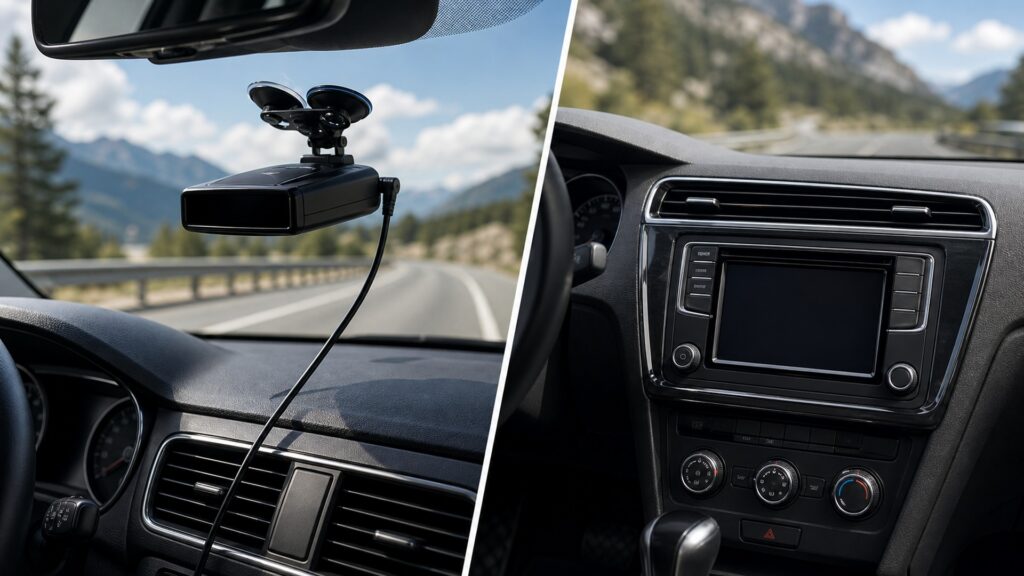
One system decides whether an observed radio pattern deserves attention; the other reproduces chosen content with controlled sound quality.
Tip: Follow information backward from the sound: an alert begins at a receiver observation, while music begins at a selected media source.
These terms preserve the boundary where an alert enters the audio path.
A brief detector output based on classified radio, optical, location, or database observations.
Music, speech, calls, or other content selected for sustained playback through the audio chain.
A change in tone, repetition, voice, strength display, or direction as detector evidence changes.
Temporary reduction of program level so a higher-priority prompt or alert remains audible.
An electrical output path that supplies a speaker or speaker group after source processing.
A supply or ground dependency capable of coupling noise, resets, or sleep behavior between accessories and audio equipment.
Tip: Name which system owns detection, level, priority, and final speaker output.
The detector's antenna and optical sensor collect environmental signals. Filtering, pattern analysis, direction, strength, location, and settings determine whether the device remains silent or issues an alert.
The detector creates information before any speaker reproduces it.
The audio system selects a radio, phone, storage, microphone, or other source; then decoding, equalization, routing, amplification, and loudspeakers shape the listening result.
Audio quality begins with program content, not environmental detection.
A detector can use its own speaker, Bluetooth, an auxiliary input, or an integration path. The receiver may mute music, set volume, or route the alert, but the detector still owns the original classification.
A clean handoff preserves both intelligibility and normal playback.
Detector silence may follow no signal, obstruction, disabled bands, a lockout, or receiver failure. Audio silence can follow source selection, mute, processing, amplification, wiring, or speakers. Shared power can affect both.
The correct fault tree starts with the missing artifact.
For the detector, verify configuration, known alerts, direction, mute, and recovery lawfully. For audio, play reference sources through all channels and test controls, calls, alerts, startup, and sleep.
Independent proof prevents one working speaker from validating the wrong system.
Alert volume belongs to the output path; detection quality depends on incoming energy, antenna geometry, filters, classification, and settings before the sound is created.
Shared speakers can make alerts more audible when routing, latency, and priority are controlled.
Common power and controls can simplify use if noise and sleep behavior remain stable.
An audio amplifier cannot recover a signal the detector failed to receive.
A radar detector cannot improve source quality, channel balance, bass response, or speaker output.
These myths treat cabin sound as proof that the same electronics produced its meaning.
It can feed an audio input, but its core job occurs earlier: receiving and classifying external signals. Music sources provide intended program content, while detector alerts represent uncertain events that require different controls and interpretation.
Speakers reproduce the alert after detection and classification. They cannot improve antenna capture, receiver noise, filtering, windshield loss, band coverage, or processing; they only change how the existing alert sounds inside the cabin.
Ducking shows that a trigger reached the integration path, not that the detector identified the source correctly. False alerts, database warnings, button tests, and software events can all invoke the same audio behavior.
They may share outlets, ground, wireless links, speakers, dashboard space, or sleep timing. Power noise can affect reception, alert routing can interrupt calls, and an always-live accessory can contribute parked battery drain.
Tip: Trace every sound to its information source.
These answers clarify selection, speaker integration, interference, and testing.
The car audio chain is responsible. Evaluate source files, decoding, equalization, gain structure, amplifier channels, speakers, installation, and cabin acoustics. A detector can only add alerts and cannot repair any of those playback stages.
Some products support a compatible wired, wireless, or receiver-mediated path. Verify latency, volume control, media ducking, call interaction, channel routing, reconnection, and recovery; the exact capability depends on both devices and installation.
A switching adapter or cable can radiate or conduct interference near the receiver. Compare operation with the accessory removed, change one variable at a time, and use supported power hardware and routing before blaming outside sources.
Configure while parked at a level recognizable over normal cabin noise without startling occupants or masking required vehicle warnings. Test day and night profiles, automatic volume behavior, mute controls, and audio-system priority changes.
Demonstrate detector reception and classification independently, then verify every audio source and channel. Finally test alert routing, ducking, calls, vehicle warnings, startup, shutdown, noise, reconnection, and parked sleep-current behavior together.
Radar detectors differ from car audio systems because they convert environmental radio or optical observations into short warnings, while audio systems convert selected program sources into controlled cabin sound.
Shared speakers or power create an interface, not equivalence. Verify detection and playback separately, then test priority, latency, noise, resets, and sleep wherever their paths meet.
These explainers deepen radar reception, audio production, and the operating controls that govern their handoff.
Follow radio capture, filtering, classification, context, and alert presentation.
Follow media selection, signal processing, amplification, and speaker output.
Test alert, mute, sensitivity, lockout, audio handoff, and recovery behavior.
Choose a retailer
Prices checked regularly. We may earn a commission at no cost to you.