
Running Board
A longitudinal platform offering an extended stepping surface along the body.
- Several doors may share it
- Width supports varied placement
- Length adds mass and exposure
Running boards usually provide a long continuous stepping surface beneath multiple doors, spreading access along the cab. Side steps are often shorter pads, hoops, or bars positioned at one or more entry points. Product naming is inconsistent, so geometry and mounting matter more than the label.
A long board can simplify foot placement for several occupants and help shield the rocker from light road spray, but it adds width, mass, cleaning area, and possible clearance loss. A compact step preserves more open space yet demands accurate foot placement. Neither should be confused with a structural rock slider unless engineered and rated for that load.
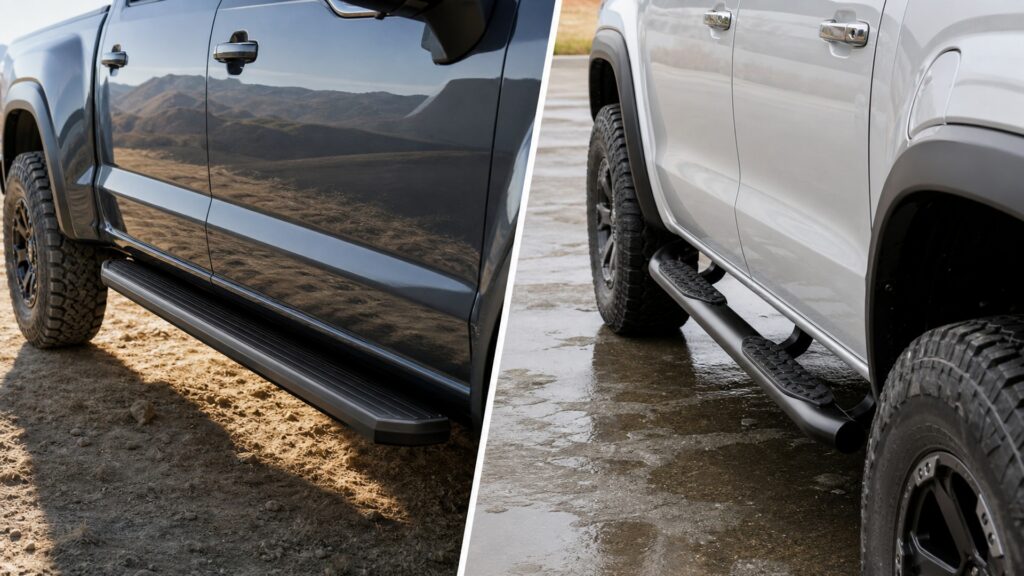
Measure where feet land, how brackets carry load, and what happens through doors, terrain, weather, and vehicle motion.
Tip: Test entry and exit with every intended occupant while parked, using normal footwear and all doors; confirm the chosen foot placement does not require twisting, jumping, or stepping on an unsupported edge.
These terms resolve ambiguous product names through measurable geometry and function.
A longitudinal platform offering an extended stepping surface along the body.
A localized step, hoop, or short bar placed near a door opening.
The textured area intended to receive footwear.
Distance and arrangement among mounts supporting the step.
Vertical space between the accessory and the terrain.
A structural off-road component intended to receive terrain contact and protect rocker areas.
Tip: Use the vehicle-specific installation drawing and load rating; similar-looking boards can attach to very different body, pinch-weld, or frame structures.
A running board offers a longer landing zone across one or more doors. A side step concentrates grip in a smaller area, which can preserve space but requires the pad to align precisely with the natural entry and exit path.
The better geometry reduces the vertical climb without creating an awkward lateral reach or unstable transfer.
Occupant weight acts through the outer step edge into brackets and vehicle mounts. Longer boards distribute several possible foot positions but can flex between supports; compact steps concentrate force near fewer attachment points.
A claimed capacity is meaningful only for the exact mounting system and permitted loading location.
Full-length boards and low brackets can reduce breakover or side clearance and collect contact across a larger area. Short steps may avoid some obstacles, yet a single low bracket can still become the limiting point.
Product outline, not category name, determines what reaches terrain first.
Boards gather mud, salt, snow, and ice along a broad platform, while side-step pads can pack contamination into one critical foothold. Powered boards add pivots, motors, sensors, wiring, and stow logic that require clean movement.
An entry aid that loses traction or fails to deploy predictably can create the fall risk it was meant to reduce.
Running boards fit multiple doors, varied occupants, or frequent cab-length access. Side steps fit one defined entry point, reduced visual bulk, or clearance priorities. Powered boards trade stowed clearance for mechanical and electrical complexity.
The practical distinction is how much stepping surface the vehicle needs and what costs that surface imposes.
Naming overlaps, but usable length, foot placement, brackets, clearance, and maintenance reveal the real design.
A long platform offers flexible placement across doors and can support several occupant entry patterns.
Continuous coverage can simplify washing footwear contact and visually integrate the cab side when correctly fitted.
A compact step can preserve clearance and target one door, but its smaller pad demands accurate alignment and confident foot placement.
Neither format guarantees rocker protection, off-road strength, safe traction, or compatibility with sensors, jacking, doors, and vehicle structure.
These myths rely on inconsistent catalog vocabulary instead of geometry and rating.
Manufacturers use the terms inconsistently and may combine them with step bar, nerf bar, assist step, or hoop. Compare dimensions, mounting, pad location, rating, and intended function rather than vocabulary.
Entry boards are not automatically designed for terrain contact or vehicle-weight loads. Without an explicit structural rating and suitable frame mounting, an impact can bend the board, brackets, body, or rocker.
Compact size may preserve clearance, but its bracket or pad can still hang low, catch obstacles, or concentrate impact. Evaluate the complete installed profile through the vehicle's intended terrain and suspension motion.
Retraction can improve driving clearance, but motors, pivots, sensors, wiring, ice, mud, and software add failure modes. Occupants need predictable deployment, safe pinch behavior, maintenance, and an alternate entry method.
Tip: Measure the actual platform, mounts, clearance, traction, and intended load before comparing labels.
These answers address terminology, mobility, winter use, installation, and structural protection.
Choose the geometry that provides a stable reachable foothold, secure handholds, adequate traction, and manageable step height for the specific users. Test entry parked and consider professional mobility guidance when balance or strength is limited.
Many do, though the lowest bracket may matter more than the visible board. Compare installed measurements, breakover location, suspension travel, tire changes, and terrain rather than relying on a generic high-clearance or low-profile description.
Some vehicle-specific kits use existing mounts; others require drilling or hardware changes. No-drill fitment still needs correct brackets, torque, corrosion inspection, clearance, and verification that factory wiring, drains, jacking points, or structure remain unaffected.
Remove snow and ice before use, clean textured pads, avoid coatings that reduce grip, inspect drainage and corrosion, and verify powered movement. Never assume a deployed surface is secure until it is fully positioned and stable.
Only when the manufacturer expressly designs and rates the exact assembly for terrain contact and the mounting structure supports those loads. Appearance, steel thickness, or a marketing phrase cannot establish vehicle-supporting capability.
Running boards differ from side steps mainly through continuous versus localized stepping area, which changes foot-placement freedom, bracket loading, clearance, contamination, and vehicle integration.
Compare the installed geometry and rating for every user and door, preserve ground and service clearance, maintain traction and mounts, and demand explicit rock-contact capability rather than inferring it from appearance.
These explainers place step geometry inside the larger rules for mounting, clearance, maintenance, and reversible versus integrated changes.
Review the load paths, mounting points, motion envelopes, and inspection rules shared by exterior accessories.
Decide when a bolt-on entry aid is sufficient and when an integrated vehicle modification is justified.
See how another lower-body accessory balances road exposure, clearance, flexibility, and mounting stress.
Choose a retailer
Prices checked regularly. We may earn a commission at no cost to you.