
Tire Spray
Water and fine contamination accelerated outward by tread and airflow.
- Speed changes droplet paths
- Tread pattern affects release
- Crosswinds spread the plume
Mud flaps matter because a tire does not merely roll over contamination; its tread can pick material up and release it along a changing tangent. Water becomes spray, grit becomes abrasive impact, and stones can strike rocker panels, trailers, cargo, or traffic behind the vehicle.
A flap works only when it intersects that debris path without contacting the tire or ground through steering, braking, suspension travel, reversing, snow, or off-road articulation. Width, length, stiffness, distance from the tire, mounting strength, and vehicle speed determine what it catches. The same part can reduce spray while adding drag, noise, packed mud, corrosion, or damage if poorly fitted.
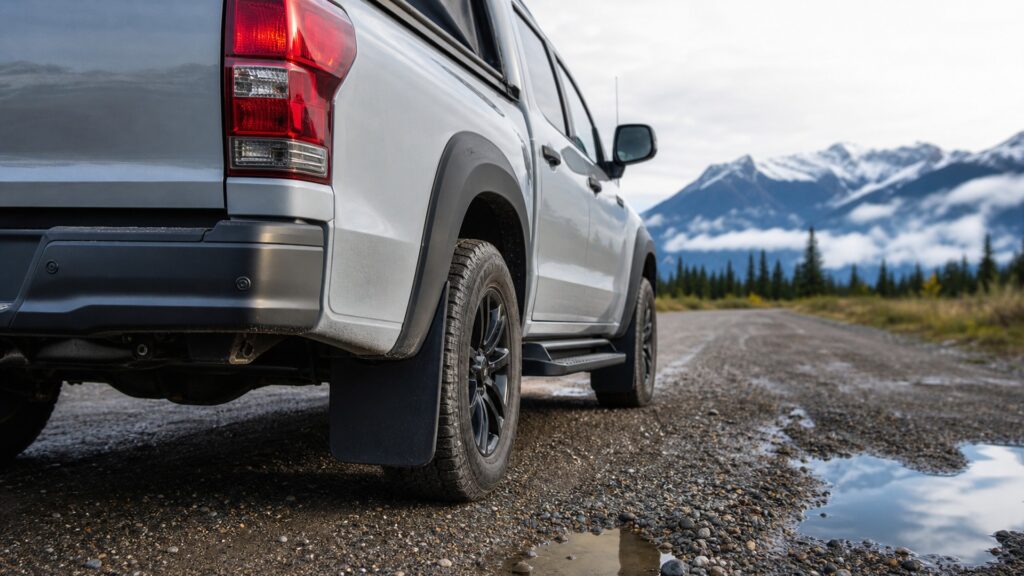
The useful question is which trajectories are interrupted and what loads the flexible barrier sends into the body.
Tip: With the vehicle safely parked, check flap clearance at steering lock and visible suspension positions; then recheck after the first wet or unpaved trip for witness marks and loosened hardware.
These terms explain why a rectangular sheet can behave differently on two vehicles.
Water and fine contamination accelerated outward by tread and airflow.
The direction a particle follows after leaving the rotating tire.
The width and vertical span positioned behind the tire.
Movement of the wheel relative to the body through steering and suspension travel.
A material's resistance to bending under load.
The structure transferring flap loads into the liner, body, frame, or dedicated mount.
Tip: Wheel offset, tire size, lift height, liner shape, trailer use, and local equipment rules can all change required coverage and mounting.
Placed close enough behind the tire, the flap receives droplets and particles before their unobstructed trajectory reaches painted panels or the space behind the vehicle. Material then falls, drains, or is redirected at lower energy.
A flap suppresses part of the plume; speed, airflow, tire design, and coverage prevent complete elimination.
A very soft flap can stream backward and expose the debris path at speed. A rigid flap holds coverage but may transmit greater impact into mounts or break when it contacts obstacles, snow, curbs, or reverse travel.
Controlled flexibility preserves useful position without turning ordinary contact into body damage.
Static photographs miss full steering lock, compression, rebound, articulation, tire growth, chains, and reverse motion. A flap that clears on level pavement can catch a tire or fold under the tread in a rut.
Clearance is a moving envelope, so every geometry change reopens the fitment question.
Brackets, liner overlaps, and body contact points can retain wet soil and road salt. Vibration turns trapped grit into abrasion, while drilled holes or damaged coatings give corrosion a starting point.
Reduced visible spray does not prove the hidden mounting area is clean or dry.
Vehicles that tow, travel unpaved roads, use wider or offset tires, or operate in wet and salted regions can expose more surface behind the wheel. Correct flaps reduce that path when sized to the actual configuration and maintained.
The strongest case follows observed exposure, not the assumption that every vehicle needs the longest possible flap.
Their benefit depends on coverage and trajectory; their limits appear in motion, airflow, terrain, and hidden contamination.
Correct placement can reduce tire-thrown water, gravel, mud, and salt reaching rocker panels, lower bodywork, trailers, cargo, pedestrians, and following vehicles.
Replaceable flaps can receive abrasion and impact that would otherwise occur on painted or more expensive components.
They cannot capture every droplet or stone, and narrow, short, airflow-distorted, or poorly positioned designs leave significant bypass paths.
Excess length, stiffness, weak mounts, insufficient articulation clearance, and trapped contamination can create rubbing, noise, corrosion, breakage, or tire contact.
These myths ignore the changing path of debris and the movement of the vehicle around the flap.
Useful interception depends on tread width, release trajectory, flap width, length, offset, stiffness, airflow, and distance from the tire. A decorative narrow piece may leave the most damaging paths completely open.
Extra length can reduce clearance, drag on obstacles, fold under a tire while reversing, or transmit greater leverage into weak mounts. The correct length preserves coverage throughout vehicle motion and terrain.
They can reduce part of the water and debris plume, but airflow, speed, side escape, road depth, tread, and vehicle shape continue to disperse material. Following distance and safe speed remain essential.
Mounts can drill or stress liners, trap salted mud, rub paint, corrode hardware, and pull on body edges. Vehicle-specific attachment, drainage, cleaning, and inspection determine whether protection creates hidden damage.
Tip: Evaluate coverage under speed and suspension motion, then inspect the surfaces that become hidden.
These answers address fitment changes, towing, cleaning, rules, and damage checks.
Often, because exposed tread creates a wider release path, but wheel offset, body coverage, steering, and local requirements also matter. Choose vehicle-specific coverage that follows the full tread without contacting tires through their motion.
Yes in rain, winter salt, construction zones, loose shoulders, and gravel-strewn pavement. Their value depends on actual exposure, vehicle geometry, and the surfaces or trailer behind the tires rather than an off-road label.
They may help shield a trailer, but flap length, exhaust, hitch equipment, trailer clearance, and airflow need review. Confirm the complete tow configuration and never let a flap contact safety chains, wiring, or moving parts.
Rinse both faces, brackets, liner overlaps, drains, and paint contact points using methods safe for the vehicle. Remove packed snow, mud, and salt before they harden, add weight, obstruct drainage, or abrade finishes.
Address tire or ground contact, torn liners, loose fasteners, cracked brackets, sharp edges, displaced flaps, exposed drilled metal, paint rubbing, corrosion, blocked drainage, or a flap that folds toward the tire while reversing.
Mud flaps matter because they interrupt part of the tire-to-body and tire-to-traffic path followed by water, grit, salt, mud, and stones.
Their real performance comes from vehicle-specific width, length, stiffness, dynamic clearance, durable mounts, open drainage, hidden-surface cleaning, and reinspection after impacts, winter buildup, or geometry changes.
These explainers place flexible splash barriers beside paint films and the broader rules for mounts, clearance, drainage, and inspection.
Review how exterior barriers, mounts, sensor fields, drainage, and inspection work as one vehicle system.
Understand how road debris, washing, correction, and protective layers interact with the vehicle finish.
See how a sacrificial film handles impacts that pass beyond or around tire-spray barriers.
Choose a retailer
Prices checked regularly. We may earn a commission at no cost to you.