What Makes Single Axle Utility Trailers Different from ATV Utility Trailers

Single axle describes a trailer’s running-gear layout, while ATV utility trailer usually describes a trailer intended to work with an ATV. An ATV-towed trailer may itself have one axle. The meaningful differences lie in the exact trailer’s body, coupling, running gear, handling features, and permitted operating conditions—not in two mutually exclusive labels.

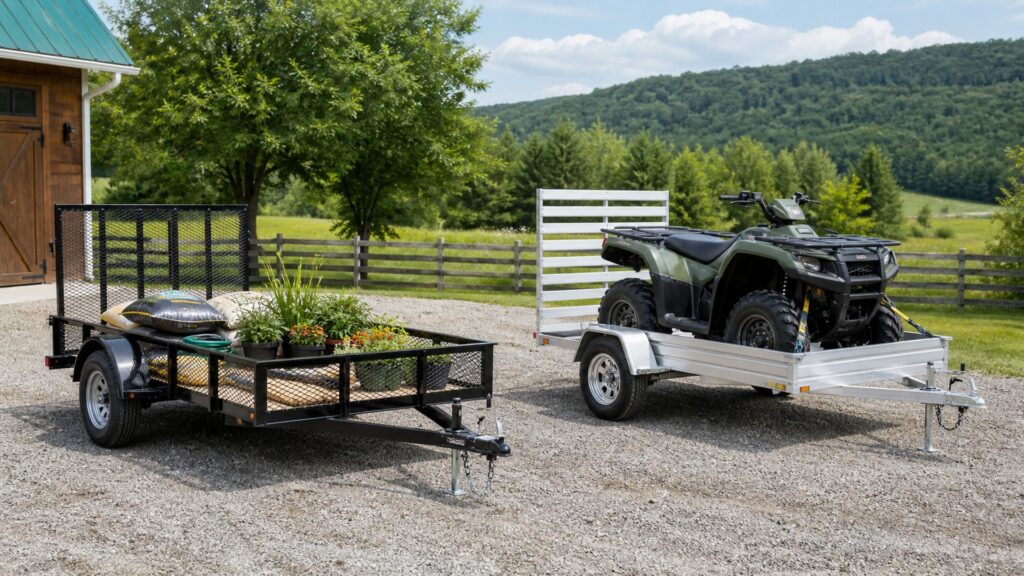
The phrase ATV trailer is also used for a trailer that transports an ATV as cargo. That is a different role from a work trailer pulled by an ATV. Establish which role is intended before interpreting a product description, rating, or feature such as a ramp or tipping tub.

By: Review Streets Research Lab
Updated: October 7, 2026
Explainer · 8-12 min read
single axle utility trailers explainer hero image for Review Streets
What You'll Learn

Understand the Design Behind the Trailer Label

Compare the parts that support the intended hauling role.

  • What one axle does and does not tell you
  • How ATV towing differs from ATV transport
  • Why a tub and an open deck handle loads differently
  • How coupling and running gear relate to the intended use
  • Why road suitability requires separate confirmation

Tip: Read the exact manufacturer description: identify both the towing vehicle and the intended cargo.

Definitions

Six Design Concepts for the Comparison

Each clarifies a different physical or operating attribute.

Axle configuration

Axle configuration is the number and arrangement of axle assemblies supporting the trailer.

  • Example: one axle under an open utility deck
  • Check: the actual axle and wheel-end specification
  • Limit: configuration alone does not identify the towing vehicle

ATV-towed work trailer

An ATV-towed work trailer carries goods while being pulled by a compatible ATV.

  • Example: a property-hauling trailer carrying tools
  • Check: the intended-use statement and ATV towing instructions
  • Limit: it is not automatically approved for road towing

ATV transport role

The ATV transport role places the ATV on the trailer as cargo.

  • Example: an ATV secured to an appropriate deck
  • Check: load mass, dimensions, ramp, and restraint provisions
  • Limit: a trailer associated with ATVs may not support this role

Load body

The load body is the deck, tub, or other structure that holds the cargo.

  • Example: a tub retaining loose garden material
  • Check: shape, loading access, and allowed contents
  • Limit: body volume does not establish allowable mass

Unloading feature

An unloading feature helps remove a load in a way the design supports.

  • Example: a specified tipping mechanism on a work trailer
  • Check: its locking parts, operating limits, and instructions
  • Limit: a tipping tub is not the same feature as a loading ramp

Operating envelope

The operating envelope is the set of conditions permitted for the exact trailer and combination.

  • Example: an off-road-only trailer used within its restrictions
  • Check: surface, speed, terrain, load, and tow-vehicle requirements
  • Limit: appearance does not establish permission for a different use

Tip: The useful differences are found in the specifications and mechanisms, not the names alone.

Layout

A Single Axle Identifies Support, Not Purpose

The axle and wheel-end arrangement supports the trailer’s movement, but it does not determine the cargo body or intended route. A general utility deck and an ATV-towed work trailer can both use a single axle. Their axle capacities, tires, bearings, suspension arrangements, and frame details can still differ substantially.

  • Identify the axle arrangement.
  • Read the trailer’s complete rating and intended use.
  • Do not infer other components from axle count.

A photograph showing two wheels is insufficient to establish capacity, towing speed, or highway suitability. The exact product documentation supplies those boundaries.

Body

A Deck and a Tub Organize Cargo Differently

An open deck can provide a platform for suitably restrained equipment or bulky items. A tub can contain material within its sides, subject to its load and use limits. A particular design may add removable sides, a tailgate, or a tipping mechanism. Those features shape loading and unloading; they do not remove the need to restrain or contain the cargo appropriately.

  • Compare usable body dimensions.
  • Check the required loading and unloading method.
  • Assess the actual cargo’s restraint needs.

Clam’s Polar FAQ describes tub and tipping features on specified models. Such features can help explain an ATV work trailer’s purpose, but not every ATV trailer shares the same tub or unloading mechanism.

Reference: Polar Trailer body and unloading features.

Connection

The Trailer Must Match the Vehicle Pulling It

The towing connection has a specified type, size, rating, and operating arrangement. The tow vehicle also has its own limits and instructions. An ATV’s ability to pull an empty trailer a short distance does not establish compatibility with its loaded mass, tongue load, or terrain. A different coupler alone does not convert an unsuitable trailer into a suitable one.

  • Check the exact towing vehicle instructions.
  • Match the connection components.
  • Assess loaded mass and required distribution.

Carry-On’s utility-trailer manual emphasizes compatible connection equipment. That general requirement remains relevant whether the towing vehicle is a road vehicle or an ATV, while the actual instructions differ.

Reference: Utility-trailer connection instructions.

Operating conditions

Running Gear and Use Restrictions Belong Together

Tires, bearings, axle design, clearance, and other components are selected for the trailer’s intended operating conditions. Do not translate a rugged appearance into permission for high-speed or highway use. Nor does road suitability establish that a trailer can negotiate any trail or slope. Use restrictions and terrain compatibility need separate attention.

  • Verify the permitted operating conditions.
  • Check the complete route against those conditions.
  • Follow the actual component service requirements.

Polar explicitly identifies its trailers as off-road hauling products rather than highway trailers. That is a manufacturer-specific boundary, not a statement that every product described as an ATV trailer is identical.

Reference: Polar Trailer intended-use statement.

Role

An ATV on the Deck Creates a Transport Task

When the ATV is cargo, evaluate its mass and dimensions along with other carried equipment. The deck, ramp where used, attachment points, and restraint must support that particular vehicle. Loading geometry and clearance also matter. The towing vehicle is then the vehicle pulling the transport trailer, not the ATV riding on it.

  • Confirm the trailer supports ATV transport.
  • Check ramp suitability and loading clearance.
  • Use the appropriate transport-restraint instructions.

A small tipping work trailer may be designed for material carried behind an ATV, while a suitable utility deck may transport that ATV to a destination. These are different roles even if both products are advertised alongside ATV equipment.

Reference: NHTSA load-security guidance.

Quick Reality Check

Axle Description and Intended-Use Description

Ask what information each label actually supplies.

Single axle tells you

There is one axle assembly in the trailer layout.

Further specifications are needed for capacity and operating suitability.

ATV utility trailer suggests

An ATV-related use that must be clarified as towing or transport.

A need to examine the exact body, connection, and intended conditions.

Common Myths

Misconceptions About ATV and Single-Axle Trailers

Avoid confusing a physical layout with a complete capability.

ATV utility trailers cannot be single-axle trailers

The categories overlap because they describe different attributes.

An ATV trailer necessarily carries an ATV

It may instead be a work trailer intended to be pulled by one.

A tub keeps every load secure without restraint

Containment and restraint must suit the actual cargo and operating conditions.

Changing the hitch makes an off-road trailer highway-ready

Connection compatibility does not change the trailer’s design or use restrictions.

Tip: Read the intended role before comparing capacity or features.

FAQ

Questions About Single-Axle and ATV Trailer Design

Answers about bodies, running gear, and intended use.

What is the main distinction?

Single axle describes layout; ATV utility trailer describes an intended relationship with an ATV that needs clarification.

Are ATV work trailers always tubs?

No. Body and unloading features vary by model, so inspect the actual design.

Can one trailer be both categories?

Yes. A single-axle work trailer may be designed to be towed by an ATV.

Can a road utility trailer be used on a trail?

Only when the exact trailer, tow vehicle, and route fit their operating instructions and restrictions.

What changes when the ATV is cargo?

Its mass, dimensions, loading method, and restraint become part of the transport assessment, while another vehicle does the towing.

Bottom Line

Single-axle layout and ATV use describe different aspects of a trailer. The exact body, connection, running gear, and operating limits reveal the useful differences.

Clarify whether the ATV is towing or being carried, then compare designs for that role.

Next Steps

Go Deeper or Compare Your Options

Use these Review Streets paths to compare related categories and practical next decisions.